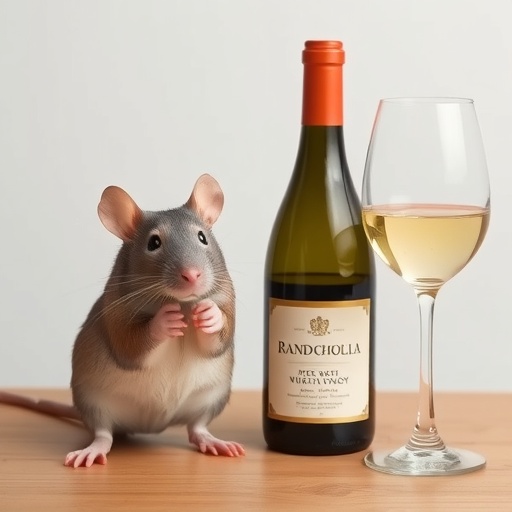
In a groundbreaking study, researchers have unveiled that rats possess the remarkable ability to not only differentiate between two varieties of white wine but also to generalize their taste preferences across these two distinct classifications. This discovery opens up new avenues for understanding cognitive capabilities in non-human species, particularly concerning their sensory perception and decision-making processes. The research, conducted by a team of scientists led by Enrico Frasnelli, aimed to investigate the cognitive complexity of rats regarding olfactory and taste-based discrimination tasks, a significant leap from traditional models often constraining research on animal behavior to more simplistic interpretations.
At first glance, the idea that a rodent, often dismissed as mere pests, can engage in such complex taste discrimination challenges preconceived notions about animal intelligence. The study specifically examines the rats’ ability to recognize and distinguish between two varieties of white wine— a varietal from Italy and another from France, each characterized by unique flavor profiles attributed to varying fermentation processes. This fine-tuned sense of taste indicates that rats may employ sophisticated taste and scent recognition abilities, hinting at an evolutionary advantage linked to foraging strategies and survival instincts in the wild.
Rats are well-known for their acute sense of smell, which plays an indispensable role in their foraging and mating behaviors. The researchers capitalized on this trait, developing a series of experimental trials to assess the rodents’ reactions to the two different wines. The experimental setup involved exposing rats to distinct wine samples and observing their choices. In multiple trials, the rats not only identified the varieties but also exhibited notable preferences, suggesting an inherent ability to categorize their sensory experiences and communicate these preferences through behavior. This pattern of choice further emphasizes the depth of their cognitive processes, suggesting that rats can generalize across different stimuli based on their past experiences.
The methodology employed in this study follows rigorous scientific standards, including control elements to ensure that confounding variables were minimized. The rats were conditioned to recognize the specific wines through a process combining positive reinforcement with behavioral assessments. Such an approach not only established a robust framework for testing but also emphasized the ethical treatment of the animals involved. Researchers ensured that all procedures complied with animal welfare guidelines, acknowledging the need for responsible research practices in the field of cognitive ethology.
Moreover, the implications of this study extend far beyond the laboratory setting. Understanding how rats discern between wine varieties may provide insights into their natural behavior in the wild. For instance, discussing how these cognitive skills influence their foraging behavior and interaction with their environment can reshape perceptions about rodent intelligence. As society grapples with broader issues like wildlife conservation and animal rights, this research casts a spotlight on the necessity of recognizing the complex mental abilities exhibited by various animal species.
In broader scientific discourse, the results of this study challenge the traditional hierarchy of cognitive abilities within the animal kingdom. Historically, intelligence has often been attributed to primates and cetaceans, while rodents have been underestimated in their mental capacities. However, findings such as these advocate for a re-evaluation of existing categorizations, recognizing that intelligence exists on a spectrum and is manifested in various forms across species. The study encourages further exploration into how different environments and evolutionary pressures shape cognitive development among diverse animal taxa.
Another intriguing aspect of the research is the potential parallelism it draws with human sensory discrimination. By examining how rats process flavors and make choices, scientists can glean insights into human taste perception, especially regarding the complexities involved in flavor identification and preference formation. This crossover is particularly relevant in fields such as consumer behavior and food sciences, where understanding the nuances of taste perception can significantly impact product development and marketing strategies.
The study also raises questions about the neural mechanisms underlying rats’ ability to distinguish wine varieties. Future research endeavors may delve deeper into the neurological basis of these cognitive tasks, exploring regions of the rat brain responsible for processing olfactory and taste information. Identifying these neural correlates could pave the way for comparative studies that examine similar competencies in other species, drawing a more nuanced understanding of cognitive evolution across the animal kingdom.
In addition, the societal implications of such findings may ignite conversations about animal cognition and welfare. As public opinion increasingly favors ethical considerations in animal testing, research like this could serve as a clarion call for more humane practices and a deeper understanding of non-human perspectives. The emotional and cognitive worlds of animals are complex, and fostering awareness of these capabilities among the general populace could lead to greater advocacy for animal rights and conservation initiatives.
Looking ahead, researchers plan to expand upon these findings by examining a wider range of sensory modalities and cognitive tasks in rats. Future studies could include exploring auditory recognition or the ability to differentiate among various food sources. By continuing to investigate the cognitive capacities of rats, scientists hope to uncover the intricacies of their perceptual world, further elucidating how these creatures adapt to their environments.
In conclusion, the groundbreaking research conducted by Frasnelli et al. marks a pivotal moment in the study of animal cognition. It compels scientists and the public alike to rethink rodents’ capacities and the extent of their sensory experiences. By bridging the gap between laboratory research and real-world applications, the study not only highlights the significance of exploring animal intelligence but also enriches our understanding of the diverse cognitive capabilities across the animal kingdom. As we delve deeper into the minds of these creatures, we may ultimately reshape our relationship with them and the natural world.
Subject of Research: Rats’ ability to distinguish and generalize between two white wine varieties.
Article Title: Correction: Rats can distinguish (and generalize) among two white wine varieties.
Article References:
Frasnelli, E., Chivers, B.D., Smith, B.C. et al. Correction: Rats can distinguish (and generalize) among two white wine varieties. Anim Cogn 28, 80 (2025). https://doi.org/10.1007/s10071-025-02005-5
Image Credits: AI Generated
DOI: 10.1007/s10071-025-02005-5
Keywords: Rats, cognition, taste discrimination, cognitive ethology, animal intelligence.