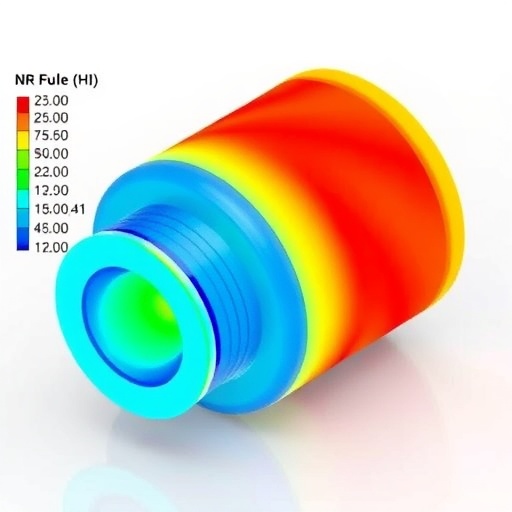
In the ever-evolving landscape of sustainable energy technologies, the quest for efficient hydrogen utilization in fuel cells has gained unprecedented urgency. The recent study led by a team of researchers, including Singer, Köll, and Pertl, delves into the innovative realm of passive hydrogen recirculation within Proton Exchange Membrane (PEM) fuel cell systems. Their groundbreaking approach employs two-dimensional computational fluid dynamics (CFD) simulations to design an ejector that promises to revolutionize the efficiency and performance of these systems.
As we explore the intricacies of this research, it becomes apparent that fuel cell technology has immense potential in decarbonizing transportation and stationary energy applications. The high efficiency, low emissions, and versatility of hydrogen fuel cells position them as a vital component in the shift toward a sustainable future. However, maximizing the efficiency of these systems is critical. The study emphasizes that improving the recirculation of hydrogen within the fuel cell can lead to substantial gains in performance and longevity.
The research team harnessed the power of two-dimensional CFD simulations to design an ejector capable of enhancing the recirculation process. By accurately modeling the fluid dynamics, the researchers were able to predict how hydrogen flows within the system and identify optimal configurations for the ejector. This utilization of advanced simulation techniques not only accelerates the design process but also allows for iterative improvements based on detailed insights into fluid behavior.
At the core of the ejector’s design is the principle of passive recirculation, which contrasts sharply with traditional pumping methods. The passive approach leverages the natural flow of gases within the fuel cell to recycle hydrogen without the need for external mechanical pumps. This leads to a significant reduction in energy consumption, which is crucial for improving the overall energy efficiency of PEM fuel cell systems.
A critical aspect of this study emphasizes the challenges presented by the varying conditions under which fuel cells operate. Factors such as temperature, pressure, and reactant concentrations can significantly impact performance. The researchers creatively circumvent these challenges by ensuring that the ejector function remains effective across a wide spectrum of operational scenarios. The flexibility of the design allows for adaptability in real-world applications, which is essential for the successful integration of fuel cells into existing energy infrastructures.
The authors highlighted the potential repercussions of their findings for various industries, suggesting that the design of the ejector could be a game-changer for the automotive sector, especially as manufacturers seek to develop hydrogen-powered vehicles. The reduction in energy lost to inefficient hydrogen management directly correlates with improved range and performance. As the automotive market moves towards a cleaner future, innovations such as these will be pivotal in garnering consumer confidence and driving adoption.
Moreover, the implications of this research extend beyond automotive applications. The study opens possibilities for employing hydrogen fuel cells in aerospace and marine industries, where weight and efficiency are critical constraints. With a greater emphasis on reducing emissions and enhancing sustainability, the proposed ejector system could aid in transforming these sectors by facilitating the deployment of hydrogen technologies at scale.
The meticulous nature of the simulations conducted by the research team cannot be overstated. By utilizing two-dimensional modeling, the researchers were able to explore complex interactions between different fluid dynamics at play during the recirculation process. These insights are invaluable as they lay the groundwork for future three-dimensional studies that could further optimize the design and function of the ejector.
As the research community continues to advance the frontiers of hydrogen technology, the significance of this work should not be overlooked. By addressing critical challenges inherent to fuel cell systems, this innovative ejector design represents a step forward in making hydrogen a more practical choice for clean energy solutions. It aligns with global initiatives to shift from fossil fuels towards renewable energy sources, providing a tangible pathway toward achieving long-term sustainability goals.
In conclusion, the development of an ejector for passive hydrogen recirculation highlights an important milestone in the field of fuel cell technology. The pioneering work of Singer, Köll, Pertl, and their team illustrates the profound impact that computational modeling and innovative engineering can have in addressing the increasing demand for efficient energy solutions. As the world grapples with climate change and the need for cleaner energy alternatives, advancements in hydrogen technology will undoubtedly play a crucial role in the emergence of a greener economy and sustainable future.
The study therefore not only contributes to scientific knowledge but also resonates with broader societal aspirations for a world powered by clean and renewable energy sources. By effectively combining simulation techniques with a thorough understanding of biochemical dynamics, the research paves the way for next-generation fuel cell technology—one that is economically viable, environmentally friendly, and ready to meet the demands of modern society.
Through ongoing research and collaboration, it is plausible that these advancements will become integral components of our energy systems, underpinning a broader transition to hydrogen-based solutions across diverse sectors. As industries seek to innovate while addressing global sustainability challenges, the vision articulated within this research could ignite the momentum needed to transform hydrogen from a theoretical concept into a pervasive reality in the decades to come.
Subject of Research: Hydrogen recirculation in PEM fuel cell systems
Article Title: Development of an ejector for passive hydrogen recirculation in PEM fuel cell systems by applying 2D CFD simulation.
Article References:
Singer, G., Köll, R., Pertl, P. et al. Development of an ejector for passive hydrogen recirculation in PEM fuel cell systems by applying 2D CFD simulation.
Automot. Engine Technol. 8, 211–226 (2023). https://doi.org/10.1007/s41104-023-00133-z
Image Credits: AI Generated
DOI: 10.1007/s41104-023-00133-z
Keywords: hydrogen fuel cells, computational fluid dynamics, ejector design, sustainable energy solutions, passive recirculation
Tags: 2D CFD simulation for fuel cellscomputational fluid dynamics researchdecarbonizing transportation solutionsejector design for hydrogen systemsenhancing fuel cell efficiencyhydrogen fuel cell performance optimizationhydrogen utilization in energyinnovative energy solutions for sustainabilitymodeling fluid dynamics in fuel cellspassive hydrogen recirculation technologyproton exchange membrane fuel cellssustainable energy technologies