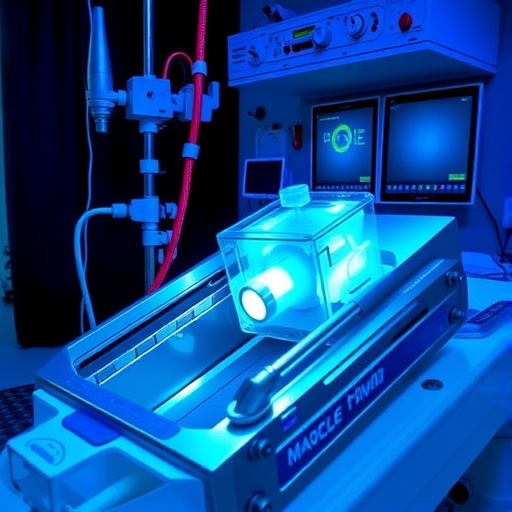
In a groundbreaking study published in 2026, researchers led by Zolala et al. unveil a novel technique known as magnetostatic pumping, tested within an ex vivo extracorporeal membrane oxygenation (ECMO) model. This cutting-edge approach has sparked significant interest in the medical community as it presents a potential paradigm shift in how we deliver mechanical circulatory support during critical care scenarios. The implications of this research could be profound, not only in enhancing patient care but also in advancing the underlying technology of ECMO systems.
Magnetostatic pumping leverages the principles of magnetism to facilitate fluid movement within a system, which in this case, is essential for ensuring adequate blood flow and oxygenation in patients experiencing severe respiratory failure or circulatory shock. Traditional ECMO devices, while effective, are often marred by various limitations, including mechanical complexities and logistical challenges regarding implantation and maintenance. The innovative approach described in this study offers a simplified, yet efficient alternative that could improve operational efficiency in high-stakes environments.
In their experiments, Zolala and his colleagues utilized an ex vivo model to simulate clinical conditions that would necessitate ECMO intervention. This model allowed them to manipulate variables and observe the effects of magnetostatic pumping in real-time, providing valuable insights into its potential efficacy and safety. By employing advanced imaging technologies, the team was able to track fluid dynamics and assess the function of the pump under various conditions, revealing noteworthy outcomes that could lead to enhanced patient survival rates.
One of the most striking findings of this study is the ability of the magnetostatic pump to maintain consistent blood flow rates while minimizing hemolysis – the destruction of red blood cells – a common complication associated with conventional ECMO systems. This breakthrough could significantly reduce the adverse effects often seen in patients requiring such complex interventions, a finding that is paramount in critical care medicine where patient stability is essential for recovery.
From a technical standpoint, the researchers meticulously detailed the design and operation of the magnetostatic pump. The mechanism involves the careful positioning of magnets that create a magnetic field strong enough to propel fluid through tubing, emulating the natural pulsatile flow of the heart. This innovative approach circumvents several mechanical components typically found in traditional pumps, reducing the overall footprint and complexity of the device, thus enhancing portability and ease of use in both hospital and field settings.
The research team also conducted extensive testing to compare the magnetostatic pump’s performance against conventional pneumatic pumps utilized in current ECMO technology. The results were promising; not only did they achieve superior flow rates, but the tactile feedback from the magnetostatic mechanism provided a greater sense of control during clinical applications. This creates exciting possibilities for medical professionals who often grapple with the unpredictability of current ECMO devices under stressful circumstances.
Furthermore, the study highlighted the ease of integration of the magnetostatic system with existing ECMO setups, allowing for a seamless transition for healthcare providers. Such adaptability is crucial in emergency medical situations, where time and efficiency can be the difference between life and death. This enhancement in procedural fluency is expected to be a vital contributor to positive clinical outcomes in critical care scenarios involving ECMO.
Another significant aspect of the research is its potential impact on healthcare costs. Given that ECMO procedures can be prohibitively expensive due to the complexity of the machines and the skilled personnel required to operate them, the introduction of a more straightforward and cost-effective method like magnetostatic pumping could lead to broader accessibility. If these systems can be manufactured at lower costs while maintaining or improving efficacy levels, healthcare facilities may be more inclined to adopt this technology, ultimately benefiting more patients in need of life-saving treatments.
The promising findings from the research also lay the groundwork for future studies aimed at optimizing magnetostatic pumping for various clinical applications beyond ECMO. For instance, applications in other scenarios requiring fluid transport, such as dialysis or infusion treatments, could be explored, expanding the utility of this innovative technology. This illustrates the versatility of magnetostatic principles, which may have far-reaching implications in medical engineering and patient care.
There remains, however, a need for further research to delineate the long-term effects and potential challenges associated with implementing magnetostatic pumps in clinical practice. The study by Zolala et al. is a critical starting point that highlights the need for additional controlled trials to validate their findings in diverse patient cohorts. The transition from experimental to widely adopted clinical practices is seldom straightforward, often necessitating rigorous testing and validation phases to ensure patient safety and device efficacy.
In conclusion, Zolala et al.’s research on magnetostatic pumping represents a significant advancement in ECMO technology with the potential to reshape patient care in critical medicine. As the medical community approaches the challenges of complex respiratory and circulatory support, innovations like this offer hope for improved outcomes and more efficient healthcare delivery. The possibility of healthier, more resilient patients in our hospitals could become a reality as we continue to innovate and refine life-saving technologies.
As the dust settles from this important research, one cannot help but feel a sense of anticipation for the next steps. The potential societal impact cannot be stressed enough, as advancements of this nature spark discussions not only in surgical rooms but also in boardrooms of healthcare facilities contemplating cost efficiencies. As we look forward to more breakthroughs, one can only imagine the lives that will benefit from these pioneering efforts in medical technology.
Subject of Research: Magnetostatic pumping in an ex vivo extracorporeal membrane oxygenation model.
Article Title: Magnetostaltic pumping in an ex vivo extracorporeal membrane oxygenation model.
Article References:
Zolala, M., Heim, V., Denis, C.V. et al. Magnetostaltic pumping in an ex vivo extracorporeal membrane oxygenation model.
J Transl Med (2026). https://doi.org/10.1186/s12967-026-07734-w
Image Credits: AI Generated
DOI: 10.1186/s12967-026-07734-w
Keywords: Magnetostatic pumping, extracorporeal membrane oxygenation, critical care technology, blood flow dynamics, hemolysis reduction, cost-effectiveness in healthcare.
Tags: circulatory shock managementcritical care advancementsECMO efficiency improvementex vivo ECMO modelfluid movement in ECMOimplications for patient careinnovative medical technologymagnetism in medical applicationsmagnetostatic pumpingmechanical circulatory supportoperational efficiency in ECMOrespiratory failure treatment