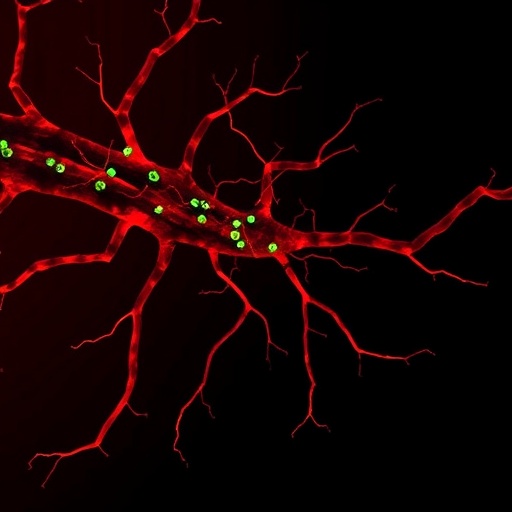
In a groundbreaking study set to redefine our understanding of ocular biology, researchers have discovered that the endothelial stem cells responsible for generating the retinal vasculature are located in the optic nerve. This revelation, published in Nature Communications, offers unprecedented insight into the origins and maintenance of the retinal blood vessels, a critical component for vision and eye health. The study, led by Sakimoto, Takigawa, Oguchi, and their team, unravels the complex biology underlying retinal vascular regeneration and proposes new avenues for therapeutic intervention in retinal diseases.
For decades, the retinal vasculature was assumed to rely primarily on local endothelial cells within the retina itself for regeneration and repair. However, the novel investigation challenges this paradigm by identifying a distinct population of endothelial stem cells residing outside the retinal tissue, specifically within the optic nerve. This location proves to be a crucial reservoir for cells that migrate and contribute to retinal vascular growth and maintenance. The optic nerve, traditionally recognized for transmitting visual information from the eye to the brain, now emerges as a vital niche harboring stem cells fundamental to retinal vascular biology.
The team employed an array of sophisticated methodologies, combining lineage tracing, molecular profiling, and advanced imaging techniques, to meticulously characterize these endothelial stem cells. Lineage tracing experiments revealed that these cells in the optic nerve exhibit stem-like properties, capable of self-renewal and differentiation into mature endothelial cells that integrate into the retinal vasculature. Molecular analyses identified unique markers distinguishing these progenitors from differentiated endothelial cells, confirming their stem cell status.
This discovery not only fills a significant knowledge gap regarding the source of endothelial progenitors involved in retinal repair but also sheds light on how retinal vasculature can regenerate after injury or disease. The presence of a stem cell niche in the optic nerve implies a dedicated and efficient mechanism for vascular regeneration that can be potentially harnessed for therapeutic purposes. Diseases such as diabetic retinopathy, age-related macular degeneration, and retinal vein occlusion, all characterized by impaired or pathological retinal blood vessels, could benefit from strategies aimed at activating or transplanting these endothelial stem cells.
Moreover, the identification of this population suggests intricate communication between the optic nerve microenvironment and the retinal tissue. It posits a biological model where cues from the optic nerve niche regulate the mobilization and differentiation of stem cells to maintain a healthy retinal vasculature. The study elaborates on signaling pathways and molecular mechanisms that govern this process, revealing key regulators such as VEGF (vascular endothelial growth factor) and Notch signaling, which orchestrate endothelial cell fate and proliferation.
In-depth analysis demonstrated that the optic nerve niche offers a specialized microenvironment protecting and regulating these stem cells. This supportive milieu likely provides factors that preserve stemness while enabling responsiveness to retinal demands. The research highlights interactions with supporting glial cells, extracellular matrix components, and local gradients of growth factors, which collectively create a dynamic and responsive niche conducive to vascular regeneration.
Functionally, the study employs in vivo models to show that depletion or dysfunction of optic nerve endothelial stem cells severely impairs retinal vascular repair following injury. Conversely, stimulating these stem cells enhances vascular regrowth and restores retinal perfusion. These findings underscore the therapeutic potential of targeting this stem cell population to mitigate retinal ischemia and vascular insufficiencies that lead to vision loss.
The implications of this research extend beyond ocular health, offering a conceptual framework to explore stem cell reservoirs in other nervous system components linked to vascular maintenance. It challenges existing dogma on tissue-specific stem cell localization and encourages revisiting other presumed local regenerative sources, possibly uncovering similar niches that cooperate to preserve vascular integrity throughout the body.
Furthermore, this study opens new paradigms in regenerative medicine by proposing that stem cell niches located in anatomically and functionally distinct regions can significantly influence the maintenance and repair of adjacent tissues. It suggests that a broader perspective is needed when investigating tissue regeneration, encompassing inter-tissue communication and stem cell mobilization across different anatomical compartments.
From a developmental biology perspective, the findings provide clues about vascular development during embryogenesis and postnatal maturation. The optic nerve’s role as a stem cell reservoir might reflect conserved mechanisms underlying vascular patterning and growth in the retina, offering new developmental markers and targets for research.
Clinically, the research sets a foundation for novel therapeutic strategies. By isolating, expanding, and manipulating these endothelial stem cells outside the patient’s body, personalized cell therapies could be developed to treat retinal vascular diseases. Furthermore, pharmacological activation of this niche within the optic nerve could promote endogenous repair mechanisms, reducing the need for invasive treatments and improving outcomes.
Additionally, understanding the signaling pathways involved in stem cell activation provides novel pharmacological targets. Small molecules or biological agents could be engineered to selectively modulate the optic nerve niche environment, enhancing stem cell proliferation and migration to the retina. This approach might offer highly specific treatments with fewer systemic side effects.
The study also underscores the importance of advanced imaging and molecular techniques in uncovering elusive stem cell populations. Combining in vivo imaging with transcriptomic profiling proved instrumental in resolving the identity and function of these cells, highlighting technological advancements driving modern biomedical discoveries.
On a broader scale, this discovery accentuates the complexity and elegance of ocular biology, revealing how different eye components interact to preserve function and adapt to stress or damage. The optic nerve’s dual role as a conduit for visual signals and a stem cell reservoir exemplifies multifunctionality in biological systems.
As the research community digests these findings, future studies will undoubtedly focus on further characterizing the signaling networks involved, exploring the possibility of other niches contributing to vascular maintenance, and investigating the translational potential for human ocular diseases. This seminal work thus lays the groundwork for a paradigm shift in retinal biology and regenerative ophthalmology.
In conclusion, the identification of endothelial stem cells residing in the optic nerve establishes a novel biological niche critical for maintaining retinal vasculature. This discovery challenges longstanding assumptions and opens transformative avenues in understanding, diagnosing, and treating retinal vascular disorders. By bridging stem cell biology, developmental neuroscience, and clinical ophthalmology, the research heralds a new era in vision science, ultimately aiming to preserve and restore sight in millions worldwide.
Subject of Research: Endothelial stem cells in retinal vasculature regeneration
Article Title: Endothelial stem cells of the retinal vasculature reside in the optic nerve
Article References:
Sakimoto, S., Takigawa, T., Oguchi, A. et al. Endothelial stem cells of the retinal vasculature reside in the optic nerve. Nat Commun 17, 606 (2026). https://doi.org/10.1038/s41467-025-68201-6
Image Credits: AI Generated
DOI: https://doi.org/10.1038/s41467-025-68201-6
Tags: advanced imaging techniques in biologyendothelial stem cells in optic nervelineage tracing in vascular researchmolecular profiling of retinal cellsocular biology advancementsoptic nerve role in eye healthretinal blood vessel regenerationretinal disease research breakthroughsretinal vascular stem cellsstem cell niche in retinal biologytherapeutic interventions for retinal diseasesvision health and retinal vasculature