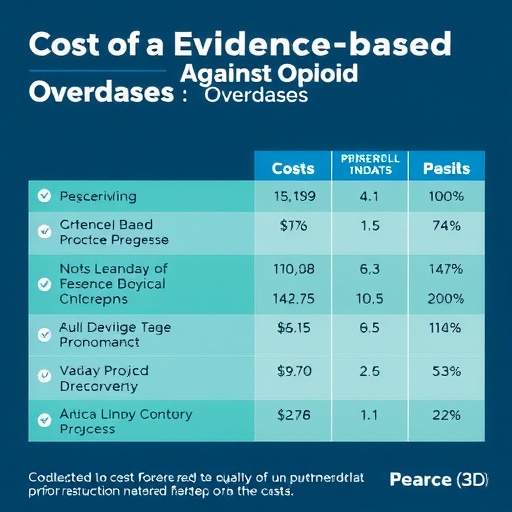
In a profound exploration of one of the most pressing public health crises in modern society, new research sheds light on the financial implications of implementing evidence-based strategies designed to combat opioid overdoses in New York State communities. The study led by a collaborative team including Li, J.M., Gruss, D., and Hunt, T., promises to reshape how stakeholders approach the epidemic and provides pivotal insights into the resource allocation necessary for effective interventions.
Opioid crisis management has become a critical concern for local and state governments, healthcare professionals, and community organizations struggling to respond to rising fatalities linked to opioid misuse. With the United States facing one of the highest rates of opioid-related deaths in the world, understanding the cost and benefits of intervention strategies is essential. This new study documents the expenses associated with various evidence-based practices, asserting a compelling case for targeted investment in these methods that can save lives.
One of the core findings of the research is that the upfront costs associated with implementing these evidence-based practices may deter some stakeholders from pursuing them, particularly in economically strained communities. However, by assessing not merely the initial financial outlay but also the long-term savings associated with reduced healthcare costs, the study argues for a paradigm shift in how communities view the value of these interventions. The researchers highlight that investing in these programs can lead to significant reductions in emergency room visits, hospitalizations, and premature deaths.
Detailed analysis within the study provides insight into the different types of evidence-based practices available, from harm reduction initiatives such as needle exchanges and supervised consumption sites, to medication-assisted treatment programs that have proven effective in managing opioid use disorders. Each of these solutions comes with its own set of costs and respective benefits, which the authors of the study highlight in order to present a comprehensive overview of the possible financial implications.
Crucially, the study also examines the role of government funding and policy in supporting these initiatives. With many of the interventions relying heavily on state and federal resources, a thorough understanding of the existing funding mechanisms is explored. For instance, the authors argue that increasing public funds directed toward these interventions can facilitate smoother implementation, especially in under-resourced areas. The implication of policy changes comes as the authors call on legislators to recognize the long-term economic benefits inherent in these investments.
Moreover, the researchers present comparative case studies from a variety of New York State communities, documenting both successful and struggling programs. By detailing these real-world examples, the article illustrates how local context drastically affects the implementation and sustainability of these initiatives. Successful case studies highlight widespread community buy-in, local advocacy efforts, and collaborative models that engage multiple stakeholders.
There’s also a discussion of the critical need for continuous evaluation of these interventions. Quantifying their impact goes beyond merely counting lives saved; it entails a multi-faceted approach that considers social, economic, and public health indicators. The authors emphasize that ongoing assessment allows for the fine-tuning of intervention strategies as new data emerge, ensuring that programs remain effective and relevant over time.
A striking aspect of the research is its acknowledgment of the stigma surrounding opioid misuse which affects policy perceptions and funding opportunities. The authors advocate for ongoing public education campaigns aimed at reducing this stigma, thus promoting acceptance of vital harm reduction strategies. By reframing opioid misuse as a public health concern rather than a moral failing, the study suggests that communities may be more willing to allocate resources towards effective treatment and prevention strategies.
Additionally, the paper explores technological innovations that can aid in implementing these practices more efficiently and cost-effectively. The integration of digital health tools, predictive analytics, and community outreach platforms can support efforts to engage populations at risk, track successes, and improve overall intervention outcomes. The authors stress how embracing technology can significantly enhance data collection and management, ultimately leading to better-informed decision-making.
Notably, the research concludes with a call to action for not only local stakeholders but for national leaders as well. The opioid crisis demands a coordinated response from governmental entities at all levels to galvanize resources and share best practices. Harnessing a multi-disciplinary approach that involves healthcare providers, law enforcement, educators, and community organizations could lead to the synergies necessary for impactful change.
In summary, the study by Li, Gruss, and Hunt stands as a pivotal contribution to the ongoing discourse surrounding the opioid epidemic. By thoroughly exploring the costs associated with implementing evidence-based strategies, the research provides a blueprint for communities aiming to mitigate overdose fatalities. The salient points raised throughout advocate for collective action—illustrating that while the financial investment may appear daunting, the potential human and economic savings justify the cause.
In facing the complexity of opioid overdose prevention, the need for well-founded, actionable strategies has never been greater. The implications of this research extend beyond New York, with lessons applicable to communities grappling with similar crises across the nation. For those involved in public health, policymaking, and community service, the findings serve as an urgent reminder: ending the opioid crisis is not only a moral imperative but an essential economic strategy.
Subject of Research: Economic impact of evidence-based practices to reduce opioid overdose in communities.
Article Title: Cost of implementing evidence-based practices to reduce opioid overdose fatalities in New York State communities.
Article References:
Li, J.M., Gruss, D., Hunt, T. et al. Cost of implementing evidence-based practices to reduce opioid overdose fatalities in New York State communities.
Addict Sci Clin Pract 20, 77 (2025). https://doi.org/10.1186/s13722-025-00606-6
Image Credits: AI Generated
DOI: https://doi.org/10.1186/s13722-025-00606-6
Keywords: opioid overdose, evidence-based practices, public health, financial implications, New York State.
Tags: community strategies against opioid misusecost of evidence-based practiceseconomic impact of opioid epidemicevidence-based interventions for public healthfinancial implications of opioid interventionshealthcare costs related to opioid overdoseslong-term savings in healthcareNew York State opioid crisisopioid overdose prevention strategiesresource allocation for health initiativesstakeholders in opioid crisis managementtargeted investment in addiction treatment