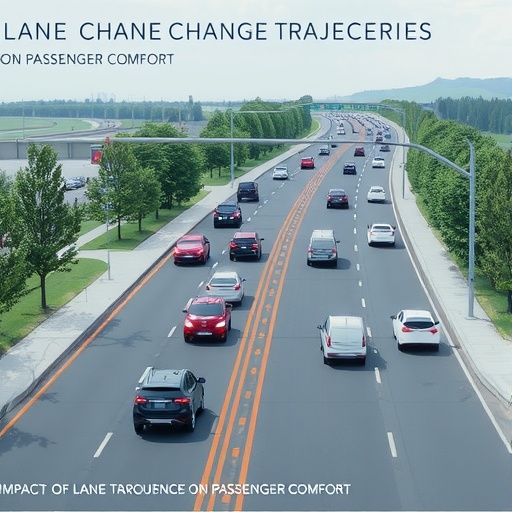
In a world where autonomous driving technology is rapidly progressing, understanding the implications of these advancements on passenger comfort is paramount. Recent research led by Heimsath, Krantz, Neubeck, and colleagues sheds light on the intricacies of automated lane changes in a controlled setting—specifically, the Stuttgart driving simulator. The study, published in Automotive Engineering Technology, navigates the effects of different lane change trajectories on passenger comfort, a critical aspect often overshadowed by technical developments.
As the automotive industry strives for a future dominated by self-driving cars, comprehensively studying passengers’ experiences becomes increasingly vital. The research explores how various automated lane change maneuvers influence the comfort and overall satisfaction of passengers. Traditional driving relies heavily on human intuition and reflexes, but transitioning to fully automated driving introduces a distinct paradigm that raises various questions surrounding passenger dynamics in these vehicles.
One of the primary objectives of the study was to evaluate the subjective experience of passengers during different types of lane changes. Using the Stuttgart driving simulator, researchers meticulously designed several scenarios that replicated real-world conditions. By doing so, they aimed to ascertain whether smoother lane changes were perceived more favorably than more abrupt transitions. The findings hold immense implications for how future autonomous systems are designed and implemented.
A significant aspect of the research involved collecting data from participants as they experienced these varying lane change trajectories. The subjects provided real-time feedback on their comfort levels during each maneuver, which the researchers meticulously analyzed. This process not only allowed for an in-depth understanding of the psychological responses elicited during automated driving but also contributed to formulating a set of criteria for developing enhanced control algorithms for autonomous vehicles.
The importance of passenger comfort in automated vehicles cannot be overstated. As manufacturers pursue the goal of providing a seamless driving experience, they must also prioritize the psychological well-being of passengers. The study indicated that sudden or jerky movements during lane changes could lead to heightened discomfort, anxiety, and even motion sickness among passengers. Automakers must consider these emotional and physiological responses when programming vehicles’ driving behaviors.
Moreover, the research underlines the importance of customizable settings in automated vehicles. Given that not all passengers have the same tolerance for motion, offering options to adjust the driving style could lead to a more personalized and satisfactory travel experience. Whether it’s a smooth and gentle approach for those vulnerable to motion-related discomfort or a more aggressive style for thrill-seekers, flexibility could become a game changer in passenger acceptance of autonomous vehicles.
Interestingly, the varying impact of individual attributes on passenger comfort emerged as a pertinent topic in the study. Factors such as age, prior experience with cars, and personal disposition towards technology played a role in determining how subjects perceived lane change maneuvers. Investigating these dynamics could provide manufacturers with insights on how to better tailor driving experiences to different demographic segments, thus optimizing their autonomous systems for a broader audience.
Additionally, the research highlighted the importance of context in passenger reactions to automated driving maneuvers. In different scenarios, passengers exhibited varying levels of comfort and unease. For instance, lane changes executed in a less congested, open environment were generally better received than those performed in heavy traffic. Such findings could lead to the technological advancement of predictive algorithms capable of modifying driving behavior based on real-time conditions, creating an adaptive driving experience that prioritizes passenger comfort under fluctuating circumstances.
As the development of autonomous vehicles continues, integrating findings from studies such as this could aid in refining the interaction between humans and machines. Driving models that favor passenger comfort not only promote acceptance of these technologies but also foster trust between individuals and their automated companions. Balancing safety with comfort will be essential for widespread adoption, and studies like this are stepping stones towards achieving that equilibrium.
In summary, the research conducted by Heimsath et al. serves as a significant contribution to understanding the essential parameters of passenger comfort in automated driving. By examining how different lane change trajectories influence comfort levels, the study provides valuable insights that can guide the design and programming of future autonomous vehicle technologies. As these innovations reshape the landscape of personal transport, ensuring a balanced focus on technical performance and user experience will be imperative for the success of autonomous vehicles in the market.
Ultimately, the confluence of technology and human experience has the potential to create roadways that are not only safer and more efficient but also more enjoyable for everyone involved. As researchers continue to unpack these dynamics, they illuminate the path towards a future where riding in a car becomes a harmonious journey rather than just a means of transportation.
Subject of Research: Passenger comfort during automated motorway lane changes.
Article Title: Passengers comfort during automated motorway lane changes: a subject study on different lane change trajectories at the Stuttgart driving simulator.
Article References:
Heimsath, C., Krantz, W., Neubeck, J. et al. Passengers comfort during automated motorway lane changes: a subject study on different lane change trajectories at the Stuttgart driving simulator.
Automot. Engine Technol. 7, 343–351 (2022). https://doi.org/10.1007/s41104-022-00118-4
Image Credits: AI Generated
DOI: 10.1007/s41104-022-00118-4
Keywords: Automated driving, lane changes, passenger comfort, driving simulator, user experience.
Tags: automated driving simulator researchautomated lane change maneuversautomotive engineering studiesautonomous driving technologyevaluating passenger dynamicshuman intuition in automated drivingimplications for future autonomous vehicleslane change trajectories impactpassenger comfort in self-driving carspassenger satisfaction in autonomous vehiclessmooth versus abrupt lane changessubjective passenger experience