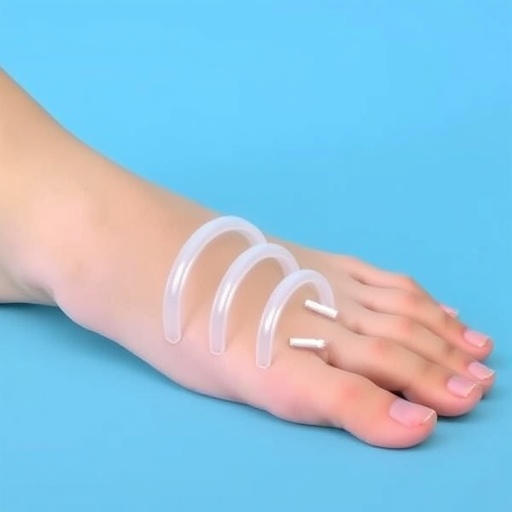
In a groundbreaking development in orthopedic surgery, a research team led by Chabihi et al. has pioneered a 3D printed foot length scale designed to enhance the precision of intramedullary nail length predictions for managing long bone fractures. This innovative approach not only leverages advanced manufacturing technologies but also addresses a persistent challenge in surgical planning—accurately determining the internal fixation devices necessary for optimal bone healing. The advent of this tool holds the potential to significantly improve surgical outcomes and streamline the preoperative process, opening avenues for further research in 3D printing applications in medicine.
Traditionally, the selection of intramedullary nail lengths has been an intricate task, often reliant on standard measurement techniques that may not account for patient-to-patient variability in anatomy. This variability is exacerbated by the diverse range of conditions that can lead to long bone fractures, including trauma and degenerative diseases. As a result, the need for a more personalized surgical approach has become apparent. The introduction of a 3D printed foot length scale addresses this shortcoming by offering an accessible, patient-specific method for determining the appropriate nail length prior to surgery.
The research meticulously outlines the methodology adopted for the development and validation of the foot length scale, employing advanced 3D printing techniques to create a reliable, repeatable product that can be customized to individual patient needs. By measuring the foot length—a parameter that has been correlated with the length of long bones—surgeons can now attain a more accurate estimate of the required intramedullary nail size. Utility of this method not only enhances surgical accuracy but also reduces the likelihood of complications related to improper nail sizing.
Moreover, the validation process conducted by the authors involved rigorous testing and comparison against existing measurement standards. This critical step ensured that the 3D printed model delivered results that are not only consistent but also clinically relevant. By integrating both biomechanical insights and 3D printing technology, the scale serves as a practical decision-making tool for orthopedic surgeons, particularly in emergency settings where time is of the essence.
The potential impact of this research extends beyond improved surgical outcomes. It illustrates the power of integrating technology into healthcare practices, potentially transforming routine procedures. As healthcare continues to move towards personalization and precision medicine, tools like the 3D printed foot length scale exemplify the innovative spirit of the medical community. This initiative not only highlights the importance of adapting technological advancements in clinical settings but also underscores the commitment of researchers to enhance patient care.
In the wider context of orthopedic research, the implications of this study contribute to an evolving paradigm that embraces digital health solutions. As 3D printing becomes more mainstream within surgical disciplines, we are likely to witness a significant inflection point in how orthopedic surgeries are performed. From preoperative planning to postoperative recovery, these technologies promise to reduce costs, shorten recovery times, and improve patient outcomes by providing customized solutions tailored to individual anatomical variations.
Additionally, the multidisciplinary collaboration involved in this project, which merges insights from engineering, medicine, and design, is a blueprint for future research in the field. Engaging professionals from various backgrounds can lead to more comprehensive solutions to complex medical problems. Teams such as this one are redefining the boundaries of possibility within surgical practices, showcasing what innovative thinking can accomplish in tackling age-old challenges.
As the study garners attention within the scientific community, its findings are likely to inspire further research. The methodology and evidence presented in this work could serve as foundational principles for other medical specialties interested in adopting 3D printing technology for personalized tools and devices. Advancements in this field will undoubtedly catalyze a surge of innovation, providing momentum for further explorations into customization in surgical technologies.
Furthermore, the study reinforces the importance of clinical trial data and peer review in establishing the credibility of new medical tools. Through in-depth analysis and validation, the authors have demonstrated that the 3D printed foot length scale is not only a theoretical concept but a practical application ready for implementation in clinical environments. Such rigorous protocols are essential for fostering trust among surgeons and ensuring patient safety and efficacy in surgical procedures.
In conclusion, the research conducted by Chabihi and colleagues represents a significant leap forward in orthopedic surgery innovations, balancing technology and clinical practice to address an urgent need in fracture management. As the medical field increasingly turns to 3D printing for solutions, this contribution is poised to enhance surgical precision and patient outcomes, ultimately proving invaluable in managing long bone fractures.
The implications of such advancements are profound—shaping future surgical standards and propelling the narrative of technology’s role in healthcare. The evolution of the 3D printed foot length scale heralds an exciting era in orthopedic surgery and underlines the critical role of ongoing research and innovation in improving patient care.
Finally, as this study sets a precedent for similar developments within the medical field, it beckons a vital question: What other areas of surgical practice stand to benefit from advancements in technology? The possibilities seem limitless, as we witness the intersection of healthcare and cutting-edge science unfold before our eyes.
Subject of Research: Development and validation of a 3D printed foot length scale for predicting intramedullary nail lengths for long bone fractures.
Article Title: Development and validation of a 3D printed foot length scale for predicting intramedullary nail lengths for long bone fractures.
Article References: Chabihi, Z., Demnati, B., Soleh, A. et al. Development and validation of a 3D printed foot length scale for predicting intramedullary nail lengths for long bone fractures. 3D Print Med 11, 48 (2025). https://doi.org/10.1186/s41205-025-00290-x.
Image Credits: AI Generated.
DOI: https://doi.org/10.1186/s41205-025-00290-x.
Keywords: 3D printing, orthopedic surgery, intramedullary nail, foot length scale, long bone fractures, surgical precision, personalized medicine, clinical validation.