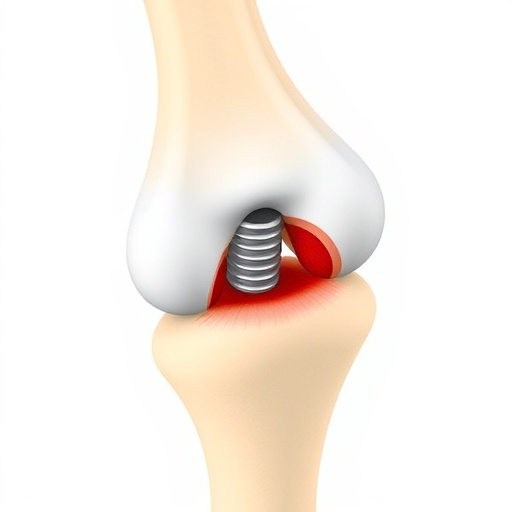
In a groundbreaking advancement in orthopedic surgery, a dynamic approach to reconstructing an extensive distal femoral giant cell tumor through the utilization of an innovative 3D-printed condylar support lattice metal implant has emerged. This revolutionary technique not only symbolizes a leap forward in medical technology but also emphasizes the intricacy and sophistication of today’s surgical applications. Researchers have employed this cutting-edge method in tandem with fibular grafts, presenting a unique solution to a complex and formidable challenge faced by many orthopedic surgeons in the field.
Giant cell tumors of bone are rare, primarily occurring around the knee joint and can lead to significant orthopedic complications. These tumors, while benign in nature, can exhibit aggressive behavior, often resulting in local destruction of bone and necessitating extensive surgical intervention. The implications of such tumors are not just limited to structural concerns but extend to functional aspects of mobility and quality of life for affected patients. Conventional treatment often entails wide resection of the affected area, leading to substantial functional deficits and a long road to recovery.
A significant milestone in this paradigm shift is the advent of 3D printing technology, which allows for the personalized fabrication of orthopedic implants tailored specifically to the anatomical and pathological considerations of individual patients. This technique has been increasingly integrated into surgical practices, significantly improving patient outcomes. The precise nature of 3D printing enables the construction of complex geometries that can mimic the intricate architecture of bone, promoting better integration with surrounding tissue.
In the case of reconstructing the distal femur, the use of a condylar support lattice implant provides essential structural support while also reducing the risk of complications such as implant failure or rejection. The lattice design is particularly advantageous, allowing for a lighter yet robust implant that can withstand the mechanical loads typically encountered at the knee joint. This characteristic not only enhances the stability of the implant but also promotes better healing and integration with the host bone.
The procedure outlined in Chaudhry et al.’s pioneering work further integrates autologous fibular grafts, providing an additional layer of biological support. Fibular grafts have a long history in orthopedic surgery, recognized for their osteogenic potential and ability to contribute to the repair and regeneration of bone. By combining the mechanical advantages of the 3D-printed lattice implant with the biological benefits of fibular grafts, the approach advances both biomechanical stability and biological healing processes.
The surgical strategy proposed by the researchers is meticulously detailed, addressing preoperative planning, intraoperative techniques, and postoperative care. Preoperatively, careful imaging and tumor mapping are critical to ensuring accurate resection and reconstruction. The surgical team meticulously considers the patient’s individual anatomy, the characteristics of the tumor, and the desired outcomes post-surgery.
During the surgery, the integration of 3D-printed components allows for real-time adjustments and ensures a snug fit within the resected area, significantly minimizing the chances of complications associated with traditional bone grafting procedures. Intraoperative imaging techniques such as fluoroscopy or CT imaging further aid in verifying the appropriate placement of the implant, enhancing confidence in the surgical outcome.
Postoperatively, the healing process is carefully monitored. Patients are generally placed on a progressive rehabilitation program that includes physiotherapy to promote mobility and strength. The study reveals promising early findings, demonstrating reduced recovery times and improved functional outcomes for patients who underwent this novel surgical approach.
As patients increasingly desire less invasive procedures with shorter recovery periods, techniques such as the one described in this study will likely become more prevalent in orthopedic practice. The need for personalized treatment strategies is paramount, particularly in oncology-related orthopedic cases where the risks associated with traditional interventions can be significantly high.
Moreover, as part of a broader movement towards precision medicine, this novel method of reconstruction not only underscores the importance of technological advancements in surgery but also highlights the potential for improved patient-centered care. It represents a paradigmatic shift where innovations in engineering and medical science converge, yielding new solutions to long-standing challenges faced by healthcare professionals.
The authors’ research serves as an inspiring case study, showcasing the intersection of biomechanics, material science, and surgical expertise. It encourages further exploration into the capabilities of 3D printing within the medical field, advocating for more extensive clinical trials to validate the efficacy and safety of such techniques over larger patient populations.
In summary, the integration of 3D-printed implants in the reconstructive surgery of distal femoral giant cell tumors signifies a major advancement in orthopedic procedures. It not only enhances surgical outcomes but also opens the door to further innovations that could transform the landscape of orthopedic oncology. As the medical community continues to adopt and refine such technologies, it remains imperative to stay focused on patient care and the overarching goal of improving health outcomes for individuals facing complex orthopedic challenges.
Subject of Research: Reconstruction of distal femoral giant cell tumors
Article Title: Reconstruction of a large distal femoral giant cell tumor using a 3D-printed condylar support lattice metal implant and fibular grafts: a novel biomechanical and surgical approach
Article References:
Chaudhry, A., Sambharia, A.K., Bahre, B. et al. Reconstruction of a large distal femoral giant cell tumor using a 3D-printed condylar support lattice metal implant and fibular grafts: a novel biomechanical and surgical approach. 3D Print Med 11, 38 (2025). https://doi.org/10.1186/s41205-025-00282-x
Image Credits: AI Generated
DOI: https://doi.org/10.1186/s41205-025-00282-x
Keywords: 3D printing, giant cell tumor, orthopedic surgery, femur reconstruction, fibular grafts, biomechanical support, precision medicine.