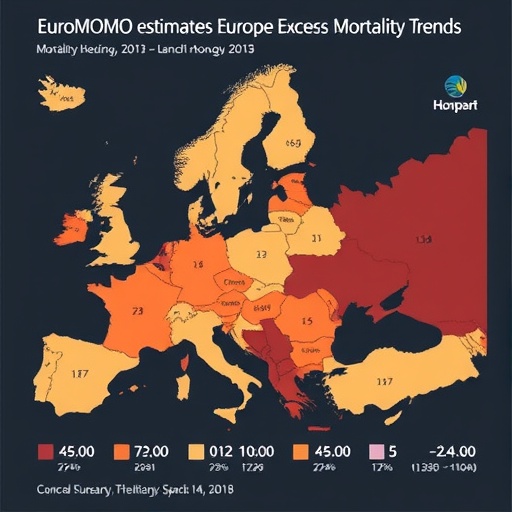
As the world continues to grapple with the aftershocks of the COVID-19 pandemic, comprehensive analyses of mortality data remain crucial in understanding the true impact of the crisis and guiding public health responses. A newly published study by Nørgaard, Nielsen, Schjørring, and colleagues, featured in Nature Communications in 2026, offers an unprecedented, detailed examination of excess mortality across Europe during the COVID-19 pandemic and previous influenza seasons, utilizing data collected by the EuroMOMO network. This research leverages advanced statistical modeling frameworks to dissect patterns of mortality beyond officially reported COVID-19 deaths, revealing not only the magnitude of the pandemic’s toll but also subtle but meaningful distinctions compared to typical seasonal influenza mortality.
EuroMOMO, the European Mortality Monitoring Project, has been a pivotal collaborative platform since its inception, gathering real-time mortality data from multiple European countries. The dataset compiled is uniquely granular, incorporating age-specific and week-by-week mortality rates from general populations, enabling the detection of aberrations in death rates that surpass expected baseline levels. By applying rigorous excess mortality estimation techniques, the researchers quantified deviations in mortality attributable to direct and indirect effects of viral respiratory epidemics. Their multi-seasonal analysis spans several influenza waves preceding the pandemic alongside the COVID-19 outbreak period, establishing an empirical context for the comparative burden of these public health crises.
The methodology underpinning this study is grounded in sophisticated time-series statistical models designed to estimate expected mortality baselines while controlling for confounding seasonal and demographic variations. The team employed an algorithmic approach adjusting for trends in population size, age distribution, and known seasonal fluctuations in mortality. These statistical models factored in lag effects between infection and fatal outcomes while accounting for other mortality influencers like temperature extremes and non-respiratory hazard events. By contrasting observed weekly death counts against model-predicted baselines, they derived excess mortality estimates that capture hidden mortality burdens that standard cause-of-death reporting may understate.
One of the study’s critical insights involves the characterization of excess mortality peaks linked to the COVID-19 pandemic, which unequivocally exceeded mortality surges typically seen during severe influenza seasons in Europe. The authors noted that mortality spikes in 2020 and 2021 coincided temporally and geographically with SARS-CoV-2 transmission waves, with substantial excess deaths recorded particularly among older age groups — a demographic historically vulnerable to both influenza and COVID-19. The magnitude and protracted duration of these peaks starkly differentiated the pandemic from previous influenza outbreaks. This distinction underscores the exceptional public health challenge posed by COVID-19 relative to seasonal flu.
Moreover, the study highlights the heterogeneous impact of COVID-19 across European countries participating in EuroMOMO, reflecting variations in healthcare capacity, timing and stringency of interventions, population demographics, and viral variant circulation. In countries with robust health systems and early containment measures, excess mortality was moderated but not eliminated, revealing the virus’s intrinsic lethality even under optimal response scenarios. Conversely, nations where healthcare resources were overwhelmed or interventions delayed experienced more pronounced mortality burdens, illuminating critical lessons for effective pandemic preparedness and response.
Beyond direct virus-induced deaths, the research sheds light on indirect mortality consequences. Disruptions to routine healthcare services, delayed treatments for chronic conditions, and mental health crises arising from prolonged social restrictions likely contributed to elevated death rates. The study’s excess mortality framework integratively captured this broader mortality footprint, which often escapes classification in official COVID-19 death counts. This holistic perspective calls for multidimensional strategies addressing both infectious disease control and maintaining essential health services during prolonged public health emergencies.
The temporal granularity of EuroMOMO data further enabled detection of transient mortality anomalies, such as those associated with heatwaves or other environmental stressors coinciding with pandemic waves. By delineating overlapping mortality drivers, the researchers advanced understanding of complex multi-factorial influences shaping excess deaths. Their findings emphasize the importance of enhancing surveillance systems to integrate diverse data streams, including meteorological and environmental indicators, for more nuanced public health risk assessment and resource allocation during overlapping crises.
The study’s revelations about age- and region-specific mortality patterns support targeted intervention approaches. For instance, prioritizing vaccination and protective measures for elderly populations yielded clear mortality reduction benefits. However, the persistence of excess mortality even in some vaccinated groups highlights ongoing risks, including waning immunity or emergence of immune escape variants. The authors advocate for sustained surveillance and adaptive vaccination strategies as key elements of long-term pandemic management.
In comparing COVID-19 to historical influenza seasons, the investigation underscored the unprecedented scale and complexity of the recent pandemic. Influenza mortality, while significant and long-recognized, generally exhibits shorter, more predictable seasonal peaks with comparatively lower excess death counts. The excess mortality approach, therefore, serves as a valuable epidemiological tool to contextualize different respiratory viral threats and refine public health responses proportionate to observed impacts.
Crucially, this research exemplifies the indispensable role of multinational collaboration in pandemic monitoring. EuroMOMO’s structure, combining real-time data exchange with harmonized analytical methodologies, enables timely identification of mortality crises and coordinated interventions across borders. Sustaining and expanding such platforms will be vital for early warning and mitigation of future epidemics or emerging infectious threats in an interconnected world.
The study by Nørgaard et al. also raises important questions about mortality data quality and completeness. Variability in death certification practices, reporting delays, and differences in healthcare infrastructure quality across countries may influence excess mortality estimations. The authors emphasize the need for continued improvement in mortality data systems to enhance accuracy and comparability, enabling policymakers to capture the full health burden of pandemics and allocate resources equitably.
This comprehensive assessment of excess mortality directly supports better understanding of COVID-19’s true human cost, beyond confirmed case tallies and cause-of-death coding. Such insights are critical for refining epidemiological models, informing economic and social policy decisions, and calibrating public risk communication. The revealed disparities and excess mortality patterns also reinforce the imperative to address social determinants of health that exacerbate vulnerability during pandemics.
Looking forward, the analytical approach established by this study offers a powerful framework for ongoing mortality surveillance. By integrating EuroMOMO-style excess mortality estimation with pathogen-specific diagnostics, viral genomic surveillance, and population health metrics, public health authorities can construct a multidimensional picture of disease burden. This holistic surveillance paradigm is essential for optimizing intervention strategies, healthcare resource utilization, and ultimately minimizing mortality from future pandemics.
In sum, this research provides a landmark contribution to the scientific understanding of how COVID-19 reshaped mortality landscapes in Europe. It spotlights the critical value of excess mortality estimation in capturing pandemic impacts that transcend standard reporting, offering actionable insights for preparedness, response, and recovery efforts. As the global community prepares for future infectious threats, studies like this underscore the enduring need for robust, transparent, and collaborative mortality monitoring infrastructures.
We stand at a pivotal juncture in public health where data-driven mortality surveillance bridges the gap between clinical realities and policy imperatives. The granular, multi-country excess mortality measurements presented by Nørgaard, Nielsen, Schjørring, et al. provide not only a retrospective reckoning of the pandemic’s devastation but also a blueprint for strengthened epidemic intelligence worldwide. Their findings challenge us to harness advanced epidemiological tools and international partnerships to safeguard population health in an era defined by emerging infectious challenges.
Embracing the lessons learned from this compelling excess mortality analysis, health authorities and governments must prioritize investments in integrated mortality data systems, enhanced laboratory capacity, and preventive interventions. Robust modeling coupled with timely international data sharing is paramount to detect mortality deviations early, enabling agile responses that save lives. The COVID-19 pandemic has irrevocably demonstrated the stakes involved—there can be no complacency in monitoring the silent, yet profound, shifts in mortality that signal emerging threats.
Ultimately, the work of Nørgaard and colleagues exemplifies the intersection of rigorous science and public health impact. By illuminating the hidden death toll of COVID-19 across a diverse European landscape, their study galvanizes global efforts toward resilient health systems and proactive pandemic countermeasures. Continued vigilance and research will be essential to anticipate and mitigate excess mortality risks, safeguarding human life during inevitable future waves of infectious disease.
Subject of Research: Excess mortality in Europe during the COVID-19 pandemic and previous influenza seasons as estimated by EuroMOMO.
Article Title: Excess mortality in Europe estimated by EuroMOMO during the COVID-19 pandemic and previous influenza seasons.
Article References:
Nørgaard, S.K., Nielsen, J., Schjørring, C.B. et al. Excess mortality in Europe estimated by EuroMOMO during the COVID-19 pandemic and previous influenza seasons. Nat Commun (2026). https://doi.org/10.1038/s41467-025-67981-1
Image Credits: AI Generated
Tags: advanced statistical modeling in public healthage-specific mortality rates in EuropeCOVID-19 pandemic impact on mortalityEuroMOMO mortality dataEuropean excess mortality analysisindirect effects of viral epidemicsinfluenza season mortality comparisonmortality monitoring in European countriesmulti-seasonal mortality trendspandemic and influenza mortality distinctionspublic health response to excess mortalityreal-time mortality data collection