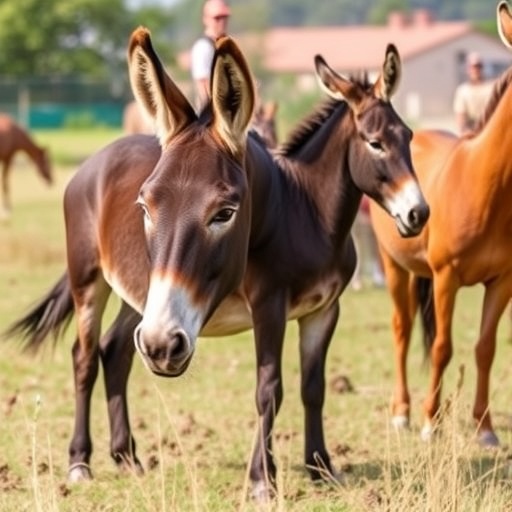
In the landscape of agricultural biotechnology, understanding genetic diversity and breed classification have emerged as critical components in enhancing animal husbandry practices. A recent study has unveiled a novel integrated approach that combines Boruta and SMOTE methodologies for the effective classification of donkey breeds using single nucleotide polymorphism (SNP) data. This significant advancement addresses the challenges posed by high dimensionality and limited sample sizes, paving the way for more accurate genetic assessments and improvements in breeding programs.
The study, conducted by researchers Li, Xu, and Li, emphasizes the importance of genetic markers in breed identification. SNPs, the most common type of genetic variation among individuals, serve as pivotal indicators of breed traits. By analyzing these markers, researchers can delineate the genetic makeup of different donkey breeds, which is paramount for conservation efforts and the optimization of breeding strategies. This research captures the essence of blending artificial intelligence techniques with genetic analysis to pave the way for scientific breakthroughs in animal genetics.
One of the central challenges in this domain is the high dimensionality of SNP datasets. With thousands of genetic markers potentially influencing traits, the complexity increases significantly. Traditional classification methods often struggle to manage such vast datasets, leading to overfitting and misclassification of breeds. The Boruta algorithm emerges as a formidable solution to this issue. By performing feature selection in a robust manner, it effectively identifies the most relevant SNPs, thereby reducing noise and enhancing the accuracy of classification tasks.
Complementing the Boruta algorithm, the Synthetic Minority Over-sampling Technique (SMOTE) plays a crucial role in addressing the imbalance of sample sizes often encountered in genetic studies. Donkey breeds, particularly rare ones, may have limited representation in sample collections. This lack of data can skew results and inhibit the ability to generalize findings across breeds. SMOTE counters this by creating synthetic samples based on existing data, thus enriching the dataset and providing a more equitable landscape for model training.
The integrated application of Boruta and SMOTE holds significant promise, particularly in the context of rapid breed classification. The implications of this research extend beyond mere academic interest; they have real-world applications in improving breeding strategies, enhancing genetic diversity, and aiding conservation efforts for endangered donkey breeds. With the ability to process high-dimensional SNP data efficiently, this integrated method positions itself as a cornerstone in modern genetic evaluation systems.
As the world faces increasing pressures on food security and biodiversity, understanding and improving donkey breeds can have far-reaching effects. Donkeys play a vital role in agrarian societies, serving not only as working animals but also as sources of genetic materials for hybridization and genetic improvement. The enhanced classification capabilities provided by the Boruta-SMOTE approach can lead to better-informed breeding practices, ultimately contributing to more sustainable agricultural systems.
Moreover, this advancement illustrates the interdisciplinary nature of modern genetic research. By combining statistical learning techniques with biological data, researchers can unlock insights that were previously elusive. The study not only contributes to the body of knowledge in the field of animal genetics but also sets a precedent for future research endeavors. This approach invites further exploration into the integration of various machine learning techniques in biological data analysis.
The implications of this work extend to various stakeholders in the agricultural sector, including breeders, conservationists, and policymakers. For breeders, having access to accurate and rapid breed identification methods means they can make informed decisions that lead to improved productivity. For conservationists, the ability to categorize breeds effectively ensures that genetic diversity is preserved, aligning with global efforts to maintain biodiversity.
In summary, the innovative Boruta-SMOTE integrated approach represents a significant leap forward in the classification of donkey breeds using SNP data. It addresses critical hurdles such as high-dimensional data and small sample sizes, providing a robust framework for future genetic studies. This research not only enhances our understanding of donkey genetics but also contributes to the broader mission of sustainable agricultural practices. As we advance into a future where genetic resources will be paramount for food security and environmental stewardship, the tools developed through this research will undoubtedly play a vital role.
The study encourages the scientific community to further investigate and apply similar methodologies in other livestock species, thereby amplifying the benefits of this integrated approach. The findings herald a new era in agricultural genetics, where precision and efficiency go hand-in-hand, fostering improved outcomes for animals, breeders, and the environment alike.
A comprehensive understanding of genetic markers has never been more crucial. As researchers continue to explore the vast potential of genetic data, the integration of advanced methodologies will shape the future of animal breeding. The Boruta-SMOTE integrated approach exemplifies this progress, offering a glimpse into the future of agricultural biotechnology with implications that transcend borders and breed classifications.
In conclusion, the advancements encapsulated in this study signal an increasingly sophisticated landscape of genetic research, where the fusion of traditional practices and modern technological solutions holds the key to unlocking new potential within livestock management. As the agricultural sector adapts to the challenges of the 21st century, continuous innovation in genetic classification methods will be essential for driving sustainable practices and ensuring the viability of livestock breeds around the world.
Subject of Research: Integrated Approach for Donkey Breed Classification Using SNP Data
Article Title: A Boruta-SMOTE Integrated Approach for Rapid Donkey Breed Classification Using SNP Data: Addressing High-Dimensionality and Small Sample Challenges
Article References:
Li, C., Xu, S., Li, D. et al. A Boruta-SMOTE Integrated Approach for Rapid Donkey Breed Classification Using SNP Data: Addressing High-Dimensionality and Small Sample Challenges.
Biochem Genet (2026). https://doi.org/10.1007/s10528-025-11316-8
Image Credits: AI Generated
DOI: https://doi.org/10.1007/s10528-025-11316-8
Keywords: SNP Data, Donkey Breed Classification, Boruta Algorithm, SMOTE, Genetic Diversity, Agricultural Biotechnology
Tags: accelerated donkey breed classificationadvancements in agricultural biotechnologyanimal husbandry practicesartificial intelligence in animal geneticsBoruta and SMOTE methodologieschallenges in SNP dataset analysisconservation of donkey breedsgenetic diversity in donkeysgenetic markers for breed identificationhigh dimensionality in genetic dataoptimization of donkey breeding programssingle nucleotide polymorphism analysis