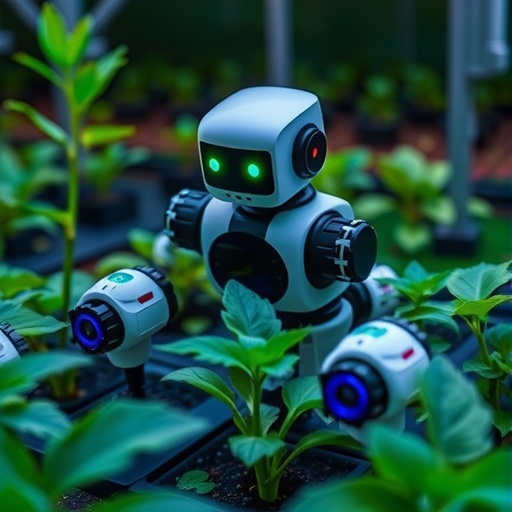
In a groundbreaking study set to transform agricultural practices, researchers have made significant advances in integrating Internet of Things (IoT) technologies with robotic systems for the automated detection of plant diseases and environmental monitoring. This innovative approach, led by an international team of experts including Talaat, F.M., Ibrahim, M.A., and Karim, A.A., presents a compelling solution to one of the most pressing challenges in modern agriculture: disease management and environmental sustainability. The implications of their findings could resonate throughout the agricultural sector, promising not only enhanced crop yields but also reduced labor costs and better resource management.
At the heart of this research is the development of an IoT-integrated robotic system that employs advanced sensors and imaging technologies to monitor crop health continuously. By utilizing these state-of-the-art sensors, this robotic system can detect early signs of disease in plants, which is crucial in preventing the spread of infections and minimizing losses. The ability to assess crop health at an unprecedented scale ensures that farmers can take timely action, thereby enhancing their ability to protect their crops and ensure food security.
The IoT technologies employed in this research facilitate real-time data transmission and analysis. The robotic systems equipped with sensors collect vast amounts of data, which is then processed using sophisticated algorithms to identify potential health issues in crops. This process minimizes the need for manual inspections, which are time-consuming and often less precise. Instead, farmers can receive immediate notifications regarding the health of their crops, alongside actionable data that can inform their management decisions.
Moreover, this robotic system operates within a network that connects various farming equipment and devices, forming a smart farming ecosystem. This interconnectivity allows for seamless communication between different components of the agricultural process. For instance, data from soil moisture sensors can inform irrigation systems, ensuring that crops receive the optimal amount of water, while simultaneously monitoring weather conditions to further enhance resource efficiency. The integration of these systems not only improves operational efficiency but also significantly reduces the environmental impact of agricultural practices.
The environmental monitoring capabilities of this robotic system extend beyond crop health assessments. The researchers have designed it to gather data on various environmental factors, including soil health, temperature fluctuations, and humidity levels. Such comprehensive monitoring can lead to better understanding and management of the ecosystems in which these crops exist. By analyzing this data, farmers can implement practices that promote soil health and biodiversity, ultimately leading to more sustainable farming practices.
One of the standout features of this research is its focus on accessibility and usability. The team has prioritized creating a system that can be easily adopted by farmers, regardless of their technological proficiency. Through user-friendly interfaces and straightforward data presentation, even those with limited tech experience can utilize the system effectively. This democratization of technology in agriculture is crucial in ensuring that all farmers, especially those in developing regions, can benefit from these advancements.
In addition to improving on-field practices, this research holds promise for enhancing agricultural education and knowledge transfer. By incorporating this technology into agricultural training programs, aspiring farmers can gain firsthand experience with cutting-edge tools that are shaping the future of agriculture. This educational aspect will empower a new generation of farmers who are equipped with both the knowledge and the technology to make informed decisions about their farming practices.
The implications of this research extend far beyond agricultural efficiency; they touch on broader societal issues such as climate change and food security. As the global population continues to rise, the pressure on agricultural systems to produce more food sustainably becomes increasingly urgent. By leveraging IoT technologies and robotics, farmers can increase their productivity while concurrently reducing their environmental footprints. This dual focus not only addresses the immediate needs of food production but also contributes to long-term sustainability goals.
In conclusion, the pioneering work conducted by Talaat, F.M., Ibrahim, M.A., and Karim, A.A. in the realm of IoT-integrated robotic systems presents a transformative approach to modern agriculture. This system heralds a new era characterized by precision agriculture, where data-driven insights lead to smarter farming practices. From monitoring plant health to optimizing resource use, the potential applications of this technology hold great promise for confronting the challenges of the 21st century. As more researchers build upon these findings, the future of agriculture looks not only technologically advanced but also sustainable, efficient, and capable of meeting the needs of a growing global population.
With the ongoing development and assessment of such innovative technologies, the agricultural sector is poised for a revolution that will facilitate smarter farming and possibly alter the landscape of food production worldwide. As the world looks on with anticipation, it is clear that the marriage of technology and agriculture is not just beneficial; it is essential for a sustainable future.
Subject of Research: IoT-Integrated Robotic System for Automated Plant Disease Detection and Environmental Monitoring
Article Title: IoT-Integrated robotic system for automated plant disease detection and environmental monitoring.
Article References:
Talaat, F.M., Ibrahim, M.A., Karim, A.A. et al. IoT-Integrated robotic system for automated plant disease detection and environmental monitoring.
Sci Rep (2026). https://doi.org/10.1038/s41598-025-32624-4
Image Credits: AI Generated
DOI: 10.1038/s41598-025-32624-4
Keywords: IoT, robotics, plant disease detection, environmental monitoring, smart agriculture, sustainable farming.
Tags: advanced sensors in farmingagricultural sustainability solutionsautomated disease detection in cropsearly disease detection in plantsenhancing crop yields with technologyenvironmental monitoring with roboticsIoT technologies for plant healthreal-time data analysis in agriculturereducing labor costs in farmingrobotic systems for resource managementSmart robotics in agriculturetransformative agricultural practices