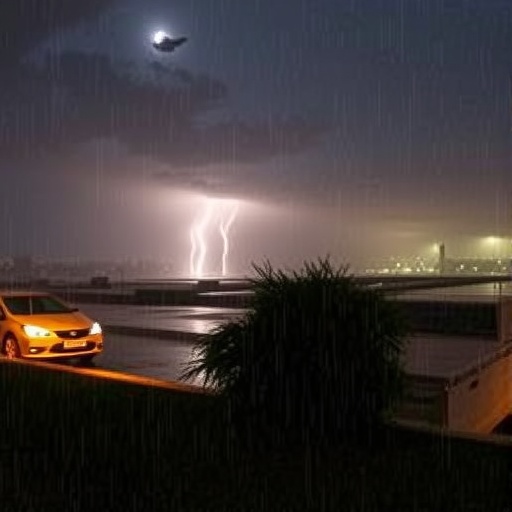
In recent years, the integration of artificial intelligence (AI) into environmental science has led to groundbreaking advances in numerous fields, with rainfall forecasting standing out as a particularly urgent challenge. Researchers have increasingly turned to physics-informed deep learning, a hybrid approach that combines the rigor of physical laws with the adaptability of artificial intelligence, allowing for more accurate predictions. This emerging technique could dramatically enhance our understanding of rainfall patterns, crucial for agriculture, water resource management, and disaster preparedness.
The work done by Inam, Umer, and Rajput marks a significant milestone in this domain. They have developed a sophisticated deep learning framework specifically designed for rainfall forecasting across various climatic regions, addressing the complexities and variabilities inherent in different environments. Their research highlights the pressing need for accurate precipitation predictions, especially in a world where climate change is intensifying weather patterns. This innovation could not only improve forecasting accuracy but also facilitate tailored strategies for rainwater harvesting and flood risk management in distinct geographical contexts.
Physics-informed deep learning differs from traditional models by incorporating not just observational data, but also the underlying physical equations governing atmospheric phenomena. This approach is particularly crucial for rainfall forecasting, where intricate relationships exist between temperature, humidity, atmospheric pressure, and precipitation patterns. By embedding these physical laws into the learning algorithms, the model can better generalize across diverse climatic regimes, leading to more robust predictions that are grounded in observable reality rather than solely relying on historical data.
The research team employed a comprehensive dataset that includes historical rainfall measurements and relevant meteorological variables, sourced from multiple geographic locations. By analyzing these multifaceted relationships, they were able to train their model effectively, ensuring it can adapt to fluctuations in weather patterns caused by climate change. This adaptability is vital, as recent studies indicate that rainfall patterns are becoming increasingly unpredictable, posing challenges for traditional forecasting models that often rely on historical trends.
One of the noteworthy aspects of the study is its focus on diverse climatic regions. The researchers recognized that rainfall behaves differently depending on the geographical and meteorological context. For instance, monsoon seasons in South Asia differ vastly from the sporadic rainfall events observed in arid regions. The AI framework developed by the researchers not only acknowledges these differences but also leverages them to enhance predictive accuracy. This specificity ensures that the model can provide actionable insights tailored to local conditions, improving its utility for regional planners and farmers.
Another innovative element of this research lies in its potential applications. Beyond merely predicting rainfall, the findings can inform water management policies, agricultural practices, and disaster readiness initiatives. By forecasting rainfall with greater precision, stakeholders can make well-informed decisions regarding irrigation schedules, flood defenses, and resource allocation. This predictive capability can mean the difference between feast and famine for farmers dependent on seasonal rains, as well as saving lives and property in flood-prone areas.
The interdisciplinary nature of this work is also noteworthy. The collaboration between meteorologists, data scientists, and engineers exemplifies how integrative approaches can yield superior results in solving complex problems. This kind of teamwork not only enhances the breadth of knowledge brought to the research but also fosters innovative thinking that drives the field forward. By combining expertise from various domains, the research team could tackle the multifaceted challenges of rainfall forecasting with more comprehensive solutions.
As the climate crisis accelerates, the implications of this research become even more profound. With extreme weather events becoming more frequent and severe, understanding how rainfall patterns change is paramount. The model developed by Inam and colleagues could serve as a critical tool in the global effort to adapt to climate change by enhancing our ability to anticipate and respond to weather-related extremes. This aligns with larger global initiatives aimed at mitigating the impacts of climate change and building resilience in vulnerable communities worldwide.
In conclusion, the groundbreaking work on the physics-informed deep learning framework for rainfall forecasting opens new horizons in the field of meteorology and environmental science. It emphasizes the importance of integrating traditional scientific knowledge with cutting-edge technology to address pressing challenges posed by climate variability. As we stand on the brink of further advancements in AI and machine learning, the possibilities for improving rainfall predictions and, consequently, enhancing human resilience against climatic extremes are promising.
This research highlights not only the advancements in technology but also the need for ongoing collaboration between scientists, policymakers, and the public to ensure these innovations translate into tangible benefits for society. As the authors continue to refine their framework and broaden its applications, the potential to revolutionize how we understand and respond to rainfall could foster a more sustainable future for all.
Subject of Research: Rainfall forecasting using physics-informed deep learning.
Article Title: A physics informed deep learning framework for rainfall forecasting in diverse climatic regions.
Article References:
Inam, S.A., Umer, S. & Rajput, H. A physics informed deep learning framework for rainfall forecasting in diverse climatic regions.
Discov Artif Intell (2026). https://doi.org/10.1007/s44163-026-00833-z
Image Credits: AI Generated
DOI: 10.1007/s44163-026-00833-z
Keywords: Rainfall forecasting, physics-informed deep learning, climate change, meteorology, artificial intelligence, predictive modeling, environmental science.
Tags: accurate precipitation predictionsadvanced forecasting technologiesagricultural impacts of rainfall predictionsAI in environmental scienceclimate change impact on rainfalldeep learning for rainfall forecastingdisaster preparedness through forecastingflood risk management innovationshybrid models for weather forecastingphysics-informed deep learning techniquesregional climatic variability in forecastingwater resource management strategies