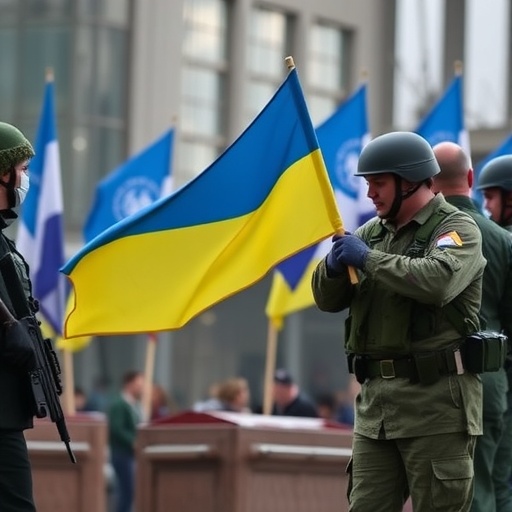
In the evolving geopolitical landscape of the 21st century, the conflict in Ukraine has emerged as a pivotal event testing the resilience of democratic ideals against the forces of autocratic aggression. A recently published study by Rudolph, L., Haggerty, F., and Thurner, P.W., featured in Nature Communications in 2026, offers a comprehensive examination of the multifaceted public support dynamics underpinning Ukraine’s defense efforts. This research delves deep into the complex interplay between democratic states and autocratic regimes, exploring how public sentiment shapes international responses and influences the strategic calculus on the global stage.
The authors start by contextualizing Ukraine’s struggle within a broader framework of international security paradigms. They argue that Ukraine represents a frontline state where the principles of self-determination clash with aggressive expansionist policies spearheaded by autocratic powers. The paper highlights how this conflict transcends national borders, affecting global political stability, economic networks, and the foundational values of liberal democracy. Understanding public support for Ukraine’s defense, therefore, is not merely an exercise in regional politics but a window into democracy’s capacity to confront authoritarian resurgence worldwide.
Central to the study is an analysis of the socio-political variables influencing public opinion across diverse democratic societies. Using robust data sets derived from multinational surveys and social media sentiment analyses, the research reveals how factors such as historical ties, media framing, economic interests, and cultural affinities contribute to varying degrees of support or ambivalence towards Ukraine. The intricate statistical modeling employed allows for high-resolution insight into the factors consolidating or eroding solidarity with Ukraine among international populations.
One of the groundbreaking aspects of this research lies in its methodological approach that integrates advanced natural language processing algorithms to parse large volumes of social media data. This approach enables the authors to capture real-time public discourse, identifying key narratives and emotional drivers behind public opinion trends. By correlating these data with geopolitical events, the study traces how international incidents—such as publicized military engagements or diplomatic negotiations—directly influence the ebbs and flows of public support.
The researchers also examine the role of misinformation and propaganda in shaping public attitudes. Autocratic regimes are often adept at deploying sophisticated information campaigns aimed at destabilizing democratic consensus and undermining support for Ukraine. The paper elucidates how disinformation networks penetrate democratic societies, seeding doubts and polarizing communities. This finding underscores the vital importance of resilient information ecosystems and independent media institutions in safeguarding democratic solidarity against external manipulations.
Furthermore, the study ventures into the psychological mechanisms of empathy and identity that underpin popular mobilization for Ukraine’s cause. Drawing from social identity theory and collective action frameworks, it highlights how citizens across democracies construct narratives of shared struggle against authoritarianism. Such narratives are pivotal in galvanizing grassroots activism, charitable contributions, and political pressure on government actors to sustain support. The authors suggest that fostering these empathetic connections is crucial for sustaining long-term international aid.
In exploring governmental responses, the paper appraises how public opinion influences policy making within democratic nations. It details instances where robust public support catalyzed increased military aid, humanitarian assistance, and diplomatic pressure against autocratic actors. Conversely, in contexts where support waned due to war fatigue or economic downturns, policymakers faced significant challenges in maintaining a coherent strategy. This bidirectional relationship underscores the reciprocal nature of democratic governance, where citizens’ attitudes and state actions continuously interact.
The economic dimensions of public support also receive considerable attention. Ukraine’s defense involves complex economic entanglements including trade disruptions, energy dependencies, and sanctions regimes targeted at autocratic states. The study evaluates how economic anxieties within democratic populations affect their willingness to endure short-term hardships for the sake of geopolitical principles. It identifies economic reassurance measures and transparent communication as key mitigators of potential public backlash against costly support initiatives.
In addition to democratic states, the research touches on the international institutions’ role in amplifying public support. Entities such as the United Nations, NATO, and regional alliances contribute normative frameworks endorsing Ukraine’s sovereignty and condemning aggression. The visible endorsement from such organizations often strengthens public resolve, providing legitimacy to governmental actions. The study’s in-depth policy analysis suggests that maintaining strong multilateral cooperation is essential in consolidating diverse public support bases.
Notably, the paper addresses the generational and cultural divides within democratic societies that influence support trajectories. Younger demographics, often digitally interconnected and socially progressive, tend to express higher solidarity levels with Ukraine, while older cohorts may exhibit more pragmatic or cautious stances influenced by memories of past conflicts or economic vulnerability. Similarly, cultural proximity and diasporic linkages to Ukraine amplify support in certain regions. These demographic insights offer valuable guidance for targeted advocacy and communication campaigns.
The authors underscore the strategic importance of communicating Ukraine’s narrative effectively to domestic and international audiences. They advocate for leveraging storytelling that humanizes the conflict, focalizing civilian resilience and democratic aspirations. This human-centric approach not only strengthens empathetic ties but counters abstract geopolitical rhetoric that may disengage the broader public. Media outlets and policymakers must thus prioritize authentic, nuanced narratives to sustain widespread engagement.
On the technological front, the study discusses the deployment of emerging digital tools to monitor and shape public opinion landscapes. From AI-driven sentiment monitoring to strategic social media campaigns, technology serves as both a battleground and enabler in the contest for hearts and minds. The research cautions against the ethical pitfalls of manipulation, calling for transparent and responsible use of digital platforms to uphold democratic principles while countering autocratic propaganda.
The paper’s conclusive reflections emphasize that public support for Ukraine’s defense is a dynamic construct influenced by myriad social, political, economic, and technological factors. Its sustainability hinges on continuous engagement, adaptive strategies, and solidarity mechanisms that transcend transient geopolitical calculations. As autocratic actors evolve their tactics, democratic societies must likewise innovate in fostering durable public commitment grounded in shared values and informed understanding.
In summary, this landmark study presents a nuanced, data-driven exploration of how global democratic publics comprehend, react to, and influence Ukraine’s defense amid encroaching authoritarianism. By bridging complex empirical inquiry with strategic insight, it illuminates pathways to bolster international solidarity through informed citizenry and accountable governance. As the world confronts mounting challenges to democracy, these findings resonate far beyond Ukraine, providing essential guidance for global democratic resilience.
The synthesis presented in Rudolph, Haggerty, and Thurner’s work calls for a renewed emphasis on the power of democratic engagement—wherein informed, empathetic publics serve as bulwarks against autocratic aggression. This research not only advances academic discourse but also offers pragmatic tools for policymakers, civil society actors, and media practitioners striving to uphold democratic security in an age defined by geopolitical turbulence and information complexity.
Subject of Research:
The study investigates public support in democratic countries for Ukraine’s defense against autocratic aggression, focusing on socio-political, economic, psychological, and technological dimensions influencing attitudes and mobilization.
Article Title:
Examining public support for Ukraine’s defense against autocratic aggression
Article References:
Rudolph, L., Haggerty, F. & Thurner, P.W. Examining public support for Ukraine’s defense against autocratic aggression. Nat Commun (2026). https://doi.org/10.1038/s41467-025-67913-z
Image Credits:
AI Generated
Tags: authoritarian resurgence and democracyautocratic aggression and democracydemocratic resilience in 21st centuryfrontline states in geopolitical conflictsgeopolitical conflict analysisglobal political dynamics and Ukraineinternational security and Ukraineliberal democracy and global stabilitypublic sentiment and foreign policypublic support for Ukrainesocio-political variables in public opinionUkraine defense efforts study