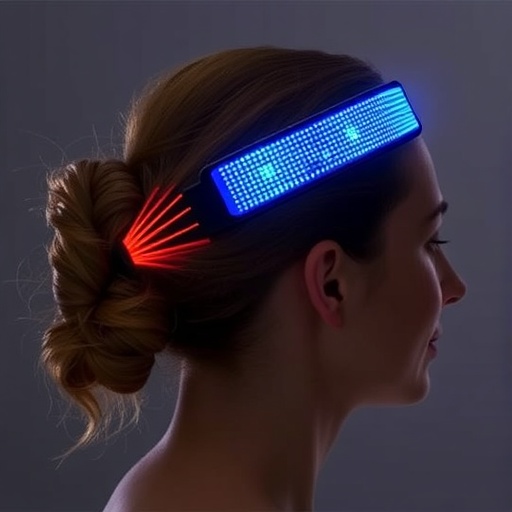
In a groundbreaking development that promises to revolutionize non-invasive treatments for hair loss, researchers have unveiled an innovative wearable phototherapy platform incorporating near-infrared (NIR) organic light-emitting diodes (OLEDs) embedded directly into textiles. This convergence of advanced materials science, bioengineering, and dermatological therapy charts a new course toward personalized, wearable medical technologies. The study, spearheaded by Cho, E.H., An, J., Chi, Y., and colleagues, demonstrates the feasibility and efficacy of a customized, textile-based NIR OLED system specifically designed for targeted photobiomodulation therapy, a method increasingly recognized for its capacity to stimulate hair follicle regeneration and improve scalp health.
The core innovation lies in the integration of flexible NIR OLEDs into wearable fabrics, a paradigm shift from conventional bulky light-emitting devices used in clinical settings. Traditional phototherapy systems for hair loss often involve rigid, cumbersome apparatuses that limit user mobility and compliance. By contrast, this new platform leverages the exceptional mechanical flexibility and lightweight nature of OLEDs to create a textile that comfortably conforms to the scalp’s contours, enabling continuous and customizable light delivery throughout daily activities.
One of the crucial technical feats underpinning this technology is the customization of NIR OLED emission spectra tailored precisely to the optimal wavelengths for hair follicle stimulation. Prior research has identified near-infrared light in the range of 700 to 900 nanometers as the most effective for penetrating dermal layers and activating mitochondrial cytochrome c oxidase, thereby enhancing cellular respiration and promoting follicular cell proliferation. The researchers optimized the OLED materials and device architecture to maximize efficiency, luminance uniformity, and longevity while maintaining substrate flexibility. This optimization is essential because sustained emission at precisely calibrated power densities ensures safety and therapeutic efficacy without thermal damage.
The manufacturing process involved advanced techniques to weave the OLED arrays into commonly worn fabrics, maintaining wearability without sacrificing optical performance. The team pioneered a unique encapsulation method that preserves OLED integrity against environmental factors such as moisture and mechanical stress, issues that typically degrade organic semiconductors. This has enabled the production of washable, durable phototherapy textiles suitable for everyday use, overcoming one of the greatest hurdles in wearable electronic design.
From a bioengineering perspective, the system is highly customizable, allowing users to tailor the intensity and duration of light exposure through a programmable interface. Such personalization addresses the variability in hair loss etiologies and patient response, optimizing treatment regimens delivered in real-world settings. Data acquisition modules integrated within the platform facilitate real-time monitoring, enabling clinicians or users themselves to adjust therapy and track progress over time. This feedback loop marks a significant advancement over static phototherapy devices, moving toward responsive, precision scalp care.
The mechanisms through which NIR phototherapy promotes hair restoration involve complex biochemical pathways. Photons absorbed by mitochondria trigger enhanced ATP production and reactive oxygen species (ROS) signaling that modulates gene expression related to cell survival, proliferation, and differentiation. Specifically, the activation of the Wnt/β-catenin pathway, crucial in hair follicle regeneration, appears to be stimulated under NIR irradiation. Cho and colleagues’ platform effectively delivers therapeutic dosages that activate these pathways without causing cytotoxicity or discomfort, a balance difficult to achieve with standard light sources.
In vivo testing on animal models demonstrated significant improvements in hair density and follicle counts after sustained phototherapy using the textile-based NIR OLEDs, with histological analyses confirming increased anagen phase duration and vascularization in treated areas. These preclinical outcomes suggest robust biological responses, reinforcing the translational potential of the technology for human clinical trials. Moreover, initial pilot human studies revealed enhanced scalp comfort, reduced heat sensations, and high user adherence, attesting to the platform’s practical advantage over existing solutions.
The implications of this technology extend beyond hair loss treatment. The seamless integration of optoelectronic systems into everyday textiles paves the way for multifunctional therapeutic wearables that can address various dermatological and neurological conditions through light-based modulation. Coupled with expanding knowledge of photobiomodulation effects on systemic tissues, such platforms could evolve into comprehensive health management devices.
Scientifically, this study contributes significantly to the expanding field of flexible electronics by demonstrating the scalability and adaptability of NIR OLEDs for bio-interfacing applications. The successful encapsulation technique and emission tuning serve as benchmarks for future designs aiming to deliver conformal, non-invasive therapies. Beyond academic research, the commercial potential for hair loss—a condition affecting millions globally—underscores the broad societal impact.
While the technology is still in its developmental phase, challenges remain, including further improvements in device lifetime, miniaturization of control electronics, and large-scale manufacturing protocols. The researchers emphasize ongoing efforts to integrate wireless power sources and artificial intelligence-driven modulation to enhance autonomous operation and user customization further.
This novel textile-integrated NIR OLED phototherapy platform epitomizes the confluence of material innovation, bioengineering precision, and medical utility. It heralds a new era where wearable, non-invasive interventions could transform common conditions previously dependent on pharmaceutical or invasive solutions. By bridging the gap between technology and biology, the work from Cho et al. sets a transformative precedent for next-generation personalized health care.
Given the urgent demand for effective and accessible hair loss treatments, this technology arrives as a powerful alternative complementing or even replacing pharmacological approaches notorious for side effects and inconsistent results. Its user-centric design philosophy encourages continuous therapy adherence, vital in chronic conditions like androgenetic alopecia and alopecia areata.
In conclusion, the pioneering integration of customized NIR OLEDs within wearable textiles marks an evolutionary step in phototherapeutic interventions. The research combines optical engineering, textile science, and biological insights to deliver a versatile, safe, and effective treatment modality poised to significantly impact hair restoration therapies. As clinical evaluations advance, this technology promises to redefine the interface between medicine and consumer lifestyle, bringing sophisticated, precision therapies into everyday life with unprecedented convenience.
Subject of Research:
Wearable phototherapy using customized near-infrared (NIR) organic light-emitting diodes (OLEDs) integrated into textiles for non-invasive hair loss treatment.
Article Title:
Wearable textile-based phototherapy platform with customized NIR OLEDs toward non-invasive hair loss treatment.
Article References:
Cho, E.H., An, J., Chi, Y. et al. Wearable textile-based phototherapy platform with customized NIR OLEDs toward non-invasive hair loss treatment. Nat Commun (2026). https://doi.org/10.1038/s41467-025-68258-3
Image Credits: AI Generated
Tags: advanced materials sciencebioengineering in hair treatmentcustomizable light delivery systemsflexible phototherapy deviceshair follicle regenerationinnovative dermatological therapiesnon-invasive hair treatmentpersonalized hair loss solutionsphotobiomodulation therapyscalp health improvementtextile-based medical technologywearable NIR OLEDs