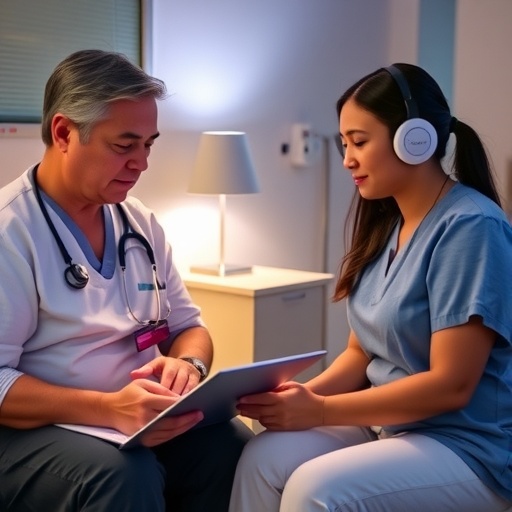
In a revolutionary leap towards enhancing patient care and operational efficiency, recent research has illuminated the effectiveness and acceptability of ambient listening scribe technology in outpatient healthcare settings. This innovative approach aims to alleviate the burden of documentation on healthcare professionals, allowing them to focus more on patient interactions rather than administrative tasks. The study, conducted by a team of researchers, including Memon, Brand, and Taylor, serves as a pivotal evaluation within this rapidly advancing field of health technology.
Ambient listening scribe technology operates as a sophisticated tool designed to capture physician-patient conversations in real time, transcribing them accurately and seamlessly. By integrating voice recognition software with natural language processing algorithms, this technology is capable of generating patient notes without disrupting the flow of dialogue. This not only promises improved documentation accuracy but also enhances the overall patient experience, fostering a more interactive and engaging environment during consultations.
One of the core objectives of the study was to assess the performance of this technology in real-world outpatient contexts. The researchers conducted a mixed methods trial evaluation, involving quantitative data analysis along with qualitative insights. These comprehensive insights allowed for a nuanced understanding of how ambient listening scribe technology performs under varying circumstances and environments. The findings suggest that the technology maintained a high transcription accuracy, often exceeding traditional documentation methods.
Moreover, patient and provider feedback was collected to gauge the acceptability of the ambient listening scribe. Many participants reported a significant reduction in the administrative burden previously placed on healthcare professionals, enabling them to dedicate more attention to their patients. The feedback highlighted that both patients and providers felt more connected during their interactions, as the technology minimized interruptions that were once commonplace due to note-taking requirements.
Diving deeper into the technology’s impact, the study revealed that ambient listening scribe technology could also lead to a reduction in consultation times. With healthcare providers no longer tethered to manual note-taking, appointments could maintain a steady rhythm, facilitating a more thorough exchange of information within a shorter timeframe. This efficiency could potentially lead to an increased patient turnover rate in outpatient settings without sacrificing the quality of care delivered.
Engagement with ambient listening scribe technology has shown promise in improving patient satisfaction scores. Patients appreciated the undivided attention from their healthcare providers, which, in turn, fostered a more trusting and open dialogue about their health conditions. The ability of providers to respond in real-time to patient concerns, without the distraction of administrative tasks, reinforced the quality of the patient experience.
However, the study did not shy away from addressing potential challenges associated with the implementation of such technology. Among the concerns raised were issues related to privacy and data security. It is essential for healthcare organizations to assure both providers and patients that necessary safeguards are in place to protect sensitive health information, especially as ambient listening capabilities involve recording personal conversations. This highlights the need for robust regulatory frameworks and ethical guidelines as the technology becomes more widely adopted.
Additionally, some healthcare providers expressed initial skepticism regarding the effectiveness of the technology, particularly in busy outpatient settings where interruptions might be frequent. Yet, the study’s findings indicated that once trained on the system, providers became advocates for its integration, recognizing its significant benefits in reducing paperwork and improving workflow efficiency.
Training and integration were highlighted as pivotal components for successful implementation. Healthcare teams underwent thorough training sessions to familiarize themselves with the technology’s functionalities. This ensured that providers were confident in utilizing the scribe effectively, which contributed to the overall positive reception of the technology. Continuous support and feedback mechanisms were also crucial in addressing any ongoing concerns or adjustments needed in the system.
As healthcare continues to evolve alongside technological advancements, the implications of ambient listening scribe technology extend beyond mere administrative efficiencies. This research underpins a paradigm shift in how care is delivered, emphasizing the importance of patient-centered approaches that prioritize communication and connection. The results advocates for a future where technology serves as a partner in healthcare delivery, rather than a distraction from it.
It’s evident that the fusion of technology within healthcare ultimately aims to enhance not just operational metrics but also the human experience. By embracing tools like ambient listening scribe technology, healthcare providers can shed the encumbrance of excess documentation, reclaim their roles as caregivers, and focus on what truly matters—delivering quality health services to patients.
In conclusion, the mixed methods trial evaluation led by Memon et al. provides compelling evidence supporting the integration of ambient listening scribe technology in outpatient settings. It opens avenues for further research and development, particularly around enhancing the technology, addressing privacy concerns, and optimizing workflows. As this technology matures, it promises a more dynamic, efficient, and humane approach to healthcare, thereby transforming the landscape of outpatient services.
In summary, the potential benefits of ambient listening scribe technology align with the broader trend towards digitization and improved patient experiences in healthcare. As the industry grapples with the ongoing challenges of high workloads and stringent documentation requirements, the findings from this study herald a future where healthcare delivery can seamlessly blend the human touch with technological proficiency.
Subject of Research: Ambient Listening Scribe Technology
Article Title: Performance, acceptability, and impact of ambient listening scribe technology in an outpatient context: a mixed methods trial evaluation.
Article References:
Memon, S., Brand, A., Taylor, B. et al. Performance, acceptability, and impact of ambient listening scribe technology in an outpatient context: a mixed methods trial evaluation. BMC Health Serv Res (2026). https://doi.org/10.1186/s12913-025-13954-5
Image Credits: AI Generated
DOI:
Keywords: Ambient listening, Scribe technology, Outpatient care, Healthcare efficiency, Patient experience.
Tags: administrative task alleviationambient listening scribe technologydocumentation burden reductionhealthcare technology acceptancemixed methods trial evaluationnatural language processing in medicineoutpatient healthcare efficiencypatient care enhancementpatient experience in outpatient settingsphysician-patient communication improvementreal-time conversation transcriptionvoice recognition in healthcare