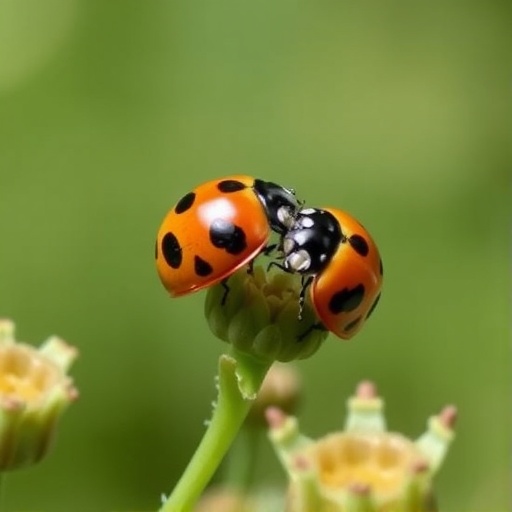
In a groundbreaking study, researchers have uncovered that disrupting the chemical signals associated with the elytra, or wing covers, of ladybird beetles can significantly delay mating without completely inhibiting the process. This fascinating revelation offers new insights into the complex interactions among insects, specifically focusing on the species Cheilomenes sexmaculata, a representative of the diverse ladybird beetle family. The elytra of these beetles are not merely protective shells; they also play a critical role in communication and mating behaviors.
The study, conducted by a team of scientists including D. Jattan, T. Yadav, and A. Singh, has important implications for the field of entomology, particularly in understanding mating strategies and interspecies communication among insects. Ladybird beetles are widely known for their vivid coloration and patterns, which serve various roles, including deterring predators and attracting mates. However, this research suggests that chemical signals, often emitted through elytral secretions, are equally, if not more, crucial in sexual attraction among these beetles.
In their experiments, the researchers manipulated the chemical composition of the elytra on ladybird beetles. By applying specific chemical disruptors that interfered with the natural pheromones normally released from these wing covers, they observed notable changes in the mating behavior of the beetles. Males typically approach females based on these chemical signals, so the disruption led to delays in courtship and mating, underscoring the reliance of C. sexmaculata on chemical cues in their reproductive process.
Notably, while mating was delayed due to these chemical interventions, it was not entirely prevented. This fascinating nuance points to the incredible resilience inherent in animal mating strategies. Even in the face of artificially altered signals, the intrinsic motivation to mate remained strong, indicating that other factors may also contribute to reproductive success. The elytral chemicals are only one piece of a far more intricate puzzle that governs how these organisms interact and reproduce.
The significance of chemical communication in insects has been well-documented, but the specific role of elytral chemistry in ladybird beetles has received less attention until now. This research breaks new ground by establishing clear links between chemical signals and mating behaviors. Interestingly, with many species of ladybird beetles exhibiting varying degrees of pheromone usage, further research could lead to a more profound understanding of sexual selection and mate preference not just in beetles, but across a wide range of species.
One of the intriguing aspects of the study is its potential applications. For instance, understanding the chemical ecology of beetles could aid in the development of pheromone traps for pest control, minimizing the need for harmful pesticides. Eco-friendly pest management strategies that leverage the natural behaviors of insects could lead to more sustainable agricultural practices.
Moreover, this research taps into the growing interest in the evolution of chemical communication systems among animals. As scientists uncover the detailed mechanisms behind these interactions, they stand to provide new insights into how species diverge and adapt over time, further enriching our understanding of biodiversity and ecosystem dynamics.
Furthermore, the delay in mating prompted by the alteration of elytral chemistry raises questions regarding how external environmental factors might influence mating behaviors in natural settings. With climate change and habitat destruction posing significant threats to insect populations, understanding these dynamics could help predict shifts in behavior and populations in increasingly unstable environments.
The study also opens avenues for future research focusing on the molecular pathways involved in chemical communication and reception. By unraveling these pathways, scientists could shed light on why certain chemical compounds resonate more with beetles than others, adding layers to our comprehension of behavior in insects.
In addition to exploring behavioral implications, the implications of disrupted chemical signals extend to evolutionary biology as well. Such alterations in reproductive success can drive natural selection processes, potentially leading to adaptations that favor the survival of individuals with more effective communication strategies.
The findings from this research highlight the inherent complexity of ecosystems where every species interacts dynamically with others. The intricate dance of life, survival, and reproduction is often dictated by invisible chemical interactions, revealing just how much remains to be learned about our natural world.
In conclusion, the study examining the interference of elytral chemistry in Cheilomenes sexmaculata shines a spotlight on the delicate balance of chemical signals in mating behaviors among insects. While the disruption delayed mating, it ultimately did not prevent it, suggesting a resilience in these animals that merits further investigation. With the lens of chemical ecology focusing on ladybird beetles, we unlock not only the mysteries of their reproductive strategies but also the broader implications for species interaction and ecological health.
As we continue to study the chemical and behavioral intricacies of ladybird beetles and other insects, we can expect to unearth discoveries that will not only inform our understanding of these organisms but also support the development of innovative strategies for conservation and pest management.
Subject of Research: Interference with elytral chemistry and its effect on mating in ladybird beetles.
Article Title: Interfering with elytral chemistry delays but does not prevent mating in ladybird beetle, Cheilomenes sexmaculata (Fabricius).
Article References:
Jattan, D., Yadav, T., Singh, A. et al. Interfering with elytral chemistry delays but does not prevent mating in ladybird beetle, Cheilomenes sexmaculata (Fabricius). Sci Nat 113, 10 (2026). https://doi.org/10.1007/s00114-025-02053-4
Image Credits: AI Generated
DOI: 08 January 2026
Keywords: Ladybird beetle, Cheilomenes sexmaculata, elytral chemistry, mating behavior, chemical communication, entomology, pest management, biodiversity.
Tags: Cheilomenes sexmaculata species studychemical disruptors in entomologychemical signals in insectselytral chemistry and communicationentomology research findingsinsect mating strategiesinterspecies communication among beetlesladybird beetle mating behaviorladybird beetle reproductive biologymating delays in insectspheromone disruption effectsrole of elytra in insect attraction