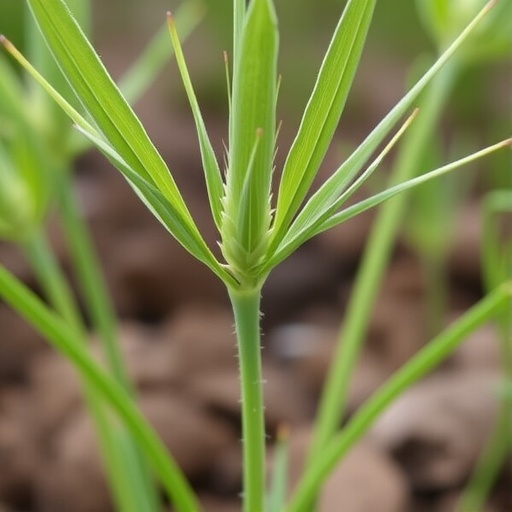
In a groundbreaking effort to unravel the intricate gene expression dynamics governing barley shoot meristem development, a team of researchers has harnessed the power of integrated single-cell and spatial transcriptomics data. This innovative approach sheds unprecedented light on the transcriptional landscapes shaping early primordia initiation, revealing subtle yet crucial regulatory networks that dictate plant architecture and reproductive development.
Central to this study is the meticulous characterization of the gene KN1, a widely recognized meristem marker traditionally thought to be absent in the L1 layer and downregulated where new organs initiate. Contradicting this conventional understanding, the researchers identified that a subset of tunica cells within maize exhibits KN1 expression at the RNA level, raising provocative questions about the gene’s mobility and function. Notably, the rice orthologue OsH1 exhibits expression in the L1 layer of floral meristems and select inflorescence meristem cells, further complicating traditional models and suggesting a conserved yet nuanced role for KN1 homologues in shoot apical meristem patterning.
The study comprehensively maps the spatial distribution of KN1 homologues in barley, specifically HvKN1 and HvHDZIV8, pinpointing their localization to tunica cells. Fascinatingly, nearly 9% of tunica cells express HvKN1, accompanied by the cytokinin biosynthesis gene HvLOG1 and WUSCHEL-LIKE HOMEOBOX genes HvWOX9C.1 and HvWOX9C.2. The expression of HvLOG1 at meristem apices implies localized cytokinin production, potentially serving as a signaling cue promoting WOX9C transcription and meristem maintenance.
In a comparative twist, the vegetative shoot apical meristem (vSAM) shows scant HvKN1 expression within tunica cells, as evidenced by sensitive smRNA-FISH detection. This observation mirrors the expression patterns of OSH1 in rice, where reproductive meristems boast elevated KN1 homolog expression, while vegetative meristems maintain low transcript levels. Such differential expression underscores the developmental stage-specific regulatory mechanisms at play and highlights the complexity of meristem identity transitions.
Delving into the inflorescence meristem (IM), the researchers identify a defined boundary demarcating founder cells (Fo) of the tassel spikelet meristem (TSM) primordium, marked by the absence of HvKN1. This early molecular signature enables precise demarcation of Fo cells as they embark on differentiation pathways. The transcription factor HvHDZIV2, previously associated with the IM or spike tip, displays a broader expression pattern, encompassing various meristematic zones within the inflorescence, suggesting versatile regulatory functions.
As organogenesis proceeds, founder cells in the TSM primordium exhibit dynamic gene expression shifts. Notably, HvKN1 is downregulated while VRS4 and HvLOG1 become active in TSM founder cells, indicative of their roles in meristem specification and cytokinin-mediated signaling. Simultaneously, the gene HvCRC, homologous to CRABS CLAW, marks developing suppressed bracts, defining boundary domains crucial for architectural patterning.
Upon visible TSM outgrowth, HvKN1 and HvHDZIV2 are reactivated within the TSM, underscoring their roles in sustaining meristem identity post-initiation. The expression of HvCOM1, a TCP family transcription factor, intricately marks rachilla formation, demonstrating how transcriptional cascades coordinate complex morphological structures during inflorescence development. By leveraging expression profiles, the investigators successfully isolated TSM founder cells and unearthed a suite of uniquely expressed genes, including an Argonaute-family member and several transcription factors spanning HD-ZIP, MADS-box, AT hook DNA-binding, and MYB domains. These factors collectively weave the regulatory tapestry directing early spike development.
Spatially, smRNA-FISH technology enabled high-resolution visualization of key transcripts within meristem domains, validating the virtual microdissection and differential gene expression analyses performed via the BARVISTA platform. This integrative methodology pinpointed 27 genes uniquely upregulated in founder cells, highlighting candidates like leucine-rich repeat receptor kinases and BREVIS RADIX-like transcriptional regulators. Excitingly, two YABBY family transcription factors—HvTOB1 and HvTOB2—emerged as pivotal markers implicated in founder cell specification, consistent with their known roles in node and internode identity modulation in rice and their regulation by homeodomain proteins akin to HvKN1.
Within the broader IM context, HvFT2, a barley homologue of the flowering regulator OsFT-L1, exhibited enriched expression, hinting at a conserved florigenic signaling axis active in barley inflorescences. OsFT-L1’s known activation by mobile paralogues OsHd3a and OsRFT1 in rice IMs invites speculation about similar systemic flowering signals orchestrating barley spike development. Complementing HvFT2, the bZIP transcription factor HvFD7, orthologous to OsbZIP62, paralleled expression patterns and may functionally interact with FT-like proteins, underpinning conserved flowering regulatory mechanisms across cereals.
Interestingly, primordial cells within barley spikes express HvSCR1, a homologue of Arabidopsis SCARECROW (AtSCR). In Arabidopsis, AtSCR regulates primordial establishment and is dynamically expressed from the earliest floral stages. This conservation suggests shared regulatory frameworks in monocot and dicot shoot development, underscoring the evolutionary depth of shoot apical meristem patterning modules.
Taken together, this study not only refines the spatial and temporal gene expression atlas of barley shoot meristems but also underscores the power of integrating single-cell transcriptomics with spatial data to decode plant developmental complexity. The sophisticated mapping of KN1 homologues, cytokinin biosynthesis genes, WUSCHEL-like transcription factors, and meristem identity regulators offers a comprehensive molecular blueprint illuminating barley spike morphogenesis.
Moreover, the identification of key transcription factor networks and epigenetic regulators, including Argonaute proteins, extends the understanding of meristem fate specification beyond conventional pathways. By enabling virtual microdissection and high-confidence differential gene expression detection, the BARVISTA platform equips researchers with a potent toolkit to explore regulatory landscapes in unparalleled detail.
The implications of this work resonate beyond basic plant developmental biology, as barley represents a staple cereal crop with significant agricultural value. By elucidating the molecular governance of spike development, breeders gain valuable targets to manipulate inflorescence architecture and optimize yield traits under fluctuating environmental pressures.
Furthermore, the inferred cytokinin signaling dynamics at meristem apices open avenues for targeted manipulation of hormonal pathways to modulate meristem activity and organogenesis. The functional parallels drawn between barley, rice, and Arabidopsis underscore conserved gene regulatory networks ripe for translational research across plant species.
The researchers’ pioneering integration of high-resolution spatial transcriptomics with single-cell RNA sequencing signifies a milestone in plant molecular biology. It paves the way for dissecting complex developmental processes with unprecedented clarity, positioning barley as a model for cereal inflorescence biology.
This holistic portrait of shoot meristem gene expression networks sets the stage for future innovations in crop improvement strategies, leveraging molecular insights to drive sustainable agricultural productivity. The study exemplifies the transformative potential of cutting-edge omics technologies to redefine our understanding of plant developmental systems.
As the agricultural sector faces mounting demands for enhanced crop resilience and yield, studies such as this underscore the critical role of fundamental research in unlocking genetic and molecular blueprints that can be harnessed for next-generation breeding.
In conclusion, the integration of single-cell and spatial transcriptomics data achieved here transcends traditional boundaries, offering an intricate view into barley shoot meristem biology. The elucidation of dynamic gene regulatory networks promises to inspire future discoveries and practical applications aimed at bolstering global food security.
Subject of Research:
Barley shoot meristem development, gene expression dynamics, single-cell and spatial transcriptomics integration
Article Title:
Imputation integrates single-cell and spatial gene expression data to resolve transcriptional networks in barley shoot meristem development
Article References:
Demesa-Arevalo, E., Dӧrpholz, H., Vardanega, I. et al. Imputation integrates single-cell and spatial gene expression data to resolve transcriptional networks in barley shoot meristem development. Nat. Plants (2026). https://doi.org/10.1038/s41477-025-02176-6
Image Credits:
AI Generated
DOI:
https://doi.org/10.1038/s41477-025-02176-6
Tags: barley shoot meristem developmentcytokinin biosynthesis in barleygene expression dynamics in plantsgene localization in plant tissuesintegrated single-cell transcriptomicsKN1 gene and plant architecturemeristem patterning and evolutionregulatory networks in shoot meristemsrice orthologue OsH1 in plant developmentspatial transcriptomics in barleytunica cells in meristem functionWUSCHEL-LIKE HOMEOBOX genes