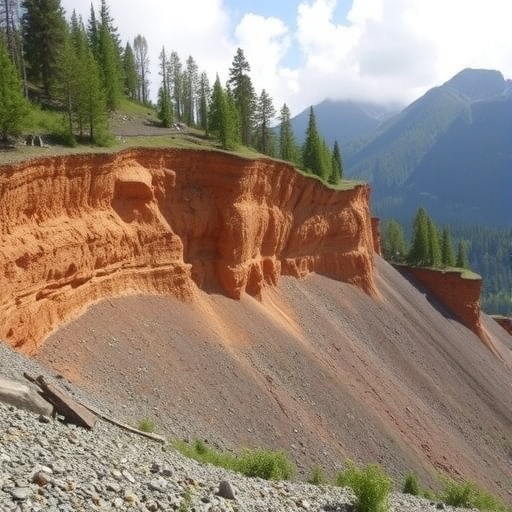
Landslides pose a significant risk to both natural landscapes and human infrastructure, driven by a complex interplay of geological, hydrological, and mechanical factors. Recent advancements in understanding the mechanics of soil behavior and stability have shed light on one crucial factor that has become a focal point of research: suction stress. This phenomenon plays a vital role in the strength of rupture zones, which are areas at the boundary between stable and unstable soil layers. A recent study by Wang, Su, and Liu underscores the importance of suction stress in determining the stability of landslides.
The study discusses how suction stress arises due to capillary action within soil pores. When soil becomes saturated, water fills these pores but does not fully alleviate the tension that binds soil particles together. This residual tension enhances the soil’s overall strength, reinforcing the structural integrity of the rupture zone. Understanding suction stress opens up a new dimension in geotechnical engineering, as it affects how engineers approach land stabilization and remediation efforts.
Moreover, the research highlights that variations in rainfall patterns due to climate change can significantly impact suction stress. With intense rainfall events becoming more frequent, understanding how moisture alters soil behavior is critical. The implications of this study are far-reaching, particularly in regions prone to landslides which could be exacerbated by climate-induced shifts in precipitation. The authors warn that as environments continue to change, so too must our strategies for addressing landslide risks.
The findings presented emphasize not only the theoretical underpinnings but also the practical applications of suction stress analysis. By utilizing advanced monitoring techniques, researchers can now model how suction stress evolves during rainfall events, leading to better predictions of when and where landslides may occur. This can significantly contribute to preventive measures, enabling governmental and environmental agencies to formulate effective evacuation and response strategies.
Wang and colleagues employed a combination of field studies and laboratory tests to quantify the relationship between suction stress and soil stability. Their experimental work consisted of simulating various moisture conditions to observe how these changes affected the strength of soil in the rupture zones. The study’s comprehensive approach provides a nuanced understanding that bridges theoretical geotechnics and real-world applications.
Additionally, the study addresses the potential benefits of integrating suction stress considerations into existing models of landslide prediction. Conventional models often overlook this critical factor, leading to underestimations of landslide susceptibility. By including suction stress in predictive frameworks, the accuracy of landslide hazard assessments could improve considerably, which is essential for mitigating risks in hazardous zones.
In more technical terms, the authors outline the implications of suction stress on effective stress principles in soil mechanics. They argue that moisture-induced changes in pore water pressure significantly alter the effective stress, which governs soil strength. This relationship is especially important in cohesive soils, where moisture content fluctuations can lead to dramatic shifts in stability.
This important research points towards necessary advancements in engineering practices as well. With a clearer understanding of suction stress dynamics, engineers might develop new materials or systems designed to reinforce vulnerable rupture zones against sliding. For instance, geo-synthetics could be employed that not only stabilize soil but also actively manage moisture levels to maintain optimal suction conditions.
Moreover, this study calls for a re-evaluation of existing landslide preparedness frameworks. As regions begin to grapple with the realities of climate change, it becomes increasingly urgent for policymakers to consider these scientific insights when designing infrastructure and urban planning initiatives. Knowledge generated from such studies can guide community planning, ensuring that new developments minimize exposure to landslide risks.
Overall, Wang, Su, and Liu’s work contributes significantly to the body of knowledge surrounding geotechnical engineering and environmental science. By emphasizing the role of suction stress, the authors provide a pathway toward enhanced safety measures against landslides, ultimately aiming to protect lives and properties in at-risk areas.
Future research could extend the findings of this study by exploring how suction stress interacts with other contributing factors to landslide occurrence. Exploring these interactions can yield a more holistic view of landslide mechanics, taking into account variables such as soil type, vegetation cover, and landscape topography.
As scientists and engineers continue to collaborate on understanding these complex systems, advancements in technology could pave the way for practical applications that are both innovative and sustainable. Interdisciplinary research could lead to new sensors and monitoring systems capable of detecting subtle changes in soil moisture, providing real-time data to support crisis management.
The findings in the study are part of an ongoing conversation in the geosciences community about adapting to a changing climate. As vulnerability to natural disasters rises in many areas, integrating scientific research into policy-making and engineering design is paramount. As we look to the future, the insights gained from examining suction stress may well provide the key to improving both our understanding of and response to landslide phenomena.
In conclusion, the implications of suction stress on the strength of rupture zones present meaningful opportunities for advancement in understanding landslide risks. As researchers and practitioners delve deeper into this subject, proactive measures can be developed that not only protect infrastructure but safeguard communities against the challenges posed by nature.
Subject of Research: The effect of suction stress on the strength of rupture zones and landslide stability.
Article Title: Effect of suction stress on the strength of rupture zone and stability of landslide.
Article References:
Wang, J., Su, A., Liu, Q. et al. Effect of suction stress on the strength of rupture zone and stability of landslide.
Sci Rep (2026). https://doi.org/10.1038/s41598-025-34658-0
Image Credits: AI Generated
DOI:
Keywords: Suction Stress, Landslide Stability, Soil Mechanics, Environmental Science, Climate Change, Geotechnical Engineering.
Tags: capillary action in soil mechanicsengineering land stabilization techniquesgeotechnical engineering and suction stresshydrological factors in landslidesimpact of climate change on landslideslandslide risk assessmentmechanical factors affecting landslide stabilityrainfall patterns and soil behaviorrupture zones in soil layerssoil pore saturation and stabilitysoil stability and suction stresssuction stress in landslides