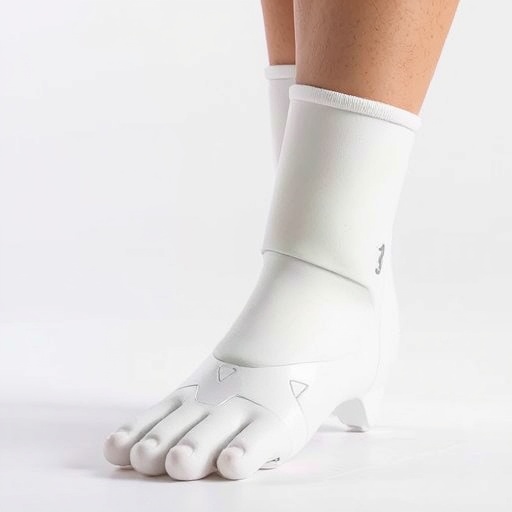
In a groundbreaking advance that promises to redefine the landscape of prosthetic technology, a team of researchers has unveiled the SoftFoot Pro—a pioneering anthropomorphic and adaptive soft articulated prosthetic foot. This innovative device, recently published in Nature Communications, capitalizes on state-of-the-art materials science and biomechanical design to reconstruct natural human gait with an unprecedented level of fidelity and adaptability.
The SoftFoot Pro marks a significant departure from traditional prosthetic feet, which often rely on rigid structures and limited articulation. Recognizing that human locomotion is a complex interplay between bones, muscles, tendons, and sensory feedback systems, the research team, led by Pace, Dimitrov, and Jakubowitz, sought to create a prosthetic foot that not only mimics the form of its biological counterpart but also replicates its dynamic mechanical functions. The result is a foot that blends softness with articulated precision, enhancing both comfort and performance for users.
At the core of the SoftFoot Pro’s innovation lies its soft robotic architecture. Utilizing advanced elastomeric materials and embedded actuation systems, the foot dynamically adapts to varied terrain and load conditions. This adaptive quality stems from a sophisticated internal network of sensors and soft actuators that work in concert, adjusting stiffness and damping properties to emulate the natural response of tendons and muscles during walking, running, and balance retention. Such biomimicry translates into more fluid and responsive movement, substantially reducing the energy expenditure typically associated with prosthetic use.
The researchers painstakingly engineered the SoftFoot Pro using a layered composite approach, integrating a blend of soft polymers with selectively positioned reinforcing fibers. This layering strategy allows for controlled deformation and energy storage during the gait cycle, enhancing propulsion and shock absorption. Unlike traditional prosthetics that often employ hard plastics or metals, the SoftFoot Pro’s materials comply with the anthropomorphic goal, achieving a balance between structural integrity and compliance that is vital for seamless interaction with the user’s residual limb and the environment.
One of the most striking features of the SoftFoot Pro is its articulated joint system. Soft actuators embedded within the foot simulate the function of the human ankle joint, granting multi-degree freedom in dorsiflexion, plantarflexion, and even subtle inversion and eversion movements. This capability is enabled by a network of microfluidic chambers that modulate internal pressures to provide adaptable stiffness, emulating the nuanced control humans exercise over their ankle during movement. Such articulation significantly enhances the wearer’s ability to maintain balance on uneven surfaces and negotiate obstacles, challenges that have long frustrated prosthetic users.
Importantly, the SoftFoot Pro integrates seamlessly with existing prosthetic socket designs, facilitated by a modular interface that translates biomechanical loads efficiently into the prosthesis. This compatibility ensures that the device can be adopted by a broad spectrum of amputees without necessitating extensive alterations to their current prosthetic systems. The research team prioritized user-centric design principles, engaging extensively with prosthesis users during development to refine ergonomics, control responsiveness, and overall comfort.
In addition to its mechanical sophistication, the SoftFoot Pro is embedded with a suite of sensors—including pressure, strain, and orientation sensors—that feed real-time data to an onboard microcontroller. This data processing unit employs advanced algorithms to continually optimize foot behavior by adapting stiffness and actuation parameters dynamically. The device’s intelligence enables it to learn from the user’s gait patterns, progressively tailoring responses to individual biomechanical idiosyncrasies over time. This adaptive learning paradigm represents a new era in prosthetic control, bridging the gap between passive hardware and active, smart assistance.
The durability and energy efficiency of the SoftFoot Pro are equally notable. Through meticulous material selection and actuator design, the team managed to reduce overall weight while maintaining robustness against daily wear stresses. The modular soft actuators consume minimal power, allowing for extended battery life and reducing device mass, which is critical for user comfort and mobility. Moreover, the use of environmentally resilient elastomers ensures performance stability across a range of temperatures and humidity levels, a vital characteristic for real-world application.
Clinical trials with amputee participants have demonstrated significant improvements in gait symmetry, walking speed, and user confidence. Participants reported enhanced proprioceptive feedback—an often-neglected feature in prosthetics—contributing to better spatial awareness and reduced falls risk. The SoftFoot Pro’s ability to adjust its mechanics on-the-fly was especially praised during ambulation over uneven and inclined surfaces, highlighting the device’s transformative potential in daily life scenarios.
The SoftFoot Pro also sets a new precedent in the ethics and accessibility of prosthetic care. By leveraging scalable manufacturing techniques, the research team aims to reduce production costs, making high-performance prosthetics more attainable worldwide. This democratization of advanced prosthetic technology could significantly improve quality of life for millions living with limb differences, underscoring the social impact potential of this innovation.
Looking toward the future, the creators of the SoftFoot Pro envision integrating even more sophisticated neural interface technologies to enable direct control through residual muscle signals or even brain-machine interfaces. Such developments would pave the way for prosthetics that act as true extensions of the human nervous system, restoring seamless motor function and sensory feedback. The adaptive soft robotics foundation established by the SoftFoot Pro serves as an essential platform upon which these advanced integrations can be realized.
The research also opens avenues for cross-disciplinary applications, bridging clues from neuroprosthetics, rehabilitation science, and robotics. The lessons learned from the adaptive soft articulated foot may inspire analogous developments in upper limb prosthetics and exoskeleton technologies, expanding the frontiers of human-machine symbiosis. The methodology of soft actuation and sensory integration demonstrated here is poised to influence not only prosthetics but also wearable robotics broadly.
In conclusion, the SoftFoot Pro represents a monumental leap forward in prosthetic design, distinguished by its harmonious fusion of soft materials, robotic actuation, and intelligent control. By meticulously emulating the biomechanical and sensory complexity of the human foot, it offers amputees unprecedented functional restoration and mobility. This innovation does not merely replace lost parts; it reimagines prosthetics as living, adaptive systems fully integrated with the human body and environment.
As research and development continue, the SoftFoot Pro stands not only as a testament to technological ingenuity but also as a beacon of hope for enhancing human potential through compassionate engineering. This work underscores the growing momentum in bio-inspired robotics and adaptive systems, charting a promising trajectory toward increasingly lifelike and responsive assistive devices.
Subject of Research:
Anthropomorphic and adaptive soft articulated prosthetic foot development integrating soft robotics and intelligent sensing.
Article Title:
The SoftFoot Pro: an anthropomorphic and adaptive soft articulated prosthetic foot.
Article References:
Pace, A., Dimitrov, H., Jakubowitz, E. et al. The SoftFoot Pro: an anthropomorphic and adaptive soft articulated prosthetic foot. Nat Commun (2026). https://doi.org/10.1038/s41467-025-68194-2
Image Credits: AI Generated
Tags: adaptive prosthetic designadvanced elastomeric materialsanthropomorphic prosthetic footarticulated prosthetic performancebiomechanical design innovationsdynamic terrain adaptationnatural human gait reconstructionprosthetic foot advancements in materials sciencesensory feedback systems in prostheticssoft prosthetic technologysoft robotic architectureuser comfort in prosthetics