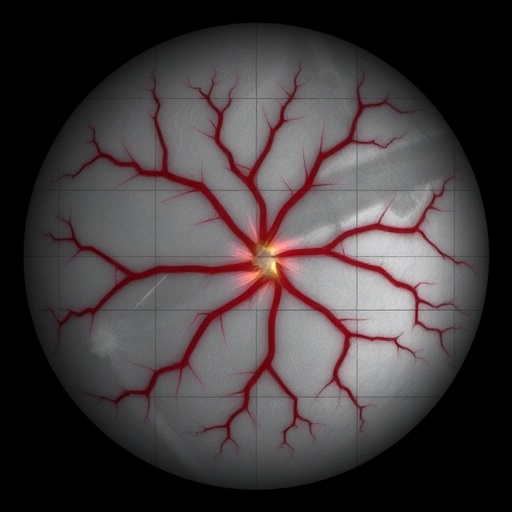
In a groundbreaking study set to advance the field of medical imaging, researchers have unveiled a novel approach to enhance the classification of arteries and veins in retinal images using advanced Y-Net convolutional networks. The significance of this work cannot be overstated as it aims to elevate the accuracy and reliability of retinal imaging diagnosis. The detection and analysis of blood vessels in the retina are critical for identifying various ocular and systemic conditions, including diabetic retinopathy and hypertension.
The retinal structure is a complex and intricate network of blood vessels that is essential for understanding the overall health of an individual. The classification of these vessels into arteries and veins is a vital first step in many diagnostic processes. Traditional methods often fall short in terms of accuracy, which can lead to misdiagnosis or delayed treatment. Recognizing this challenge, the research team developed an innovative solution leveraging Y-Net convolutional networks, a type of deep learning model known for its effectiveness in image segmentation tasks.
The Y-Net architecture is specifically designed to capture fine details in image data while maintaining computational efficiency. Its unique structure enables the model to learn from both local and global features, making it particularly adept at distinguishing between the subtle characteristics of arteries and veins. The integration of this architecture into retinal imaging offers a promising avenue for improving the quality of vascular assessment in clinical settings.
To train their model, the researchers utilized a robust dataset of retinal images that included a diverse range of vascular structures. This dataset’s diversity was essential in ensuring that the Y-Net model could generalize effectively across different patient demographics and retinal conditions. The training process involved the optimization of various hyperparameters to enhance the model’s learning and performance outcomes, resulting in a system capable of offering precise classifications.
What sets this approach apart from existing methods is the Y-Net’s ability to significantly reduce the incidence of false positives and false negatives. In traditional vascular classification approaches, common pitfalls include misidentifying the type of vessel, which can lead to erroneous conclusions regarding the patient’s health. By addressing these issues, Kumar, Aravinth, and Singh have highlighted a major advancement that could catalyze improvements in how eye care professionals interpret retinal images.
As the field of artificial intelligence continues to evolve, its applications in healthcare are proving to be transformative. The researchers’ work dovetails with a growing body of literature that advocates for the integration of AI into diagnostic processes. By harnessing the power of convolutional networks, medical professionals can gain more significant insights into a patient’s condition, leading to tailored treatment strategies and better patient outcomes.
Moreover, this study emphasizes the importance of collaboration between computer scientists and clinical practitioners. Such interdisciplinary efforts are crucial in ensuring that algorithmic advances translate effectively into practice. The researchers not only focused on the technical aspects of developing the Y-Net model but also on understanding clinical implications, thereby creating a system that meets the precision needed in medical diagnostics.
It is important to note that while the results are promising, implementing AI-enhanced systems requires careful consideration and validation across various healthcare settings. The researchers have acknowledged this need for rigorous testing, emphasizing that clinical trials will be necessary to establish the Y-Net model’s efficacy in real-world scenarios. The findings from these trials will ultimately determine how swiftly the technology can be integrated into routine ophthalmic evaluations.
As the study awaits publication in the journal ‘Discover Artificial Intelligence’, the potential for Y-Net convolutional networks to revolutionize retinal imaging is becoming increasingly apparent. This research not only holds promise for enhancing diagnosis in ophthalmology but may serve as a model for similar advancements in other areas of medical imaging. Researchers from various fields are likely to take notice of this innovative approach, inspiring further exploration into how deep learning can address long-standing challenges in healthcare.
In summary, enhancing artery and vein classification in retinal images through Y-Net convolutional networks represents a significant leap forward in the quest for accurate and reliable medical diagnostics. The collaborative efforts of Kumar, Aravinth, Singh, and their team pave the way for a new era of AI applications in medicine, one characterized by precision, efficiency, and improved patient care. As healthcare continues to embrace technological advancements, the implications of this research extend far beyond the realm of ophthalmology, heralding a future where AI plays a central role in diagnosis and treatment across the medical spectrum.
In conclusion, the researchers have opened a dialogue about the future of medical imaging and AI, inviting researchers, clinicians, and technologists to rethink how we approach diagnosis. The combination of machine learning with a genuine understanding of medical needs could redefine the standards of practice in numerous healthcare fields. The excitement surrounding this study suggests a compelling journey ahead for both retinal imaging and artificial intelligence in medicine.
As the paper progresses towards publication, the medical community eagerly anticipates the full details of this innovative work, hopeful that it will mark a substantial impact on how retinal conditions are diagnosed and treated in the years to come. The integration of AI in medicine is not just a trend; it is an evolving necessity that promises to improve lives through enhanced diagnostic capabilities.
Subject of Research: Enhanced artery/vein classification in retinal images using Y-Net convolutional networks.
Article Title: Enhancing artery/vein classification in Retinal images using Y-Net convolutional networks
Article References:
Kumar, P.M.A., Aravinth, S.S., Singh, A.R. et al. Enhancing artery/vein classification in Retinal images using Y-Net convolutional networks. Discov Artif Intell (2025). https://doi.org/10.1007/s44163-025-00660-8
Image Credits: AI Generated
DOI:
Keywords: Convolutional networks, retinal imaging, artificial intelligence, medical diagnostics, Y-Net model, deep learning, ophthalmology, vascular classification, machine learning.
Tags: accuracy in medical diagnosticsadvancements in retinal imaging technologyautomated retinal image analysisblood vessel identification in retinaconvolutional neural networks in ophthalmologydeep learning in medical imagingdiabetic retinopathy detectionhypertension diagnosis using imagingimage segmentation in healthcareinnovative approaches to ocular healthretinal vessel classificationY-Net convolutional networks