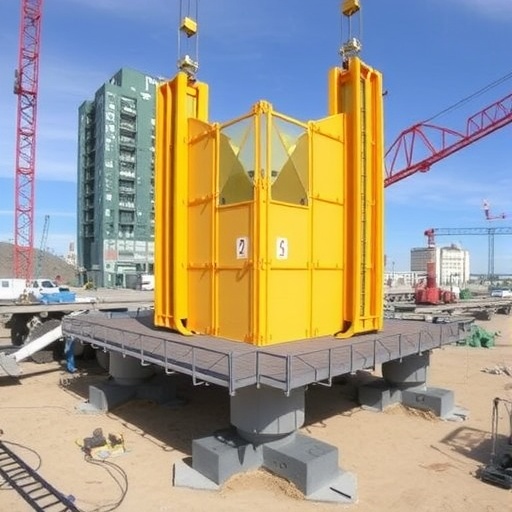
In recent years, the field of seismic engineering has seen significant advancements aimed at improving the resilience of structures during earthquakes. The latest innovation in this domain is the development of a novel pendulum column base isolation system, known as the Pendulum Column Base Isolation System with Vertical Negative Stiffness (PC-VNS), designed specifically for seismic applications. This innovative approach integrates a unique mechanism that enhances the structural integrity of buildings during seismic events, thereby mitigating the risk of catastrophic failures.
Historically, base isolation has been a prominent strategy utilized to protect structures from seismic forces by allowing controlled movement and energy dissipation. However, traditional systems can sometimes be limited in their effectiveness against diverse seismic threats. The creators of the PC-VNS system aim to overcome these limitations by introducing a novel configuration that incorporates vertical negative stiffness characteristics. This fundamental shift in design philosophy represents a significant leap forward for engineers and architects working in earthquake-prone regions.
The PC-VNS design is underpinned by the principles of negative stiffness, which involves a counteractive force that not only reduces the lateral displacements experienced by a building during seismic activity but also enhances its overall stability. Traditional systems often rely solely on bearings designed to absorb and dissipate energy. In contrast, the inclusion of vertical negative stiffness allows for a more dynamic response by engaging the physical properties of the pendulum effect, whereby the system can restore itself to an equilibrium position following displacement. This is crucial in maintaining structural integrity amidst the chaotic forces induced by tectonic events.
Researchers Azizi and Barghian have meticulously detailed the working mechanics of the PC-VNS system. It operates by employing a combination of energy dissipation and vertical stiffness, which together result in a system that utilizes gravity as a stabilizing force. With a pendulum-like behavior, the system effectively oscillates during seismic movements, ensuring that the overall centroid of the structure remains balanced and significantly reducing the energy transferred to the building. This innovative methodology represents a fusion of established engineering principles with cutting-edge material science.
In laboratory settings, extensive tests have demonstrated the efficacy of the PC-VNS system in simulating real-world seismic conditions. The experimental data reveal how the system not only enhances the longevity of buildings but also contributes to the safety of occupants during seismic events. The interaction between the pendulum mechanism and negative stiffness yields impressive results, effectively damping vibrations more efficiently than conventional systems. This testing phase has illuminated the diverse applications of the PC-VNS system, suggesting its potential for buildings, bridges, and critical infrastructure.
Moreover, the innovative nature of this system promises to reduce overall construction costs. Traditional earthquake-resistant designs often entail significant expenditures due to the materials and technology utilized in their construction. However, the PC-VNS system allows for a simpler assembly process while providing enhanced safety measures, making it an attractive option for both developers and policymakers considering urban resilience against earthquakes.
The burgeoning field of seismic technology is becoming increasingly vital as the global population continues to grow and urban centers expand. Recent studies indicate that the frequency of seismic events is increasing, particularly in regions that are geographically vulnerable. Consequently, engineering solutions that prioritize both innovation and cost-effectiveness are more crucial than ever. By leveraging the unique properties of the PC-VNS system, urban planners can deploy safer, more sustainable designs that are resilient to future seismic threats.
As the research evolves, collaboration among various disciplines will sharpen the conceptual and practical elements of the PC-VNS system. The intersection of engineering, architecture, and urban planning will be imperative in ensuring that this system can be seamlessly integrated into new and existing structures. As more engineers become acquainted with the potential of the PC-VNS technology, the paradigm of seismic resilience will undoubtedly transform.
While preliminary findings are promising, further research is critical to fully understand the long-term implications of implementing negative stiffness systems in a wide array of structures. Continuous monitoring and evaluation will ensure that the PC-VNS systems remain effective even as the seismic landscape changes over time. A systematic approach to data collection will aid in refining the design and crafting best practices to maximize the utility of this innovative technology.
Additionally, as urban areas increasingly adopt smart technologies, integrating the PC-VNS system with digital monitoring solutions could revolutionize how structures respond to seismic events. Employing real-time analytics and predictive modeling can enhance the robustness of the design by allowing for responsive systems that adapt according to varying seismic conditions. The future of safe urban living hinges on such integrative technologies.
With the introduction of the PC-VNS system, a new chapter in seismic engineering is unfolding, one that emphasizes safety, efficiency, and sustainability. It represents not only a leap in engineering design but also a commitment to protecting lives and infrastructure from nature’s most unpredictable forces. As the world looks to the future, the innovative approaches emerging from this research will play a critical role in shaping resilient cities and communities.
Furthermore, the research opens doors for additional studies that investigate other potential applications of vertical negative stiffness outside seismic resilience. Such explorations may yield breakthroughs in other fields, including mechanical systems and aerospace engineering, where similar challenges of stability and response dynamics arise. The implications of this technology stretch far beyond earthbound structures, suggesting a future ripe with possibilities for engineering stakeholders globally.
In essence, the advent of the PC-VNS system stands as a testament to human ingenuity and the unwavering quest for safety and efficiency in the face of natural calamities. The ongoing developments in this sector represent a proactive approach to engineering against seismic threats, promising a better foundation for future generations.
Subject of Research: Development of a novel pendulum column base isolation system with vertical negative stiffness (PC-VNS) for seismic applications.
Article Title: Development of a novel pendulum column base isolation system with vertical negative stiffness (PC-VNS) for pile-like behavior for seismic applications.
Article References: Azizi, A., Barghian, M. Development of a novel pendulum column base isolation system with vertical negative stiffness (PC-VNS) for pile-like behavior for seismic applications. Sci Rep (2025). https://doi.org/10.1038/s41598-025-33973-w
Image Credits: AI Generated
DOI: 10.1038/s41598-025-33973-w
Keywords: seismic engineering, base isolation, vertical negative stiffness, PC-VNS system, earthquake resilience, structural integrity, dynamic response, energy dissipation.
Tags: advanced seismic engineering techniquesearthquake-resistant building designeffective seismic force dissipationengineering advancements in earthquake safetymitigating catastrophic structural failuresnegative stiffness technology in engineeringnovel base isolation mechanismspendulum column base isolation systemseismic protection strategiesseismic resilience innovationsstructural integrity during earthquakesvertical negative stiffness applications in construction