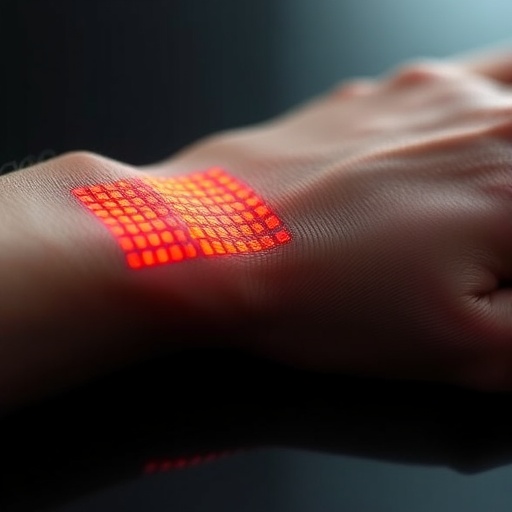
In a groundbreaking development set to revolutionize the field of tactile sensing, researchers have unveiled a skin-inspired capacitive array capable of detecting tactile modulus through an innovative scalable rigid-island architecture. This remarkable advancement, published in npj Flexible Electronics in 2025, promises to bridge the gap between human touch sensitivity and artificial tactile systems, marking a pivotal leap for flexible electronics and wearable technologies.
At the heart of this new technology is an engineering marvel that mimics the intricate mechanics of human skin, which possesses the extraordinary ability to discern subtle variations in texture, pressure, and stiffness. By studying these natural properties, the research team designed a capacitive sensing array that emulates the skin’s multilayered architecture and mechanical responses, enabling the detection of tactile modulus—the measure of a material’s stiffness or elasticity—across various surfaces and materials.
Traditional flexible sensors often struggle with accuracy and scalability, particularly when tasked with differentiating between subtle mechanical characteristics in complex environments. The team addressed these challenges by integrating a rigid-island framework embedded within a flexible substrate, creating a sensor array that combines structural stability with mechanical adaptability. This hybrid architecture supports highly sensitive capacitive sensing elements distributed over a stretchable platform, thereby allowing for precise force and deformation measurements without sacrificing flexibility.
The capacitive array comprises numerous sensing units, each featuring a miniaturized electrode pair separated by a dielectric layer sensitive to mechanical deformation. When pressure is applied, changes in the distance and dielectric properties alter the capacitance, which can be meticulously measured to infer detailed information about the material’s tactile modulus. The rigid islands ensure the electrodes remain structurally sound, preventing signal degradation during stretching or bending.
One of the most captivating aspects of this research is the scalability of the rigid-island design, which enables the sensor array to cover large areas without losing mechanical or electrical performance. This is a critical consideration for applications such as electronic skin (e-skin), prosthetics, and soft robotics, where high-resolution tactile sensing over vast surfaces is essential for nuanced interaction with the environment and improved functionality.
The researchers’ fabrication techniques involve advanced lithography and material deposition methods, enabling precise patterning of the rigid islands on flexible substrates such as PDMS (polydimethylsiloxane). These processes ensure mechanical robustness and longevity, which are crucial for real-world applications subjected to repeated mechanical stress. Additionally, the materials chosen possess biocompatibility and environmental stability, catering to biomedical and wearable device integration.
Mechanical characterization reveals this sensor array excels in detecting not only simple pressure but also the stiffness gradient of various test materials, including gels, polymers, and biological tissues. Through a rigorous testing regimen involving cyclic loading and multi-scale deformation, the capacitive array demonstrated exceptional repeatability and sensitivity, outperforming comparable tactile sensors currently available.
Beyond sensing capabilities, the innovation in signal processing algorithms and data interpretation frameworks brings a new dimension to tactile modulus detection. The sensor array’s output, when combined with machine learning models, enables the classification and mapping of complex surface textures and material properties, facilitating real-time feedback mechanisms in robotic systems and prosthetic limbs.
From a practical standpoint, the potential applications are vast and impactful. In robotic manipulation, such tactile arrays could endow machines with a heightened sense of touch, improving their dexterity and safety during human interactions. Medical prosthetics could benefit from this technology by providing amputees with sensory feedback more akin to natural limb sensation, enhancing comfort and functionality. Furthermore, in consumer electronics and wearable devices, the sensors could detect subtle tactile cues for gesture recognition and health monitoring.
The interdisciplinary collaboration spanning materials science, electrical engineering, and biomechanics has yielded a holistic approach to solving the longstanding challenge of artificial tactile sensing. By intricately replicating the natural mechanoreceptive functions of skin, the researchers have set a new standard for sensor design and tactile interaction technologies.
Looking forward, the team is exploring avenues to integrate this capacitive array with wireless communication modules and flexible power sources, aiming to develop fully autonomous tactile sensing skins deployable in a myriad of environments—from harsh industrial settings to delicate human-machine interfaces. Moreover, ongoing work includes enhancing the sensor’s spatial resolution and adapting the architecture for multi-modal sensing, incorporating temperature and humidity detection alongside mechanical properties.
This innovation also sparks intriguing possibilities for virtual reality and augmented reality systems, where realistic touch feedback is crucial for immersive experiences. By embedding such capacitive arrays into gloves or wearable patches, users could feel precise textures and forces, bringing digital environments closer to reality.
Equally notable is the environmental sustainability of the materials and fabrication processes employed. The design minimizes resource use while maintaining durability, aligning with growing demands for eco-friendly electronics. The modularity of the rigid-island approach further facilitates repairability and recyclability, addressing modern concerns about electronic waste.
In essence, this research paves the way for a new generation of flexible, highly sensitive tactile sensors that rival the human sense of touch. Its impact is expected to resonate across multiple disciplines, accelerating the evolution of smart materials, wearable biomedical devices, and human-centric robotics.
The capacitive array’s ability to detect tactile modulus with such finesse marks a quantum leap in engineering tactile interfaces. It blurs the line between biological and artificial sensory systems, capturing the unique mechanical interactions that define how living beings interpret their surroundings.
As the technology matures, widespread commercialization looms on the horizon, promising to transform how humans interact with machines and environments. The blend of biological inspiration, cutting-edge materials, and sophisticated sensor design embodied in this work exemplifies the future of flexible electronics and tactile sensing.
This pioneering work not only answers fundamental scientific questions about mechanical sensing but also sets a template for future innovations that prioritize performance, scalability, and adaptability in tactile sensing architectures. Its implications reverberate across healthcare, robotics, consumer electronics, and beyond, heralding a tactile revolution born from the fusion of biology and engineering.
Subject of Research:
Skin-inspired capacitive sensing arrays for tactile modulus detection using scalable rigid-island architectures.
Article Title:
A skin-inspired, capacitive array for tactile modulus detection via a scalable rigid-island architecture.
Article References:
Berman, A., Shi, B., Zaluska, T. et al. A skin-inspired, capacitive array for tactile modulus detection via a scalable rigid-island architecture. npj Flex Electron (2025). https://doi.org/10.1038/s41528-025-00503-7
Image Credits:
AI Generated
Tags: advancements in flexible sensor technologycapacitive array technologyengineering of tactile sensorsflexible electronics innovationhuman touch sensitivity emulationmechanical characteristics differentiationmultilayered sensor designprecision force measurementscalable rigid-island architectureskin-inspired tactile sensingtactile modulus detectionwearable technology advancements