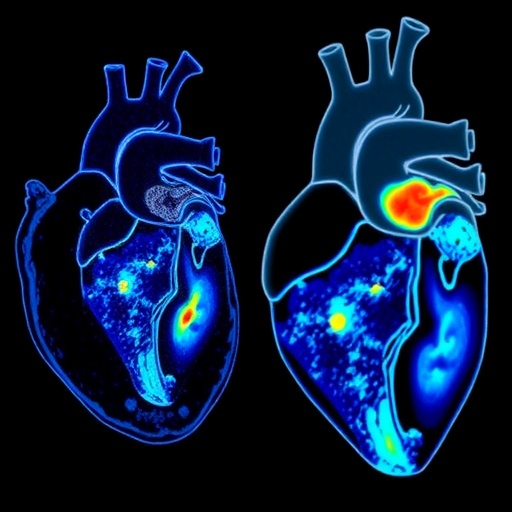
In a groundbreaking advancement set to revolutionize cardiovascular diagnostics, researchers have unveiled a novel AI-powered imaging technique named SPOT imaging, specifically designed to enhance the detection and quantification of myocardial scar tissue. Myocardial scars, resulting from heart attacks or other cardiac injuries, have long presented a challenge to clinicians due to their subtle imaging signatures and complex anatomical distributions. The innovative approach harnesses the power of deep learning algorithms combined with sophisticated image processing protocols to provide unparalleled clarity and precision in visualizing scarred heart muscle regions.
Myocardial scarring disrupts the normal electrical and mechanical functions of the heart, increasing the risk of arrhythmias and heart failure. Traditional imaging modalities, while effective to some extent, often fail to capture the full extent and heterogeneity of scar tissue, particularly in the early stages or in patients with diffuse myocardial injury. SPOT imaging incorporates artificial intelligence to overcome these limitations, elevating cardiac MRI and other imaging data to new levels of diagnostic accuracy. The technology dynamically adjusts imaging parameters using AI feedback loops, enabling more precise tissue characterization than previously achievable.
At the heart of SPOT imaging lies a powerful AI framework trained on vast datasets of cardiac images acquired from diverse patient populations. This training allows the system to learn subtle texture and contrast patterns that are indicative of scar tissue but often invisible to the naked eye or conventional analysis tools. By synergizing conventional imaging physics with cutting-edge machine learning models, SPOT facilitates an automated, reproducible, and highly sensitive identification process. This not only expedites clinical workflows but also substantially reduces human error and interobserver variability, concerns that have historically plagued myocardial scar assessment.
Beyond simple detection, the AI algorithms embedded in SPOT imaging provide detailed quantification of scar burden and distribution. Quantitative metrics derived from the technology include scar volume, density, and spatial heterogeneity indexes that are crucial for risk stratification and therapeutic decision-making. These data empower cardiologists to tailor interventions such as catheter ablation or device implantation with unprecedented specificity. Moreover, continuous monitoring of scar evolution using SPOT imaging could open new avenues for evaluating treatment efficacy and disease progression dynamically over time.
One of the most remarkable features of this system is its integration capability with existing hospital imaging infrastructures. Designed to be interoperable, SPOT algorithms can be embedded within standard MRI scanners or PACS (picture archiving and communication systems), enabling seamless transition and adoption without the need for costly hardware upgrades. This adaptability ensures that healthcare providers can leverage advanced diagnostic capabilities without significant disruption or resource expenditure, making it feasible for widespread clinical deployment across varied healthcare settings.
The implications of SPOT imaging extend well beyond the realm of myocardial scarring alone. The methodology sets a precedent for AI-enhanced imaging techniques targeting other forms of fibrotic cardiovascular diseases, offering a blueprint that could be customized for pathologies such as cardiac amyloidosis or hypertrophic cardiomyopathy. The multi-parametric analytics embedded within the platform promise to refine the phenotyping of complex cardiac disorders, thus potentially transforming disease classification frameworks and clinical trial endpoints.
A critical component of the development process involved extensive validation against gold-standard histopathological data. Researchers conducted cross-validation studies using biopsy-confirmed myocardial samples to verify the accuracy of AI-driven scar detection, underscoring the robustness of the model. These validation efforts confirmed that SPOT imaging not only matched but often exceeded human expert performance in delineating subtle fibrotic changes. This level of validation is a testament to the system’s readiness for clinical translation and regulatory approvals.
SPOT imaging’s potential to improve patient outcomes is profound. Enhanced scar detection facilitates early intervention, mitigating the risk of adverse events such as sudden cardiac arrest. Furthermore, accurately mapping the scar can help optimize the placement of devices like implantable cardioverter defibrillators (ICDs), thereby personalizing therapy to a degree previously unattainable. In doing so, this innovation heralds a new paradigm in preventive cardiology, emphasizing precision health at the individual patient level.
The development team behind SPOT imaging also highlights the ethical considerations integrated into the AI framework. The algorithms were designed with transparency and explainability at their core, ensuring that clinicians can interpret the AI’s decision-making processes. This approach fosters trust and facilitates collaborative human-AI interactions, which is pivotal for clinical acceptance. Moreover, rigorous data privacy measures were implemented during algorithm training and deployment to safeguard patient confidentiality.
Clinically, SPOT imaging is positioned to complement rather than replace existing diagnostic modalities. It synergizes with echocardiography, electrocardiography, and invasive electrophysiological studies, providing a multi-dimensional perspective of myocardial health. This multimodal integration enhances diagnostic confidence and supports comprehensive patient management strategies. Additionally, the speed of AI-assisted image interpretation significantly reduces the time from acquisition to diagnosis, addressing a critical bottleneck in acute care settings.
From a research perspective, the availability of high-fidelity scar maps generated by SPOT imaging opens new investigative opportunities. Researchers can explore the relationships between scar morphology and mechanical dysfunction or arrhythmic risk more precisely. This could fuel the discovery of novel biomarkers and therapeutic targets. Furthermore, the AI platform’s adaptability allows for continuous learning and improvement as new imaging data become available, ensuring that the system evolves with advancing scientific knowledge.
The cost implications of implementing SPOT imaging are also noteworthy. Although the technology employs sophisticated AI models, its ability to integrate with existing hardware and streamline diagnostic processes may result in overall cost savings. By reducing unnecessary testing and hospital readmissions related to undetected myocardial scars, SPOT imaging could generate significant economic benefits for healthcare systems. These factors contribute to making this innovation not only medically transformative but also financially sustainable.
Training and education are integral to successful SPOT imaging adoption. The research team has developed comprehensive clinician training modules to facilitate understanding of AI outputs and integration into clinical decision-making pathways. Empowering healthcare professionals with these skills ensures optimal utilization of the technology’s full capabilities. Additionally, patient education materials are being prepared to inform individuals about how AI contributes to their personalized cardiac care, reinforcing patient engagement and informed consent.
Looking forward, the researchers envision expanding SPOT imaging’s AI capabilities through integration with other emerging technologies such as wearable sensors and genomic profiling. This convergence could yield holistic cardiovascular phenotyping tools that map structural, functional, and molecular data onto a unified patient management platform. Such futuristic applications underline the transformative potential of AI in creating truly personalized and predictive cardiology landscapes.
In summary, SPOT imaging represents a seminal advancement in cardiac imaging driven by artificial intelligence, combining enhanced detection sensitivity, precise quantification, seamless clinical integration, and ethical transparency. As this technology transitions from research prototypes to clinical practice, it promises to redefine how myocardial scars are diagnosed and managed, ultimately improving patient prognoses and healthcare efficiencies globally. Its success signals the advent of a new era in cardiovascular medicine where AI and imaging converge to unlock deeper insights into heart disease.
Subject of Research: AI-enhanced imaging for myocardial scar detection and quantification
Article Title: AI-powered SPOT imaging for enhanced myocardial scar detection and quantification
Article References:
Bustin, A., Stuber, M., de Villedon de Naide, V. et al. AI-powered SPOT imaging for enhanced myocardial scar detection and quantification. Nat Commun 16, 11184 (2025). https://doi.org/10.1038/s41467-025-66166-0
Image Credits: AI Generated
DOI: https://doi.org/10.1038/s41467-025-66166-0
Tags: advanced cardiac MRIAI in medical imagingAI-powered imaging techniquesarrhythmias and heart failurecardiovascular diagnosticsdeep learning in healthcareimage processing in cardiologyInnovative healthcare technologiesmyocardial injury assessmentmyocardial scar detectionnovel imaging protocolsprecision medicine in cardiology