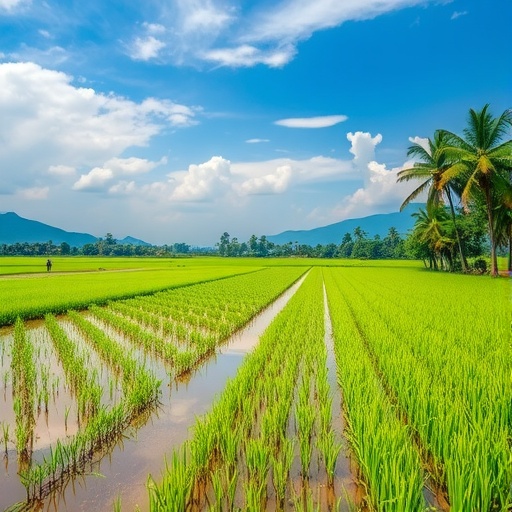
In a pivotal study addressing the challenges of rice cultivation in flood-prone regions, a group of researchers from India, led by Raman et al., have introduced innovative resource modeling and adaptive strategies to enhance sustainable rice production. This research is not just a response to immediate agricultural concerns but aims to transform farming practices in West Bengal, an area frequently ravaged by floods. Their findings underscore the urgent need for adaptive methodologies in agriculture, reflecting a broader, global crisis where climate change acts as a catalyst for extreme weather events.
The study, published in the journal Discover Agriculture, reveals that flood-prone areas present unique challenges to traditional rice farming practices. The researchers meticulously analyzed historical data and field observations, constructing dynamic models that account for various factors influencing rice yield during periods of flooding. The complexity of these models reflects the nuanced understanding required to navigate the interplay between climate phenomena and agricultural practices.
One of the standout features of this research is its emphasis on localized solutions tailored to specific environmental and socio-economic contexts. West Bengal, with its intricate network of rivers and varying soil types, serves as a case study for the application of these adaptive strategies. The researchers advocate for a shift towards integrated resource management that incorporates traditional knowledge alongside modern agricultural techniques. This dual approach not only promises immediate benefits but also ensures resilience against future climatic uncertainties.
The methodology employed by the researchers involved extensive field trials coupled with advanced computational models. These models simulate flood scenarios, allowing farmers to anticipate potential crop losses and take preventive measures. By mapping out various levels of flood severity and their anticipated impact on rice production, farmers can make informed decisions about planting schedules, crop varieties, and resource allocation. This proactive stance represents a significant departure from traditional reactive measures often taken by farmers in flood-prone regions.
The implications of this research extend beyond West Bengal. As climate change continues to affect agricultural sectors worldwide, the adaptive strategies outlined by Raman et al. could serve as a blueprint for other flood-prone regions globally. The idea is to cultivate a more resilient agricultural framework that can withstand the pressures of increasingly volatile weather patterns. Farmers across various geographical boundaries can draw lessons from the data and experiences presented in this study.
Furthermore, the authors highlight the importance of community involvement in implementing these adaptive strategies. Engaging local populations in the planning and execution phases ensures that the solutions proposed are not only scientifically sound but also culturally appropriate and readily adoptable. This grassroots approach enhances the likelihood of success, fostering a sense of ownership among farmers and stakeholders involved in the agricultural process.
Education emerges as another critical component of this research. The authors call for the establishment of training programs that equip local farmers with the necessary skills to utilize these new resource models effectively. By providing farmers with tools for understanding and applying these advanced agricultural practices, the researchers hope to foster a generation of innovators within the farming community. This emphasis on education not only enhances immediate farming practices but also empowers communities for future adaptability.
Additionally, the study explores the economic implications of implementing these adaptive strategies. By improving resilience in agricultural practices, farmers are expected to experience increased yield stability, directly impacting their income levels. The researchers argue that sustainable rice production is not just an environmental issue; it is intrinsically linked to the socio-economic fabric of farming communities. As such, investing in adaptive strategies is also investing in the livelihoods and futures of countless families reliant on rice cultivation.
The outcomes of this research also present an opportunity for policymakers in India and beyond. By recognizing the importance of adapting agricultural practices to the realities of climate change, governments can develop supportive frameworks that enable farmers to transition effectively. This alignment of research findings with policy initiatives could lead to more sustainable practices being adopted across different regions, ultimately enhancing food security on a larger scale.
Moreover, the interaction of technology with agriculture plays a pivotal role in this study. The researchers advocate for the use of precision agriculture tools that leverage satellite imagery and data analytics. These technologies can provide real-time insights into soil health and moisture levels, further informing planting decisions and resource management. With rapid advancements in technology, integrating these tools into traditional farming practices offers a significant opportunity for innovation.
In conclusion, Raman et al. provide a compelling case for the integration of resource modeling and adaptive strategies in rice production within flood-prone regions. Their research not only addresses immediate agricultural concerns but also serves as a cornerstone for future resilience in the face of climatic challenges. The multi-faceted approach they advocate highlights the importance of combining scientific research with local knowledge, technology, and community engagement. As we confront the realities of climate change, studies like this illuminate pathways toward sustainable agricultural practices that can withstand the test of time.
In a world where food security is becoming increasingly precarious, the findings of this research remain critical. Future agricultural practices must evolve, drawing from innovative methodologies that are not only sustainable but also adaptive to changing environmental conditions. The work of Raman and his team serves as a beacon for researchers, policymakers, and farmers alike, emphasizing that through collaboration, education, and innovation, sustainable agricultural futures are indeed attainable.
Subject of Research: Sustainable rice production strategies in flood-prone regions.
Article Title: Resource modeling and adaptive strategies for sustainable rice production in flood-prone regions: a case study in West Bengal, India.
Article References:
Raman, R.K., Bhakta, N., Sarkar, S. et al. Resource modeling and adaptive strategies for sustainable rice production in flood-prone regions: a case study in West Bengal, India. Discov Agric 3, 275 (2025). https://doi.org/10.1007/s44279-025-00444-9
Image Credits: AI Generated
DOI: https://doi.org/10.1007/s44279-025-00444-9
Keywords: Sustainable agriculture, climate change, rice production, flood-prone regions, adaptive strategies, resource modeling, West Bengal, community engagement, precision agriculture.
Tags: adaptive strategies for rice farmingaddressing extreme weather in agricultureclimate change impact on agriculturedynamic models for rice yieldflood resilience in crop productioninnovative resource modeling in farminglocalized agricultural solutionsresearch on flood-prone agriculturesocio-economic factors in farming adaptationssustainable agriculture in flood zonestransforming farming practices in IndiaWest Bengal rice production challenges