Credit: Emily Bass/Sam Houston State University
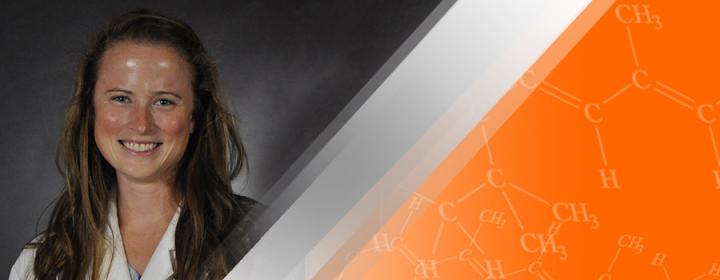
HUNTSVILLE, TX (5/4/17) — Ph.D. Student Lindsay Glicksberg of Sam Houston State University received the Emerging Forensic Scientist Award from the Forensic Science Foundation for her research on the stability of "bath salts" in biological evidence.
Glicksberg, a Ph.D. student in the Department of Forensic Science, earned the 2017 award for "Synthetic Cathinone Stability in Blood Using Liquid Chromatography/Quadrupole Time-Of-Flight/Mass Spectrometry (LC/qTOF/MS)." She studied the stability of 22 synthetic cathinones, a dangerous class of designer drugs that emerged in the US in 2009. Glicksberg's study found that specimen pH, temperature and chemical structure had a significant influence on drug stability. The study was funded by the National Institute of Justice.
"Many factors affect the stability of a drug, especially time and storage temperature, and the project was designed to assess these factors," said Glicksberg.
There has been a rise in the use and media coverage of bath salts, a class of drug that produces a wide range of stimulant effects, similar to methamphetamine, which has resulted in intoxication and death. In 2011, the Drug Enforcement Administration banned the use of some synthetic cathinones, and many states also have enacted their own laws against these chemicals. Despite these bans, people are still using these life-threatening drugs.
The Emerging Forensic Scientist Award focuses on the reliability and validity of techniques, processes or methods in forensic science. It is presented by the Forensic Science Foundation, the educational, scientific, and research arm of the American Academy of Forensic Science (AAFS), a prominent professional organization in the field. Glicksberg's research was presented at the 2017 Annual Meeting of the AAFS in New Orleans.
"Cathinone stability in biological evidence is of critical importance," said Dr. Sarah Kerrigan, Department Chair of the Department of Forensic Science and the Director of the Institute for Forensic Research, Training and Innovation at SHSU. "Changes in concentration that take place after a specimen is collected from a living or deceased person can influence how we interpret the results. We see cathinones in a wide variety of criminal investigations, ranging from impaired driving and sexual assault to death investigations and fatalities."
In addition to the award, Glicksberg recently co-authored an article on the ability to identify and measure these chemicals in biological evidence in the crime lab. "Identification and quantification of synthetic cathinones in blood and urine using liquid chromatography-quadrupole/time of flight (LC-Q/TOF) mass spectrometry" which was coauthored by Kerrigan and Kelsie Bryand of the Department of Forensic Science, was published in the Journal of Chromatography B at https://www.ncbi.nlm.nih.gov/pubmed/27697731.
Designer drugs pose a growing problem to crime laboratories and medical examiners' offices. By the time the drug is identified and banned, clandestine drug chemists have synthesized new alternatives, in an attempt to circumvent the law.
"Our findings are particularly important because we were able to identify characteristics of the molecule that influence its stability," Kerrigan said. "Not only were we able to identify the drugs which were the most unstable, but our research might help predict the stability of future synthetic cathinones that have yet to emerge."
###
Media Contact
Beth Kuhles
[email protected]
936-294-4425
@shsucj
http://www.cjcenter.org
############
Story Source: Materials provided by Scienmag