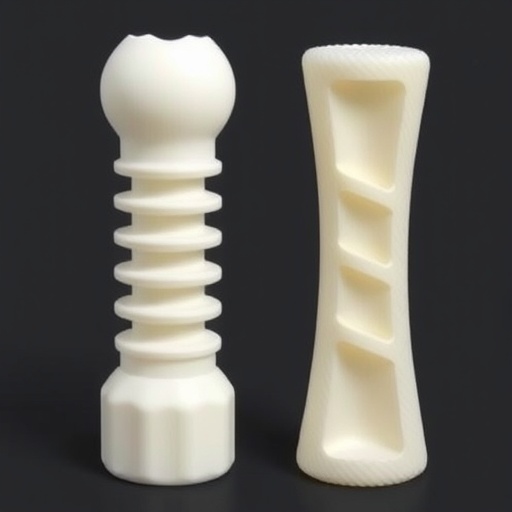
In the realm of medical engineering, the advancements in spinal implant technology are heralding a new era in treatment modalities for cervical disc degeneration. An innovative study authored by Hsieh, MK., Kao, FC., Li, YD., et al., has put forth a rigorous examination contrasting an additive manufacturing lattice-structured PEEK implant against a traditional ball-and-socket design for cervical total disc replacement. Through the utilization of finite element analysis (FEA), the researchers have provided invaluable insights that promise to significantly impact orthopedic practices in the future.
The study addresses a critical need in spine surgery: the development of implants that not only provide mechanical stability but also integrate seamlessly with biological tissue. The traditional ball-and-socket designs have long been a staple in total disc replacement procedures, but their limitations in terms of biomechanical performance and adaptability have spurred researchers to explore novel structural designs. The advent of additive manufacturing, particularly using Polyether Ether Ketone (PEEK) — a polymer noted for its favorable mechanical and biological properties — presents new possibilities for implant design.
Employing advanced finite element modeling, the researchers meticulously simulated the mechanical behaviors of both the lattice-structured PEEK implant and the conventional ball-and-socket design under various physiological loading conditions. The findings from these simulations reveal stark differences in performance. The lattice-structured implant, designed with a porous architecture, demonstrated superior stress distribution and load-bearing capabilities, reducing the risk of implant subsidence, a common complication associated with traditional designs.
A key aspect of the study revolves around the necessity for implants that encourage osseointegration, promoting the growth of bone into the implant structure, thereby ensuring stability and longevity. The lattice-structured design, thanks to its porous nature, appears to be a game-changer. The intricate architecture not only mimics the natural structure of bone but also facilitates the ingress of bone cells, enhancing the bonding process between the implant and the vertebrae. This superior integration is pivotal for long-term success in cervical disc replacements.
Moreover, the thermal and mechanical properties of PEEK make it exceptionally suitable for spinal implants. Unlike metals that may induce stress shielding and vary in thermal expansion coefficients from surrounding bone, PEEK closely resembles the elastic properties of natural bone. This compatibility minimizes the risk of complications and improves patient outcomes. The lattice structure further enhances this compatibility by providing pathways for nutrient flow and vascularization, vital for effective spinal fusion.
Cost-effectiveness is another significant advantage presented by the additive manufacturing process. Traditional implant manufacturing methods often incur high costs and lengthy lead times. The flexibility of additive manufacturing allows for rapid prototyping and customization based on patient-specific anatomy, making it an appealing option for healthcare providers striving to maximize efficiency without sacrificing quality.
The implications of this research extend beyond mechanical superiority; they venture into the domain of patient-centered care. A lighter and more adaptive implant design means that patients may experience reduced post-operative pain, shorter rehabilitation periods, and quicker returns to their normal daily activities. With an aging population increasingly affected by spinal disorders, the introduction of innovative materials and designs could substantially enhance quality of life for countless individuals.
The implications of this research stretch into future avenues for investigation. As the field of biomaterials continues to evolve, further studies will be necessary to evaluate the long-term biological responses to lattice-structured implants. The durability of these implants under chronic loading conditions over years remains to be fully explored. Investigating how they perform in diverse patient demographics with varying pathology will also be crucial.
In conclusion, the study conducted by Hsieh and colleagues provides compelling evidence for the advantages of employing a lattice-structured PEEK implant in cervical total disc replacement. Not only does the design promise enhanced biomechanical performance and compatibility with biological materials, but it paves the way for future innovations in spinal surgery. As these technologies advance further, patients stand to benefit immensely from improved surgical outcomes, reshaping the landscape of orthopedic surgery for the better.
The introduction of this new implant design is more than a mere academic exercise; it is poised to become a crucial element in the ongoing evolution of spinal care. As researchers continue to explore the depths of biomaterials and advanced manufacturing techniques, the potential for transforming lives grows increasingly tangible. This study is a testament to the relentless pursuit of excellence in medical science, underscoring the importance of innovation in improving patient health outcomes.
As the medical community eagerly awaits clinical trials and real-world applications of this promising implant design, the groundwork has been firmly laid for a future where spinal treatments not only emphasize effectiveness but also prioritize patient well-being. The study’s findings foreshadow a shift towards more personalized, efficient, and effective surgical options in spinal care, which could ultimately pave the way for enhanced healthcare systems worldwide.
Subject of Research: Additive Manufacturing Lattice-Structured PEEK Implant vs. Commercial Ball-and-Socket Design for Cervical Total Disc Replacement
Article Title: A Finite Element Analysis Comparing an Additive Manufacturing Lattice-Structured PEEK Implant to a Commercial Ball-and-Socket Design for Cervical Total Disc Replacement
Article References:
Hsieh, MK., Kao, FC., Li, YD. et al. A Finite Element Analysis Comparing an Additive Manufacturing Lattice-Structured PEEK Implant to a Commercial Ball-and-Socket Design for Cervical Total Disc Replacement.
J. Med. Biol. Eng. 45, 112–126 (2025). https://doi.org/10.1007/s40846-024-00925-0
Image Credits: AI Generated
DOI: 10.1007/s40846-024-00925-0
Keywords: Cervical Total Disc Replacement, PEEK Implant, Additive Manufacturing, Lattice Structure, Finite Element Analysis.
Tags: 3D-printed orthopedic devicesadditive manufacturing in medicineadvancements in cervical disc degeneration treatmentbiomechanical performance of implantscervical total disc replacementfinite element analysis in implantsinnovative spinal implant technologyintegrating implants with biological tissuemechanical stability of spinal implantsnovel implant structural designsPEEK spinal implantstraditional ball-and-socket designs