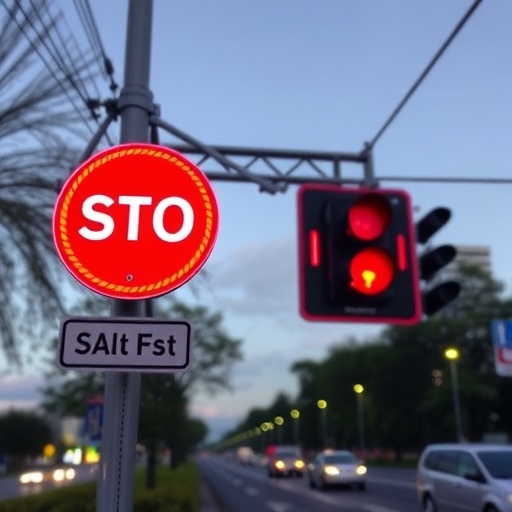
In a groundbreaking study that pushes the boundaries of artificial intelligence applications in real-world scenarios, a trio of researchers — Chencong, J., Defang, C., and Likang, B. — has developed a pioneering approach to the intelligent recognition of traffic sign images utilizing visual communication technology. This innovative project aims to enhance the efficiency and safety of vehicular navigation systems by enabling machines to interpret and respond to traffic signs as efficiently as humans. The implications of this research are vast, impacting not only automotive design but also urban planning and infrastructure development.
Traffic signs serve as vital communication tools on our roads, relaying critical information to drivers about rules, warnings, and guidance. As urban areas continue to expand, the pressure to enhance road safety and efficiency grows increasingly urgent. By leveraging advanced visual communication technology integrated with artificial intelligence, the research team seeks to create a system capable of recognizing and interpreting traffic signs with remarkable accuracy. This could lead to safer, more reliable autonomous vehicles and significantly reduce the risk of accidents caused by human error.
The researchers employed cutting-edge technology to tackle the complex problem of traffic sign recognition, which requires not only identifying various symbols and indications but also understanding contextual cues that inform their significance. Traditional methods of traffic sign recognition often struggled with variations due to weather conditions, lighting changes, and sign obstructions. However, by implementing sophisticated algorithms and machine learning techniques, the team significantly improved recognition rates even in challenging conditions.
Central to their approach was the use of convolutional neural networks (CNNs), a deep learning algorithm particularly effective in image analysis. By training these networks on extensive datasets encompassing various traffic signs from different angles, conditions, and contexts, the researchers created an AI capable of distinguishing between subtle variations. The result is a system that does not merely recognize images but understands them in a manner similar to human cognition.
The potential applications of this technology extend beyond just autonomous vehicles. For example, it could be employed in smart city infrastructure, where connected traffic signs communicate directly with vehicles. This real-time interaction could streamline traffic flow and reduce congestion by adjusting signals based on current traffic conditions. The idea of a fully integrated traffic management system utilizing autonomous recognition of signs could revolutionize how we think about city planning and vehicular design.
Furthermore, this technology could play a crucial role in enhancing the capabilities of driver-assistance systems (ADAS). By ensuring that vehicles are always aware of their surroundings and can accurately interpret traffic signage, the likelihood of accidents caused by misinterpretation of signals can be significantly diminished. As the automotive industry moves toward more autonomous features, integrating intelligent recognition systems will be fundamental for creating a safer driving environment.
The researchers also highlighted the importance of incorporating robust safety measures into the technology. They are aware that while AI can significantly enhance recognition accuracy, complacency should not arise from an overreliance on technology. Therefore, developing algorithms that can predict and interpret human behavior in relation to traffic signs remains a key area of study. This dual approach enhances both vehicle autonomy and pedestrian safety, ensuring that the overarching goal of reducing traffic-related injuries remains at the forefront.
One of the challenges faced during the research was the disparity in traffic sign designs across different countries. The researchers tackled this by developing a comprehensive international database of traffic signs to train their models effectively. This not only broadened the scope of their application but also ensured that the technology could adapt to various cultural contexts, thereby enhancing global road safety.
As conservative estimates suggest that road traffic injuries claim over a million lives each year, the need for improved traffic sign recognition is more critical than ever. This research represents a significant stride toward curbing accidents and fostering safer roads. With potential deployment timelines suggesting integration into future vehicle models by the latter half of the decade, excitement is mounting within the technology and automotive sectors.
Moreover, this advancement in visual communication technology aligns with global movements towards environmental sustainability and smarter city designs. Innovations that enhance safety while promoting efficiency dovetail with broader goals of reducing carbon emissions through more effective traffic management. By making roads smarter and vehicles more aware, we are taking critical steps toward a future where transportation is not just safer but also more sustainable.
The researchers have also expressed their vision to collaborate with automotive manufacturers, tech companies, and city planners to further refine and implement their technology. Real-world testing will be essential for evolving the algorithms and ensuring their reliability under diverse conditions. Collaborative efforts will amplify the potential impact, facilitating widespread adoption of these systems within a few years.
Ultimately, the implications of this research extend far beyond technological innovation; it embodies a shift in how society can approach road safety and urban living. As we position ourselves for a future increasingly intertwined with AI, endeavors such as these represent a beacon of hope, illuminating paths toward reduced fatalities and improved quality of life. The integration of intelligent systems in everyday infrastructure signifies not merely an upgrade in technology, but a foundational shift towards a safer, more informed society.
Chencong, J., Defang, C., and Likang, B.’s findings herald a new epoch in visual communication technology and artificial intelligence. Through their rigorous research and unwavering ambition, they offer a glimpse into a world where machines can emote and respond intelligently to our environments, paving the way for smarter, safer roads globally. As we progress into an era dominated by AI, the intersection of technology and human safety will undoubtedly continue to evolve, creating an intriguing frontier for future research and development.
Subject of Research: Intelligent recognition of traffic sign images based on visual communication technology.
Article Title: Intelligent recognition of traffic sign images based on visual communication technology.
Article References:
Chencong, J., Defang, C. & Likang, B. Intelligent recognition of traffic sign images based on visual communication technology.
Discov Artif Intell (2025). https://doi.org/10.1007/s44163-025-00581-6
Image Credits: AI Generated
DOI:
Keywords: Traffic sign recognition, visual communication technology, artificial intelligence, convolutional neural networks, autonomous vehicles, driver-assistance systems, smart cities, urban planning, road safety, machine learning.
Tags: artificial intelligence in transportationautonomous vehicle safety improvementscritical information communication on roadsenhancing vehicular navigation systemsinnovative research in transportation systemsmachine learning for traffic sign recognitionreducing accidents through technologysmart traffic sign recognitiontechnology-driven road safety solutionstraffic sign interpretation using AIurban planning and infrastructure developmentvisual communication technology in vehicles