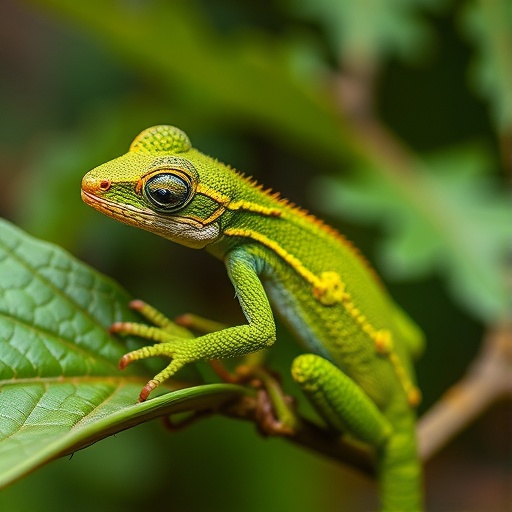
In a groundbreaking study published in Frontiers in Zoology, researchers led by Price et al. delve into the intricate relationship between thermoregulation and physiological color change in Anolis carolinensis, commonly known as the green anole. This comprehensive investigation leverages large-scale community science data alongside advanced computer vision technology to explore the adaptive significance of color change as a mechanism for temperature regulation in this fascinating species. The findings promise to reshape our understanding of how reptiles interact with their environments, particularly in relation to climate variability.
The study examines the color change phenomenon exhibited by Anolis carolinensis, which can shift from vibrant green to a muted brown under different environmental conditions. This ability is not merely aesthetic; rather, it serves an important physiological function. The researchers propose that this color change is an adaptive strategy to regulate body temperature, enhancing survival rates in varying thermal conditions. By understanding the mechanisms behind this adaptive behavior, this research contributes to the broader understanding of reptilian thermoregulation and its implications for climate resilience.
To carry out this ambitious project, the team utilized a robust framework of community science, encouraging citizen scientists to contribute data on Anolis carolinensis sightings and their associated environmental variables. This participatory approach not only enriched the dataset but also fostered a sense of involvement among the public, highlighting the vital role that citizen science can play in ecological research. The data collected from diverse geographic locations allowed for a nuanced analysis of the factors influencing color change in varying thermal landscapes.
Central to this study is the innovative application of computer vision technology, which facilitated an unprecedented level of analysis. By employing machine learning algorithms, the researchers were able to quantify color variations with remarkable precision. This technological integration represents a significant leap forward in herpetological research, providing insights that were previously difficult, if not impossible, to obtain through conventional observational methods. The ability to analyze color dynamics in real-time enables researchers to correlate environmental temperatures with color states, granting them deeper insights into thermal regulation strategies.
The consequences of this research extend beyond the immediate findings. Understanding the physiological mechanisms behind color change and thermoregulation has far-reaching implications for the conservation of reptile species in an era marked by rapid climate change. As habitats transform due to increasing temperatures, understanding how species like Anolis carolinensis adapt is critical for developing effective conservation strategies. This study underscores the importance of adaptive traits in enhancing survival, suggesting that species exhibiting robust thermoregulatory abilities may have a better chance of thriving in changing environments.
Moreover, the research highlights the need for interdisciplinary collaboration in ecological studies. By combining ecological expertise with advanced technological solutions, the researchers were able to address complex questions regarding adaptive behaviors and physiological responses. This integrative approach sets a precedent for future studies, encouraging scientists from various fields to work together in unraveling the complexities of species interactions with their ecosystems and the overarching influence of climate change.
The implications of this research are bolstered by its relevance to current global challenges. As climate change continues to exert pressure on biodiversity, understanding the adaptive capabilities of species is more critical than ever. The study of Anolis carolinensis serves as a case study in broader ecological resilience, providing a model for examining other species that inhabit ecosystems undergoing similar stresses. The integration of community science also highlights the potential for crowd-sourced data to inform scientific inquiry, paving the way for more inclusive approaches to environmental research.
In contextualizing the findings within a larger ecological framework, the researchers emphasize the interconnectedness of species and their environments. The ability of Anolis carolinensis to modify its coloration not only affects its thermal regulation but also influences interactions with other species, including predators and competitors. This multifaceted relationship exemplifies the complexity of ecological systems and the cascading effects that can arise from individual behaviors.
In conclusion, Price et al.’s study offers a compelling narrative on the interplay between technology, community involvement, and ecological understanding. The combination of large-scale community science data and cutting-edge computer vision has yielded invaluable insights into the adaptive strategies of Anolis carolinensis. As the scientific community continues to grapple with the impacts of climate change, research like this provides hope that understanding the adaptive capacities of species can lead to more effective strategies for conservation and biodiversity preservation.
The research further provokes questions about the future of reptiles in an anthropogenically altered world. Researchers are now tasked with exploring how these findings can be applied to other species and ecological contexts, shedding light on universal patterns of adaptation and resilience. This study serves as a clarion call for the scientific community and the public alike to embrace innovation and collaboration in the pursuit of understanding our planet’s biological richness and fragility.
Through highlighting the crucial link between thermoregulation and physiological adaptation, this study sets a compelling agenda for future research. Experts are encouraged to explore similar adaptive traits across various organisms, potentially shedding light on evolutionary trajectories influenced by environmental changes. The implications of these findings extend far beyond academic circles, reaching into the realms of conservation policy and public awareness, reminding us of the intricate balance between species and their habitats in an era of unprecedented change.
Understanding the adaptive mechanisms of color change in Anolis carolinensis amplifies the urgency of addressing climate change impacts on wildlife. As researchers continue to unearth the complexities of color adaptation, the story of the green anole is emblematic of broader ecological narratives that underscore the importance of maintaining biodiversity. The knowledge gleaned from these studies not only enriches scientific discourse but also serves as a catalyst for action in the conservation community, ensuring that we are equipped to protect these remarkable species and their habitats for future generations.
Subject of Research: Physiological color change and thermoregulation in Anolis carolinensis.
Article Title: Using large-scale community science data and computer vision to evaluate thermoregulation as an adaptive driver of physiological color change in Anolis carolinensis.
Article References:
Price, S., Guralnick, R., Sheehy, C.M. et al. Using large-scale community science data and computer vision to evaluate thermoregulation as an adaptive driver of physiological color change in Anolis carolinensis.
Front Zool 22, 31 (2025). https://doi.org/10.1186/s12983-025-00580-4
Image Credits: AI Generated
DOI: https://doi.org/10.1186/s12983-025-00580-4
Keywords: Anolis carolinensis, thermoregulation, color change, community science, computer vision, climate change, physiology, biodiversity, conservation.
Tags: adaptive significance of color changeAnolis carolinensis color changecitizen science and ecologyclimate variability and reptilescommunity science in reptile studiescomputer vision in ecological researchcontributions of citizen scientists to researchgreen anole environmental adaptationphysiological mechanisms in reptilesreptilian survival strategiesstudying color change in animalsthermoregulation in reptiles