• HOME
  • NEWS
  • EXPLORE
    • CAREER
      • Companies
      • Jobs
    • EVENTS
    • iGEM
      • News
      • Team
    • PHOTOS
    • VIDEO
    • WIKI
  • BLOG
  • COMMUNITY
    • FACEBOOK
    • INSTAGRAM
    • TWITTER
Saturday, February 7, 2026
BIOENGINEER.ORG
No Result
View All Result
  • Login
  • HOME
  • NEWS
  • EXPLORE
    • CAREER
      • Companies
      • Jobs
        • Lecturer
        • PhD Studentship
        • Postdoc
        • Research Assistant
    • EVENTS
    • iGEM
      • News
      • Team
    • PHOTOS
    • VIDEO
    • WIKI
  • BLOG
  • COMMUNITY
    • FACEBOOK
    • INSTAGRAM
    • TWITTER
  • HOME
  • NEWS
  • EXPLORE
    • CAREER
      • Companies
      • Jobs
        • Lecturer
        • PhD Studentship
        • Postdoc
        • Research Assistant
    • EVENTS
    • iGEM
      • News
      • Team
    • PHOTOS
    • VIDEO
    • WIKI
  • BLOG
  • COMMUNITY
    • FACEBOOK
    • INSTAGRAM
    • TWITTER
No Result
View All Result
Bioengineer.org
No Result
View All Result
Home NEWS Science News

Potential for Saudi Arabian coral reefs to shine

Bioengineer by Bioengineer
May 2, 2017
in Science News
Reading Time: 2 mins read
0
Share on FacebookShare on TwitterShare on LinkedinShare on RedditShare on Telegram
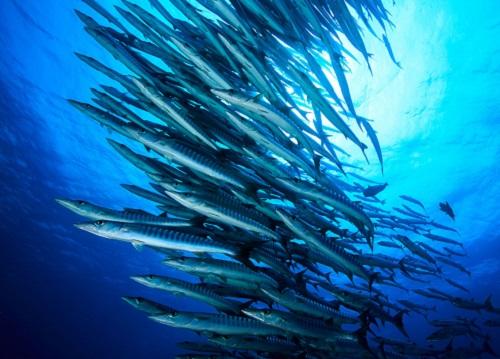
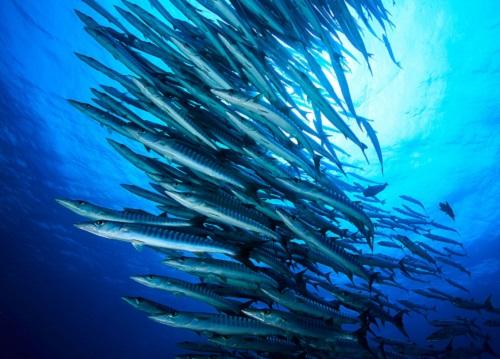
IMAGE

Credit: © 2017 Tane Sinclair-Taylor

Marine surveys estimating fish population density and diversity are crucial to our understanding of how human activities impact coral reef ecosystems and to our ability to make informed management plans for sustainability. KAUST researchers recently conducted the first baseline surveys of reefs in the southern Red Sea by comparing reefs off the coast of Saudi Arabia with those of Sudan1.

"A major issue is that there is no established historical record for Red Sea ecosystems," said Dr. Darren Coker, who worked on the project with KAUST M.Sc. Alumnus Alexander Kattan and Professor Michael Berumen all of the University's Red Sea Research Center. "This means we can only hypothesize what the natural reef environment would have looked like before human interference through fishing began."

Berumen's team systematically compared 14 Saudi reefs with 16 offshore reefs in Sudan. The reefs are around 200-300 Km apart and share almost identical environmental conditions in terms of sea temperature, climate and coral species. However, Saudi Arabia has a long-established history of fishing, while Sudan does not.

"There is much more to the story than just the numbers of fish we see," said Berumen. "We collected and analyzed data between and within regions to look at fish abundance, biomass and community diversity across all the reefs surveyed."

"To minimize potential bias, I conducted all the survey dives myself," said Kattan, who trained intensively to ensure he could correctly identify fish species and accurately estimate their size underwater. "A friend helped me practice in a pool by diving with different sizes and shapes of simulated fish on popsicle sticks! Because size estimates were converted into biomass, it was vital that I was able to gauge sizes correctly."

The team found that the biomass of top predators in the Sudanese reefs was almost three times that of the Saudi reefs. The top predators were far rarer in Saudi Arabian waters, a phenomenon that the researchers attribute to fishing pressures. Furthermore, fish abundance was around 62 % higher in Sudan and biomass was 20 % higher. There was also slightly greater diversity on the Sudanese reefs.

"This is the strongest evidence yet of the impact of fishing on Saudi Arabia's reefs," said Berumen. "While Saudi Arabia appears to have lost many larger fish, these species, including top predators, have not completely disappeared, so there is an opportunity to turn the situation around. Saudi's reefs could be restored to the condition of the almost pristine Sudanese reefs through careful management and protection, and they could one day thrive as eco-tourism sites."

###

Media Contact

Michelle D'Antoni
[email protected]

http://kaust.edu.sa/

############

Story Source: Materials provided by Scienmag

Share12Tweet8Share2ShareShareShare2

Related Posts

Digital Health Perspectives from Baltic Sea Experts

February 7, 2026
Florida Cane Toad: Complex Spread and Selective Evolution

Florida Cane Toad: Complex Spread and Selective Evolution

February 7, 2026

Exploring Decision-Making in Dementia Caregivers’ Mobility

February 7, 2026

Succinate Receptor 1 Limits Blood Cell Formation, Leukemia

February 7, 2026
Please login to join discussion

POPULAR NEWS

  • Robotic Ureteral Reconstruction: A Novel Approach

    Robotic Ureteral Reconstruction: A Novel Approach

    82 shares
    Share 33 Tweet 21
  • Digital Privacy: Health Data Control in Incarceration

    63 shares
    Share 25 Tweet 16
  • Study Reveals Lipid Accumulation in ME/CFS Cells

    57 shares
    Share 23 Tweet 14
  • Breakthrough in RNA Research Accelerates Medical Innovations Timeline

    53 shares
    Share 21 Tweet 13

About

We bring you the latest biotechnology news from best research centers and universities around the world. Check our website.

Follow us

Recent News

Digital Health Perspectives from Baltic Sea Experts

Florida Cane Toad: Complex Spread and Selective Evolution

Exploring Decision-Making in Dementia Caregivers’ Mobility

Subscribe to Blog via Email

Enter your email address to subscribe to this blog and receive notifications of new posts by email.

Join 73 other subscribers
  • Contact Us

Bioengineer.org © Copyright 2023 All Rights Reserved.

Welcome Back!

Login to your account below

Forgotten Password?

Retrieve your password

Please enter your username or email address to reset your password.

Log In
No Result
View All Result
  • Homepages
    • Home Page 1
    • Home Page 2
  • News
  • National
  • Business
  • Health
  • Lifestyle
  • Science

Bioengineer.org © Copyright 2023 All Rights Reserved.