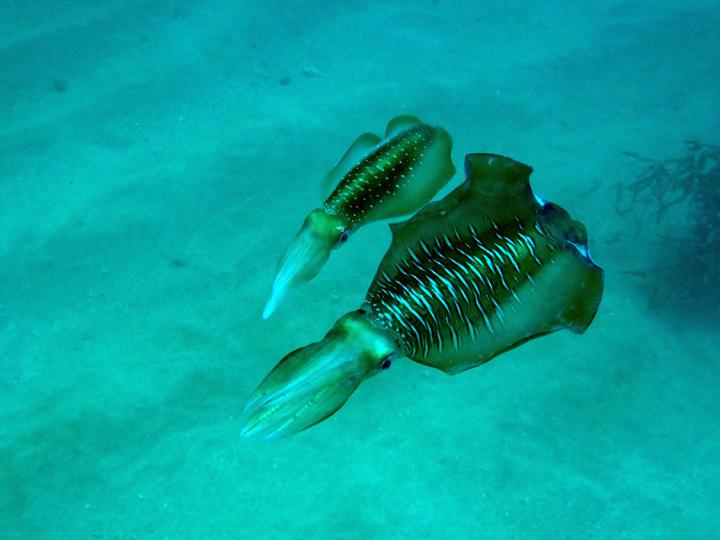
Credit: Photo by Mr. Chun-Yen Lin, Institute of Molecular Medicine, National Tsing Hua University, Hsinchu, Taiwan
William Shakespeare wrote with a quill, Helen Keller liked her typewriter, and the oval squid prefers to use its body, when it comes to expressing love. But unlike these famous authors, the romanticisms of Sepioteuthis lessoniana were unknown. Until now.
Recent research out of the National Tsing Hua University (Taiwan), and published in Frontiers in Ecology and Evolution, has finally deciphered the previously unknown symbols and shapes the oval squid decorates itself in, and how they are used.
The animals make use of naturally occurring chromatic components, which are stored within their bodies. They use these to paint their skin with lines, spots and stripes, of varying shades and complexities, to signal their desirability to future lovers and warn off potential foes. Researchers, led by Prof Chiao, took to the East China Sea, near the city of Taipei, to study the oval squid in the wild. Underwater they built an attractive home, made of bamboo branches and leaves, to provide the female oval squid a safe place to nest, lay their eggs, and provide shelter to hatchlings.
Over the course of three months scuba divers recorded the movements and displays of the gathering squid, looking for repeating patterns of tone change between mating partners. Amazingly they also observed the underwater show included elegant and specific movements that varied depending on the gender and social status.
For instance, should two males get into a fight over a possible partner, then they will swim around each other, vying for the higher position. The conclusion of this "dance" is when the winner literally ends up on top of the loser. He cements this victory with a strong visual display, broadcasting his success to all, including his future mate. The loser is not completely defeated however as he can still have a chance to fertilize some of the female's eggs, all be it outside of her egg laying period. In a rapid movement which the researchers termed "male-upturned mating", the squid will approach above her, flip himself upside down, place his sperm and scoot away, passing on his genes to the next generation.
Female oval squid are polyandrous, meaning that they will, during their egg laying period, take multiple males to be their mate. Like the fighting males, they too will use expressive patterns to determine possible partners. A dark pattern on her body indicates a rejection of the pursing male's advances.
In total, the researchers found five common behavior patterns with their own intricate movements and tone signals, and which are also dependent on an individual squid's standing in the group. This intricate language of patterns, movements and associated behaviors have been compiled into an "ethogram" (a dictionary of a species' communication methods) which will assist in future behavioral studies, not just in these expressive cephalopods, but in other species too.
In time, we may come to understand the exact meanings in the symbols the romantic oval squid adorns on its body. But until then, we will have to make do with the sonnets of Shakespeare to make our partner swoon.
###
Media Contact
Melissa Cochrane
[email protected]
0041-787-246-393
@frontiersin
http://www.frontiersin.org
############
Story Source: Materials provided by Scienmag