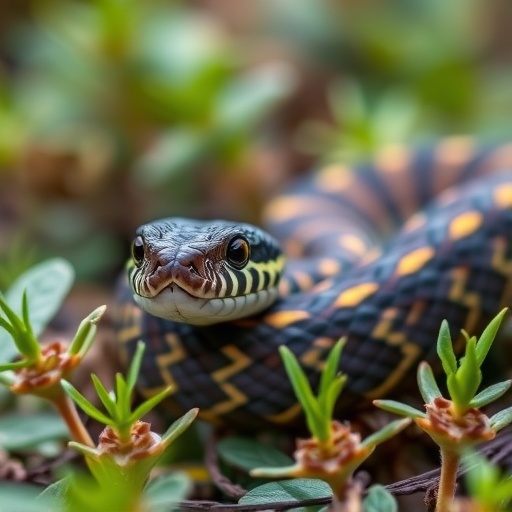
In a groundbreaking study published in “Frontiers in Zoology,” researchers have unveiled alarming evidence regarding the behavioral adaptations of grassland vipers (Vipera spp.) in response to climate change. This meticulously conducted research illustrates how rising temperatures are impacting the daily activities of these snakes, specifically focusing on their activity periods, which are critical for understanding their ecological roles and survival strategies.
The study, carried out by a team of experts led by Mizsei, E., Sos, T., and Móré, A., employs mechanistic modeling to assess how changing environmental conditions are compelling these reptiles to alter their active periods. As the planet is facing unprecedented climate shifts, the implications of such behavioral changes could have cascading effects on biodiversity and ecosystem stability. The researchers have effectively illustrated that as the climate warms, the typical patterns of grassland viper activity are beginning to shift, affecting both their feeding and reproductive behaviors.
The primary premise of the research is rooted in understanding the thermoregulatory behavior of grassland vipers. As ectothermic animals, these snakes rely heavily on external temperatures to regulate their metabolic processes. As such, any fluctuations in temperature can drastically alter their energy expenditure and hunting efficiency. This study emphasizes that in warmer climates, vipers might become increasingly active during unusual hours, often leading to heightened competition for resources and increased vulnerability to predators.
Furthermore, the authors highlight the role of seasonal changes that are becoming increasingly erratic due to climate change. The altering of seasons—coupled with new temperature regimes—results in mismatches between viper activities and their prey availability. This biological disconnect not only jeopardizes the snakes’ survival but could also disrupt the entire food web they inhabit. The team employs detailed models to simulate how vipers adjust their active times in correlation with temperature fluctuations, shedding light on the delicate balance between these serpents and their ecosystem.
As globalization exacerbates climate trends, the continued research into the behavioral ecology of species like Vipera spp. is more crucial than ever. The work illustrates that habitat destruction and climate change are intertwined issues, significantly affecting several facets of ecological systems. The study addresses the urgent need for conservation efforts tailored to the specific needs of affected species, including the implementation of measures that promote the preservation of their natural habitats.
The findings provoke significant questions regarding the adaptability of grassland vipers over time. If these snakes cannot adjust quickly enough to the rapid changes in their environments, they may face severe consequences, potentially leading to declines in their populations. This realization echoes a broader theme within wildlife studies; the faster we warm the planet, the less time many species have to adapt. Taking proactive steps to understand and mitigate these changes is fundamental to conservation strategies.
In light of this research, it becomes essential to consider the broader implications for biodiversity as a whole. Grassland vipers play a crucial ecological role, acting as both predators and prey within their habitat. Their decline could signal broader ecological shifts that might incite wild fluctuations in species populations, thereby impacting ecosystems at large. Understanding these dynamics opens the door for improved management strategies, allowing for targeted research and conservation ecosystems that are more endemic and resilient.
The mechanistic modeling approach taken in this study marks a significant advancement in our understanding of behavioral ecology, particularly in response to climate variables. By creating accurate simulations, the researchers offer invaluable insights into how future environmental changes might compel viper populations to evolve new strategies for survival. This dynamic exploration of behavior not only offsets existing scientific knowledge but also serves as a clarion call for immediate actions to mitigate climate impacts on vulnerable species.
This research is not just a scientific endeavor; it holds serious socio-political implications. It emphasizes the need for collaborative efforts between ecologists, policymakers, and the public to address the climate crisis in ways that promote biodiversity conservation. Furthermore, the study encourages the integration of scientific findings into public policy decisions, highlighting how ecological stability cannot be disconnected from social responsibility towards the environment.
As we navigate through substantial environmental challenges, it becomes increasingly apparent that studies like those conducted by Mizsei and colleagues are critical to not only understanding the intricacies of specific species but also the conservation of entire ecosystems under threat. The reflections of policymakers, conservationists, and scientists must converge to forge pathways that illuminate sustainable practices and raise awareness toward climate change’s multifaceted impacts.
In conclusion, the study stands as a pivotal contribution to the field of wildlife conservation amidst climate upheaval. By illuminating the behavioral shifts of grassland vipers due to rising temperatures, it reveals the urgent need for adaptive conservation strategies that align with the pace of climate change. As we move forward, research will play an instrumental role in shaping effective responses, fostering resilience in our planet’s delicate web of life.
Subject of Research: Activity Time of Grassland Vipers in Response to Climate Change
Article Title: Restriction times on the rise: mechanistic modelling of activity time of grassland vipers (Vipera spp.) in the face of climate change.
Article References:
Mizsei, E., Sos, T., Móré, A. et al. Restriction times on the rise: mechanistic modelling of activity time of grassland vipers (Vipera spp.) in the face of climate change.
Front Zool 22, 10 (2025). https://doi.org/10.1186/s12983-025-00564-4
Image Credits: AI Generated
DOI: https://doi.org/10.1186/s12983-025-00564-4
Keywords: Climate Change, Grassland Vipers, Behavioral Ecology, Mechanistic Modeling, Biodiversity Conservation
Tags: behavioral adaptations to climate shiftsbiodiversity and ecosystem stabilityclimate change impact on reptilesecological roles of grassland vipersectothermic animal adaptationsfeeding and reproductive changes in snakesgrassland viper behavior changesmechanistic modeling in ecologyrising temperatures and wildlifetemperature effects on snake metabolismthermoregulation in snakesviper activity patterns