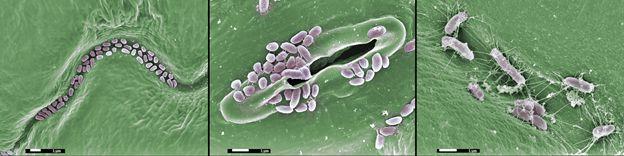
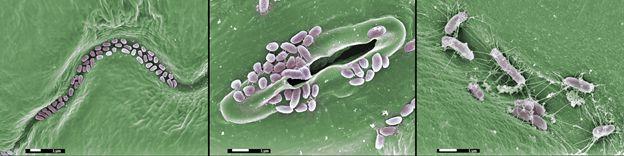
Credit: James Kremer
A coordinated effort to understand plant microbiomes could boost plant health and agricultural productivity, according to a perspective piece published March 28 in the open access journal PLOS Biology. The perspective is authored by Posy Busby of Oregon State University in Corvallis, and colleagues at eight other research institutions, including Colorado State University.
Like humans, plants live in intimate contact with microbes, including beneficial bacteria and fungi that enhance plant growth and disease resistance. While the importance of a few individual bacterial species, such as the nitrogen-fixing rhizobia of legumes, is widely understood, relatively little is known about the structure, function, and perturbations of the complex microbial communities that surround roots and dwell on leaves.
To help understand how beneficial microbes can be harnessed in sustainable agriculture, Busby and colleagues call for a plant microbiome project modeled after the recently completed Human Microbiome Project, which provides a reference set of human microbial genome sequences to develop new tools for analyzing those genomes. The plant microbiome effort will focus on understanding relationships that impact plant growth and could aid agricultural production, including efficiency of nutrient use, stress tolerance, and disease resistance. Although some work has been done, the authors note, "there has been no coordinated effort to consolidate and translate new ideas into practical solutions for farmers."
To that end, they propose a set of five broad research priorities:
- Develop model host microbiome systems for crop and non-crop plants. Multiple models are needed to span the range of crop plants, which include grains, vegetables, fruits, and economically important tree species. Tools for creating and working with these systems, and data derived from them, should be available in public databases.
- Define the "core microbiome," the set of organisms found in most samples of a particular set of plants, in order to identify relationships that should be prioritized for further study. Comparison of core microbiomes is likely to reveal further insights into both genetic and environmental influences on microbiome composition.
- Seek to understand the rules of microbiome assembly and resilience. As part of this goal, the authors recommend prioritizing research aimed at designing synthetic microbial communities that can successfully colonize plant organs and persist long enough in natural environments to benefit the host.
- Determine the functional mechanisms at work in agricultural microbiome interactions, to learn how these interactions promote nutrient exchange, drought tolerance, and other features of microbiome activity.
- Characterize the complex interactions among plant genotype, environmental factors, farm management strategies, and microbiome composition to learn how each influences the other. "The definition of a 'healthy' or 'beneficial' microbiome may depend on specific environmental challenges faced by the plant," the authors point out, or alternatively, there may be a "generic" microbiome whose composition promotes growth and health under a wide range of conditions.
"More so than ever before, the tools, technologies, and funding are now in place to tackle the fundamental questions in agricultural biome research," they conclude. Dr. Jan Leach of Colorado State University adds that "understanding how members of the microbiome interact with each other and with other components of the phytobiome, including living (plants, insects, etc.) and nonliving (temperature, moisture, wind, soil) factors will accelerate development of sustainable management practices, and will improve agricultural productivity."
###
Media Contact
Anne Manning
[email protected]
970-491-7099
@ColoStateNews
############
Story Source: Materials provided by Scienmag