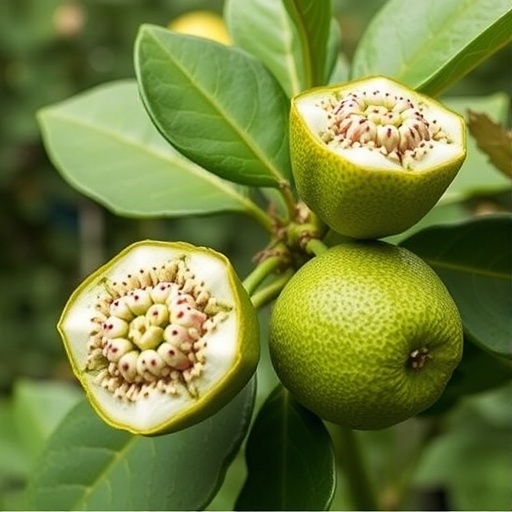
Guava plants, prized for their sweet fruits and nutritional value, have become a focal point for agricultural studies due to their susceptibility to various diseases. Among these, the complex interactions of the crown gall bacterium and root-knot nematodes present a significant challenge for farmers and researchers alike. Recent findings by Elsaedy and colleagues shed light on this complex disease dynamic that undermines guava cultivation, providing valuable insights into effective management strategies.
The crown gall bacterium, scientifically identified as Agrobacterium tumefaciens, is notorious for causing tumor-like growths on the roots and stems of various plants, including guavas. The disease typically manifests as galls, which are unsightly and detrimental to plant health, leading to reduced fruit yield and overall vigor. What makes this pathogen particularly insidious is its ability to transfer DNA into the host plant, disrupting normal cellular processes. Coupled with the presence of root-knot nematodes, specifically Meloidogyne spp., the situation becomes even more dire. These microscopic worms invade plant roots, forming galls and compromising nutrient uptake, further exacerbating the plant’s stress when already battling bacterial infection.
Research conducted by Elsaedy et al. delves into the pathogen interactions that typify this complex disease affecting guava plants. The study outlines how the concomitant presence of both the crown gall bacterium and root-knot nematodes leads to enhanced disease severity. The result is a cascading effect that diminishes plant health, thus impacting overall agricultural viability. Scientific inquiries into these interactions have revealed that the simultaneous stress on the plant reduces its ability to fend off pathogens, creating a vicious cycle that requires astute management strategies.
In an era where sustainable agriculture is paramount, the imperative for effective management of guava plant diseases cannot be overstated. Elsaedy and colleagues emphasize integrated pest management (IPM) as a critical framework for controlling these dual threats. By shifting away from reliance on chemical pesticides, IPM combines biological control, cultural practices, and resistant plant varieties to create a comprehensive approach that minimizes adverse environmental impacts. Utilizing biological control agents like beneficial nematodes and bacteria can enhance the plant’s resilience, actively promoting healthier soil ecosystems.
Moreover, the researchers highlight the importance of soil health in combating crown gall and root-knot nematodes. Healthy soil, rich in organic matter and beneficial microorganisms, inherently improves plant vigor and resistance to diseases. Implementing practices such as crop rotation, soil amendments, and appropriate irrigation strategies can significantly alleviate both pathogenic pressures. These methods create an environment less conducive for pathogen proliferation, allowing guavas to thrive.
Field experiments conducted by the research team provide robust data supporting their management recommendations. Comparative studies indicating the efficacy of various interventions offer insight into which strategies yield the best results. For instance, utilizing resistant guava cultivars coupled with specific soil amendments resulted in a noticeable reduction in disease incidence. This evidence-based approach empowers farmers with practical solutions compatible with their local agroecosystems.
The study further nuances the understanding of plant-pathogen interactions. Understanding the molecular mechanisms at play can reveal potential genetic targets for developing disease-resistant guava varieties. Genetic studies elucidating how Agrobacterium tumefaciens manipulates host plant pathways might advance breeding programs aimed at enhancing guava resilience against these diseases.
In the broader context of plant pathology, investigating the dynamics between crown gall bacteria and root-knot nematodes exemplifies a significant area of study that could resonate with other crops facing similar challenges. The findings from Elsaedy et al. may have implications for various agricultural sectors beyond guava, making the results relevant across diverse crop systems.
The ongoing research adds layers to the complexity of pathogen management in guava cultivation, urging continuous investigation into novel control measures. This emphasis on interdisciplinary approaches in plant health–combining molecular biology, agronomy, and environmental science–is crucial for developing resilient agricultural systems.
Furthermore, the impact of climate change on these diseases cannot be ignored. Environmental shifts can alter pathogen behavior and host susceptibility, reinforcing the need for adaptive management strategies. Seasonal variations influencing soil moisture levels, temperature, and biodiversity will likely affect the interactions between guava plants and their pathogens.
As this body of work continues to develop, the agricultural community can glean valuable lessons from Elsaedy et al.’s findings. Their exploration provides a roadmap toward mitigating the adverse impacts of crown gall and root-knot nematodes on guava plants. As challenges grow more complex in a changing world, the adoption of integrated strategies grounded in scientific research will remain essential.
In summary, the detailed characterizations of the crown gall bacterium and root-knot nematodes presented by Elsaedy and colleagues enrich our understanding of plant pathology’s multifaceted dimensions. Their insights are not only timely but also critical for enhancing guava plant resilience, reaffirming the necessity for ongoing research and innovative management techniques in the realm of sustainable agriculture.
As researchers continue to uncover the intricacies of these pathogens, the agricultural sector stands on the brink of significant advances that could redefine how we approach plant disease management. The quest for durable solutions is ongoing, and the compelling data emerging from studies like those of Elsaedy et al. exemplify the collaborative spirit essential for tackling these enduring challenges in plant health.
Subject of Research: Interactions of crown gall bacterium and root-knot nematodes affecting guava plants.
Article Title: Characterization and management of crown gall bacterium and root-knot nematode as a complex disease infecting guava plants.
Article References:
Elsaedy, M.A., Osman, K.A., Younis, A.M. et al. Characterization and management of crown gall bacterium and root-knot nematode as a complex disease infecting guava plants. Discov. Plants 2, 326 (2025). https://doi.org/10.1007/s44372-025-00419-6
Image Credits: AI Generated
DOI: https://doi.org/10.1007/s44372-025-00419-6
Keywords: Crown gall bacterium, root-knot nematodes, guava plants, integrated pest management, plant pathology, sustainable agriculture.
Tags: agricultural studies on guavaAgrobacterium tumefaciens disease dynamicscomplex plant pathogen interactionscrown gall disease effectseffective disease management in guavagall bacteria in guava plantsguava cultivation challengesMeloidogyne spp. impact on plantsnematode interactions with plantsnutritional value of guava fruitsplant pathogen management strategiesroot-knot nematodes in agriculture