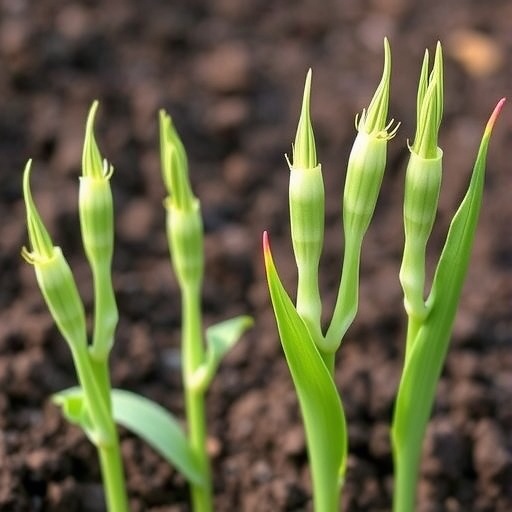
Salt stress poses a formidable barrier to agricultural productivity worldwide, exerting profound effects on crop growth, yield, and quality. As increasing soil salinization threatens arable land, the search for genetic solutions to enhance salt tolerance in crops has become a paramount objective in plant science and breeding. The challenge lies in the scarcity of salt-tolerant genes and the complexity of the physiological and molecular responses underpinning tolerance. In this urgent context, sorghum emerges as a robust model, exhibiting exceptional resilience to saline conditions. Understanding the genetic basis of sorghum’s salt tolerance mechanisms holds immense promise for the development of cultivars capable of thriving in high-salinity environments.
A groundbreaking study recently published in the Journal of Integrative Agriculture unveils critical insights into the genetic architecture of salt tolerance in sorghum seedlings. Conducted by an expert team from China, this research leveraged state-of-the-art genome-wide association study (GWAS) methodologies to dissect the genetic components associated with key root traits under salt stress. By resequencing 186 sorghum accessions, the scientists meticulously analyzed phenotypic variation in relative root length (RL) and root fresh weight (RFW)—two vital indicators of root system vigor and plant resilience in saline soils.
Through comprehensive GWAS mapping, the researchers pinpointed eight candidate genes localized within a specific genomic region co-associated with salt tolerance traits. Notably, the gene SbTEF1 attracted particular attention due to its functional annotation as a transcription elongation factor protein and its distinctive expression changes following salt exposure. Transcription elongation factors play crucial roles in regulating gene expression under stress conditions, making SbTEF1 a compelling candidate in modulating adaptive responses.
To further elucidate the functional significance of SbTEF1, the team performed extensive haplotype analysis coupled with gene cloning and linkage disequilibrium (LD) studies. Their work identified a presence-absence variation (PAV284) situated in the promoter region of SbTEF1. This promoter variant directly influences the gene’s expression under salt stress, thereby altering root growth dynamics and the overall salt tolerance phenotype in sorghum seedlings. Such regulatory variants are increasingly recognized as pivotal modulators of phenotypic plasticity in plants under abiotic stress.
The discovery of PAV284 as a regulatory element controlling SbTEF1 expression opens exciting avenues for precision breeding. By serving as a reliable genetic marker, PAV284 can facilitate marker-assisted selection (MAS) strategies aimed at introgressing salt tolerance alleles into commercial sorghum varieties. This molecular breeding approach promises to accelerate the development of salt-hardy cultivars, safeguarding crop yield stability amidst escalating soil salinity challenges.
Professor Yufei Zhou from Shenyang Agricultural University, the study’s corresponding author, highlights the transformative potential of this finding: “The identification of SbTEF1 and its promoter variation offers a tangible genetic target for breeding programs. Incorporating PAV284 into marker-assisted breeding pipelines will significantly enhance sorghum’s adaptability to saline environments, ensuring sustainable crop production.”
The implications of this research extend beyond sorghum alone, providing a valuable framework for understanding transcription elongation factors’ roles in plant abiotic stress responses more broadly. The methodology employed—a combination of resequencing diverse germplasm, GWAS, and functional genomics—exemplifies the integrative approach necessary to unravel complex traits like salt tolerance.
Moreover, the technical rigor of this study is underscored by its multifaceted analyses. The utilization of linkage disequilibrium mapping allowed for precise localization of genetic variants, while haplotype assessments shed light on the evolutionary dynamics of SbTEF1 alleles in natural sorghum populations. Functional validations via gene cloning further confirmed the causal relationship between PAV284 and salt-induced gene expression changes, cementing the gene’s role in adaptive tolerance.
The significance of root traits in salt tolerance cannot be overstated. Roots serve as the frontline interface with saline soils, mediating water and nutrient uptake under stress conditions. By focusing on relative root length and root fresh weight, the research elucidated how genetic variation impacts root system architecture and physiological performance, critical determinants of overall plant resilience.
This study aligns with global efforts to combat the detrimental effects of soil salinity on food security. Through unlocking the molecular secrets of sorghum’s salt tolerance, breeders and biotechnologists can now harness natural genetic diversity more effectively. The integration of precision genomics with traditional breeding methods accelerates the pathway toward climate-resilient crops tailored for challenging agroecosystems.
Looking ahead, further exploration of SbTEF1’s downstream targets and interaction networks will deepen understanding of the transcriptional reprogramming orchestrated during salt stress adaptation. Such research will inform synthetic biology approaches to engineer more robust stress response pathways, expanding possibilities for crop improvement across diverse species.
In summation, the identification of natural variation in the SbTEF1 gene and its regulatory promoter region provides a compelling genetic handle on salt tolerance in sorghum seedlings. This advancement exemplifies how cutting-edge genomic tools can unlock valuable traits embedded within crop germplasm, ultimately supporting resilient agricultural systems in an era of increasing environmental uncertainty.
Subject of Research: Cells
Article Title: Natural variation in SbTEF1 contributes to salt tolerance in sorghum seedlings
Web References:
https://doi.org/10.1016/j.jia.2024.03.030
Image Credits:
Credit: Liu C et al.
Keywords:
Agriculture, Bioinformatics, Cell biology, Plant sciences
Tags: breeding salt-tolerant cultivarscandidate genes for salt toleranceenhancing crop yield under salinitygenetic diversity in sorghumgenetic solutions for agricultural productivitygenome-wide association study in plantsmolecular responses to saline environmentsphenotypic variation in root lengthphysiological responses to salt stressresilience of sorghum to salinityroot traits under salt stresssalt tolerance mechanisms in crops