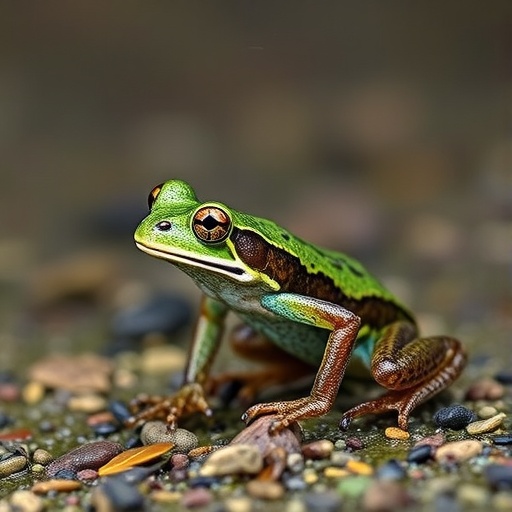
A groundbreaking discovery in the realm of entomology has recently emerged from the dense tropical rainforests of Uganda. Dr. Alvin Helden, a distinguished entomologist affiliated with Anglia Ruskin University in Cambridge, England, has identified seven previously unknown species within the genus Batracomorphus, a group of leafhoppers known for their unique frog-like appearance. This remarkable find not only expands the taxonomic breadth of this genus but also provides fresh insights into the biodiversity of tropical ecosystems, underscoring the importance of preserving these delicate habitats.
The genus Batracomorphus, whose name is derived from the Greek term meaning “frog-shaped,” comprises leafhoppers characterized by their predominantly green coloration, large, bulbous eyes, and the distinctive manner in which they hold their elongated hind legs folded tightly alongside their bodies, enabling powerful jumps akin to those of frogs. These morphological traits are not merely aesthetic; they play a crucial role in the survival strategies of these insects, aiding in camouflage within leafy environments and efficient locomotion to evade predators. Before this study, only 375 species of Batracomorphus had been documented worldwide, with a mere two species known from the United Kingdom, highlighting the relative scarcity of records from specific regions, especially Africa.
Dr. Helden’s fieldwork was conducted in Uganda’s Kibale National Park, a high-altitude rainforest ecosystem exceeding 1,500 meters in elevation. The seven new species were collected using sophisticated light-trapping techniques, a method that capitalizes on nocturnal insect phototaxis to attract specimens for study. This method is particularly effective in underscoring insect diversity in forest strata often difficult to sample. The high-altitude setting of Kibale offers unique environmental conditions that foster distinct biological communities, making this discovery significant for understanding species distribution along elevation gradients in tropical forests.
Taxonomic classification in the case of Batracomorphus is an understatedly complex endeavor due to pronounced morphological similarities among species. The primary challenge for Dr. Helden was to conclusively establish the novelty of each species identified. Leafhoppers in this genus exhibit cryptic external morphology, meaning traditional visual markers are insufficient for species differentiation. The definitive tool for species distinction lies in the detailed examination of male genital structures. These structures exhibit highly species-specific shapes and configurations, a phenomenon arising from the “lock and key” mechanism of reproduction which ensures reproductive isolation and prevents interspecies hybridization.
This reproductive specificity is a marvel of evolutionary biology. The male’s genitalia serve as the “key,” designed to fit exclusively with the female’s complementary genital “lock,” crafted from chitin—the same robust material constituting their protective exoskeleton. This structural compatibility is an effective reproductive barrier, maintaining genetic integrity among species by preventing the production of hybrid offspring. Such intricate biophysical adaptations have profound implications for the stability and evolution of species within the Cicadellidae family.
The publication of these findings in the peer-reviewed journal Zootaxa marks the first documentation of new Batracomorphus species in Africa since 1981, signaling a resurgence of interest and research in this overlooked group. Dr. Helden’s meticulous work has not only filled pivotal gaps in the taxonomic record but has also provided a benchmark for future ecological and evolutionary studies in the region. Leafhoppers, despite their relatively small size and inconspicuous nature, form a vital component of trophic networks, acting as herbivorous agents and as prey for a spectrum of avian and insectivorous predators.
Beyond their ecological roles, leafhoppers are indicators of environmental health. Their presence and diversity can signify well-functioning ecosystems, particularly in tropical rainforests where rich biodiversity supports complex ecological interactions. Dr. Helden emphasized that while some leafhopper species are agricultural pests linked to economically important crops like maize and rice, the majority are benign and integral to sustaining ecological balance in their natural habitats. Their study contributes to a broader understanding of ecosystem dynamics, biodiversity preservation, and the impact of climate and environmental changes on species distribution.
The journey to unearthing these seven new species was fraught with challenges intrinsic to tropical fieldwork, including enduring intense heat, humidity, and the physical demands associated with sampling in difficult terrain. Despite these adversities, the satisfaction derived from discovering species hitherto unknown to science is immeasurable for researchers like Dr. Helden. This discovery carries a sense of personal resonance as well, as reflected in the naming of one species, Batracomorphus ruthae, a tribute to his late mother, Ruth. She was a scientist herself, whose nurturing encouragement and provision of a first microscope kindled Dr. Helden’s lifelong passion for scientific inquiry.
The act of naming this species in honor of a beloved family member transcends scientific taxonomy; it reminds us that scientific pursuits are profoundly human endeavors, intertwined with personal histories and narratives. In a broader context, such naming conventions contribute to the rich tapestry of biological nomenclature, linking human culture with natural history in enduring ways.
The discovery of these new leafhopper species attests to the continuing necessity of biodiversity inventories, particularly in understudied tropical ecosystems that harbor vast unknowns awaiting exploration. It highlights the indispensable role of taxonomists and field biologists in documenting life on Earth, a task becoming ever more urgent amid accelerating rates of habitat loss and global environmental change. Dr. Helden’s work exemplifies this mission, combining rigorous scientific methodology with passionate conservation commitment.
In sum, this discovery advances not only the taxonomic and ecological knowledge of a fascinating insect group but also reinforces the intrinsic value of biodiversity as a resource for science and conservation. It invites renewed focus on the lesser-known denizens of tropical forests, urging support for comprehensive research efforts to unveil the myriad forms of life that inhabit our planet’s most diverse ecosystems.
Subject of Research: Leafhoppers of the genus Batracomorphus, including descriptions of seven new species discovered in Kibale National Park, Uganda.
Article Title: Leafhoppers of the genus Batracomorphus (Hemiptera: Cicadellidae: Iassinae) of Kibale National Park, Uganda, with descriptions of seven new species.
News Publication Date: 13-Nov-2025
Image Credits: Photograph by Dr. Alvin Helden, Anglia Ruskin University
Keywords: Insects, Species, Biological nomenclature, Biological systematics, Animal taxonomies, Ecology, Ecosystems, Tropical ecosystems, Entomology, Animals, Wildlife, Africa
Tags: Batracomorphus genusbiodiversity in tropical ecosystemsconservation of tropical habitatsecological significance of insect diversityentomological fieldworkfrog-like insectsinsect camouflage adaptationsleafhopper entomologymorphological traits of leafhoppersnew species discoverytaxonomic classification of insectsUganda rainforest research