• HOME
  • NEWS
  • EXPLORE
    • CAREER
      • Companies
      • Jobs
    • EVENTS
    • iGEM
      • News
      • Team
    • PHOTOS
    • VIDEO
    • WIKI
  • BLOG
  • COMMUNITY
    • FACEBOOK
    • INSTAGRAM
    • TWITTER
Saturday, February 7, 2026
BIOENGINEER.ORG
No Result
View All Result
  • Login
  • HOME
  • NEWS
  • EXPLORE
    • CAREER
      • Companies
      • Jobs
        • Lecturer
        • PhD Studentship
        • Postdoc
        • Research Assistant
    • EVENTS
    • iGEM
      • News
      • Team
    • PHOTOS
    • VIDEO
    • WIKI
  • BLOG
  • COMMUNITY
    • FACEBOOK
    • INSTAGRAM
    • TWITTER
  • HOME
  • NEWS
  • EXPLORE
    • CAREER
      • Companies
      • Jobs
        • Lecturer
        • PhD Studentship
        • Postdoc
        • Research Assistant
    • EVENTS
    • iGEM
      • News
      • Team
    • PHOTOS
    • VIDEO
    • WIKI
  • BLOG
  • COMMUNITY
    • FACEBOOK
    • INSTAGRAM
    • TWITTER
No Result
View All Result
Bioengineer.org
No Result
View All Result
Home NEWS Science News

Researchers solve the century-old mystery of Blood Falls

Bioengineer by Bioengineer
April 25, 2017
in Science News
Reading Time: 2 mins read
0
Share on FacebookShare on TwitterShare on LinkedinShare on RedditShare on Telegram
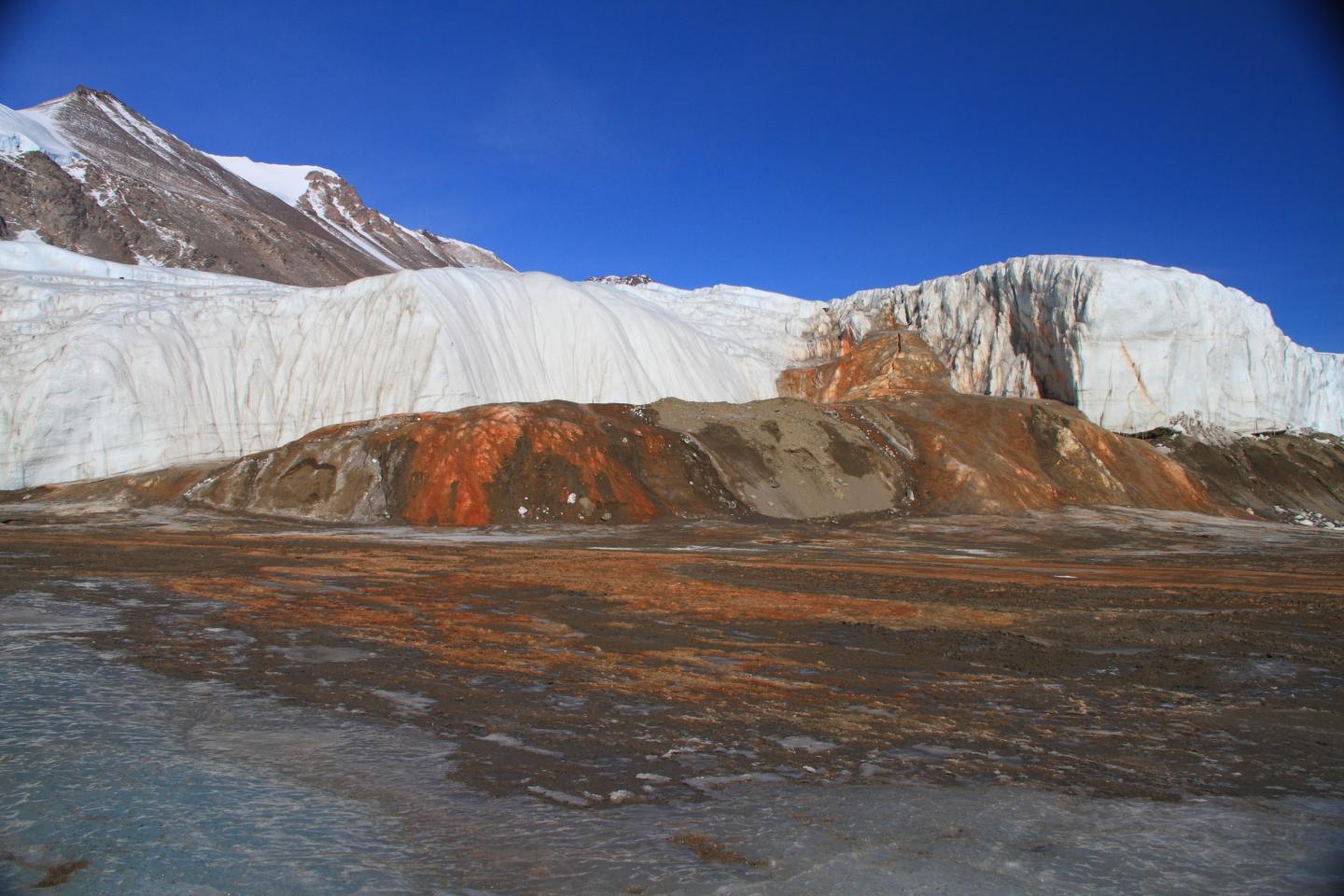
IMAGE

Credit: Photo by Erin Pettit

A research team led by the University of Alaska Fairbanks and Colorado College has solved a century-old mystery involving a famous red waterfall in Antarctica. New evidence links Blood Falls to a large source of salty water that may have been trapped under Taylor Glacier for more than 1 million years.

The team's study, published in the Journal of Glaciology, describes the brine's 300-foot path from beneath Taylor Glacier to the waterfall. This path has been a mystery since geoscientist Griffith Taylor discovered Blood Falls in 1911.

Lead author Jessica Badgeley, then an undergraduate student at Colorado College, worked with University of Alaska Fairbanks glaciologist Erin Pettit and her research team to understand this unique feature. They used a type of radar to detect the brine feeding Blood Falls.

"The salts in the brine made this discovery possible by amplifying contrast with the fresh glacier ice," Badgeley said.

Blood Falls is famous for its sporadic releases of iron-rich salty water. The brine turns red when the iron contacts air.

The team tracked the brine with radio-echo sounding, a radar method that uses two antenna — one to transmit electrical pulses and one to receive the signals.

"We moved the antennae around the glacier in grid-like patterns so that we could 'see' what was underneath us inside the ice, kind of like a bat uses echolocation to 'see' things around it," said co-author Christina Carr, a doctoral student at UAF.

Pettit said the researchers made another significant discovery – that liquid water can persist inside an extremely cold glacier. Scientists previously thought this was nearly impossible, but Pettit said the freezing process explains how water can flow in a cold glacier.

"While it sounds counterintuitive, water releases heat as it freezes, and that heat warms the surrounding colder ice," she said. The heat and the lower freezing temperature of salty water make liquid movement possible. "Taylor Glacier is now the coldest known glacier to have persistently flowing water."

Pettit said she enlisted Badgeley as an undergraduate student to help with the overall mission of understanding the hydrological plumbing of cold-based glaciers.

"Jessica's work is a perfect example of the high level of work undergraduate students can do when you give them a challenge and set the expectations high," she said.

###

The National Science Foundation sponsored the research.

ADDITIONAL CONTACT: Erin Pettit, [email protected]
ONLINE: "An Englacial Hydrologic System of Brine Within a Cold Glacier: Blood Falls, McMurdo Dry Valleys, Antarctica," Journal of Glaciology, April 24, 2017, http://bit.ly/2peicdz

Media Contact

Meghan Murphy
[email protected]
907-474-7541
@uafairbanks

http://www.uaf.edu

############

Story Source: Materials provided by Scienmag

Share12Tweet8Share2ShareShareShare2

Related Posts

Inflammasome Protein ASC Drives Pancreatic Cancer Metabolism

February 7, 2026

Phage-Antibiotic Combo Beats Resistant Peritoneal Infection

February 7, 2026

Boosting Remote Healthcare: Stepped-Wedge Trial Insights

February 7, 2026

Barriers and Boosters of Seniors’ Physical Activity in Karachi

February 7, 2026
Please login to join discussion

POPULAR NEWS

  • Robotic Ureteral Reconstruction: A Novel Approach

    Robotic Ureteral Reconstruction: A Novel Approach

    82 shares
    Share 33 Tweet 21
  • Digital Privacy: Health Data Control in Incarceration

    63 shares
    Share 25 Tweet 16
  • Study Reveals Lipid Accumulation in ME/CFS Cells

    57 shares
    Share 23 Tweet 14
  • Breakthrough in RNA Research Accelerates Medical Innovations Timeline

    53 shares
    Share 21 Tweet 13

About

We bring you the latest biotechnology news from best research centers and universities around the world. Check our website.

Follow us

Recent News

Inflammasome Protein ASC Drives Pancreatic Cancer Metabolism

Phage-Antibiotic Combo Beats Resistant Peritoneal Infection

Boosting Remote Healthcare: Stepped-Wedge Trial Insights

Subscribe to Blog via Email

Enter your email address to subscribe to this blog and receive notifications of new posts by email.

Join 73 other subscribers
  • Contact Us

Bioengineer.org © Copyright 2023 All Rights Reserved.

Welcome Back!

Login to your account below

Forgotten Password?

Retrieve your password

Please enter your username or email address to reset your password.

Log In
No Result
View All Result
  • Homepages
    • Home Page 1
    • Home Page 2
  • News
  • National
  • Business
  • Health
  • Lifestyle
  • Science

Bioengineer.org © Copyright 2023 All Rights Reserved.