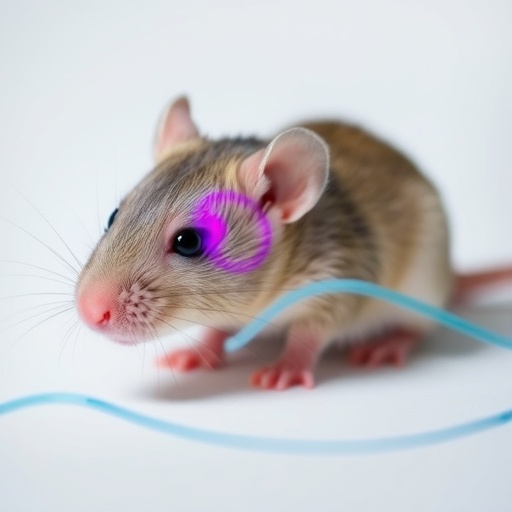
In a groundbreaking study published in the journal Biological Sex Differences, researchers Zhang, Ren, and Chen explored the intriguing influence of sex on spatial cognition as modulated by transcranial alternating current stimulation (tACS). This pioneering research highlights the importance of gender-specific considerations in neuroscience, particularly in understanding how brain stimulation techniques can lead to differential outcomes based on biological sex. The two frequencies employed in their study, 10 Hz and 40 Hz, are poised to provide insights into cognitive functions and may aid in the development of tailored therapeutic approaches.
Transcranial alternating current stimulation (tACS) is an innovative non-invasive brain stimulation technique that involves the application of a weak electrical current to stimulate neuronal activity. By transmitting alternating currents at specific frequencies, tACS can modulate brain oscillations associated with various cognitive processes. Researchers have increasingly recognized its potential for advancing our understanding of the neural underpinnings of cognition. However, until recently, the degree to which sex differences influence the effects of tACS on cognitive tasks remained largely unexplored, making this study all the more relevant.
Zhang and colleagues focused on spatial cognition, a complex and vital cognitive domain that underpins a range of everyday tasks from navigation to problem-solving. Understanding the neural mechanisms involved in spatial cognition is critical, especially considering that spatial abilities tend to differ between males and females in various species, including humans. By investigating how tACS affects these abilities in a mouse model—an established model for studying spatial cognition—the researchers aimed to uncover foundational insights that could be extrapolated to humans.
The researchers’ choice of frequencies—10 Hz and 40 Hz—stems from their established associations with different cognitive functions. Low-frequency stimulation, such as that at 10 Hz, is often linked to enhanced connectivity within specific neural networks involved in cognitive tasks. Conversely, higher frequencies like 40 Hz have been associated with functions such as attention and memory consolidation. This differential impact according to stimulation frequency served as a central theme in Zhang and colleagues’ research.
As part of their methodology, the team administered the tACS to male and female mice to ascertain how each sex responded to the respective frequencies. The experiments involved employing a variety of spatial cognition tasks, including maze navigation and object location tests, to assess cognitive performance post-stimulation. The results revealed striking differences in how male and female mice responded to the tACS at the two frequencies.
Interestingly, the findings indicated that female mice exhibited a marked improvement in spatial cognition when stimulated at 10 Hz, showcasing heightened navigation abilities compared to their baselines. On the other hand, male mice demonstrated superior performance with 40 Hz stimulation, suggesting that the cognitive improvement was frequency-dependent and influenced by the sex of the subjects. These results underscore the nuanced interplay between brain stimulation frequency, sex, and cognitive function.
The implications of this research extend beyond animals and offer profound insights into potential human applications. As researchers investigate the neurobiological basis of sex differences in cognition, the principles derived from this study could guide the design of future tACS applications for clinical populations—particularly in addressing cognitive deficits that may be more pronounced in one sex compared to the other.
Moreover, this pioneering research could contribute to a new wave of personalized medicine approaches in cognitive enhancement and rehabilitation. By taking into account sex-specific responses to brain stimulation techniques, clinicians may be able to optimize therapeutic strategies and maximize their efficacy in affected individuals. Such advancements could revolutionize treatments for conditions such as Alzheimer’s and other forms of dementia, where spatial cognition is often impaired.
As society pushes for a more inclusive understanding of cognitive neuroscience, studies like those conducted by Zhang and colleagues play a critical role in ensuring that research continues to evolve alongside our awareness of biological differences. The study emphasizes that a one-size-fits-all approach is inadequate when it comes to cognitive interventions that may be influenced by sex, and that acknowledging these differences can lead to more effective therapies.
The findings from this research call for further exploration into the mechanisms underlying sex differences in cognitive performance. Investigating how hormonal fluctuations and brain structure differences play a role could unlock additional layers of understanding. Future inquiries could also utilize advanced imaging techniques to elucidate the neural correlates of the enhanced performance observed in female mice at 10 Hz and male mice at 40 Hz.
By expanding the scope of research to include not only but also other frequencies of brain stimulation, scientists could uncover additional nuances regarding the optimization of cognitive performance across different contexts. Such insights would be invaluable for the field of neurophysiology and could inform next-generation stimulation protocols designed to cater to varying cognitive needs.
In conclusion, the study by Zhang, Ren, and Chen opens the door to a more comprehensive understanding of how sex influences cognitive processes and the effectiveness of brain stimulation techniques. As researchers build on these findings, we can anticipate exciting developments in both the theoretical and clinical realms of cognitive neuroscience. This multidisciplinary exploration of the intricate relationship between sex and cognition will likely pave the pathway for future interventions that enhance cognitive health for all individuals.
Subject of Research: Effects of transcranial alternating current stimulation on spatial cognition in mice, with a focus on sex differences.
Article Title: Sex differences in the effects of 10 Hz and 40 Hz transcranial alternating current stimulation on spatial cognition in mice.
Article References: Zhang, Y., Ren, P., Chen, Z. et al. Sex differences in the effects of 10 Hz and 40 Hz transcranial alternating current stimulation on spatial cognition in mice. Biol Sex Differ 16, 89 (2025). https://doi.org/10.1186/s13293-025-00778-5
Image Credits: AI Generated
DOI: https://doi.org/10.1186/s13293-025-00778-5
Keywords: transcranial alternating current stimulation, spatial cognition, sex differences, cognitive neuroscience, non-invasive brain stimulation.
Tags: biological sex and cognitive functioncognitive processes and brain oscillationsgender differences in neuroscienceinnovative research in brain stimulationneuronal activity modulation with tACSnon-invasive brain stimulation techniquessex-specific outcomes in cognitive tasksspatial cognition in micetACS frequency impact on braintailored therapeutic approaches in neurosciencetranscranial stimulation effects on cognitionunderstanding mouse cognition through tACS