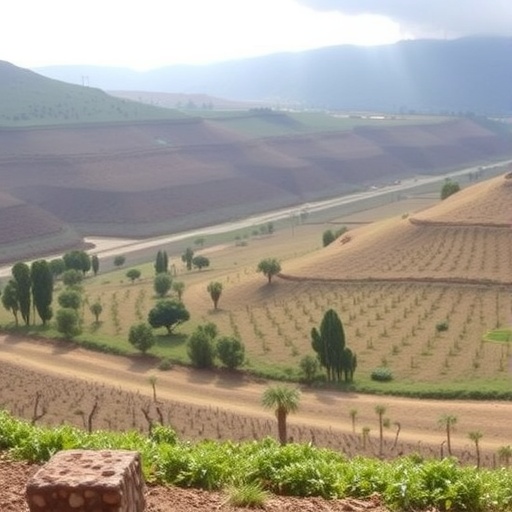
Drought has emerged as one of the most pressing environmental challenges facing regions around the globe, and the Abaya Chamo sub-basin in Ethiopia is no exception. In a recent study, researchers investigated the multifaceted impact of drought conditions in this area, unveiling critical insights into the severity and dynamics of droughts as they relate to agricultural productivity and water resource availability. Utilizing advanced indices such as the Standardized Precipitation-Evapotranspiration Index (SPEI), Stream flow Index (SSI), and Standardized Soil Moisture Index (SSMI), the study meticulously characterized the drought events that have plagued this vital region.
The findings shed light on significant drought intensity levels, with SPEI, SSI, and SSMI indicating extreme conditions at values of −2.5, −2.8, and −2.4, respectively. These numbers suggest a troubling trend—that the Abaya Chamo sub-basin is experiencing unprecedented drought stress affecting both soil moisture and streamflow, crucial indicators for agricultural viability. The Gelana catchment, in particular, recorded the highest average drought magnitude, registering an alarming average of −130 for SPEI-3 and −126 for SPEI-1. Such numerical values represent major deviations from normal, suggesting an urgent need for local stakeholders to act on these findings.
Drought occurrences were found to predominantly occur between March and September, a period that coincides with the crop growing season in the sub-basin. This temporal alignment indicates that the agricultural productivity of the region is gravely impacted as drought intensifies. In consequence, farmers in the Gelana catchment are facing significantly more severe conditions compared to those in the Bilate catchment. This disparity highlights the need for targeted drought management strategies tailored to the specific vulnerabilities of each catchment.
The implications of these findings cannot be overstated. For local farmers and policymakers alike, the study underscores the urgent requirement for adaptive water resource management techniques. Stronger, comprehensive drought risk management strategies are essential in ensuring the sustainability of agricultural practices and securing food resources for the region. Stakeholders are thus encouraged to channel investments into enhancing monitoring systems and early warning methods, which play a pivotal role in effective drought mitigation and response planning.
Moreover, researchers advocate for focused future studies that prioritize the collection of high-resolution spatial data. By doing so, it becomes feasible to conduct thorough spatial mapping and propagation analysis of various drought types across the sub-basin. The integration of geospatial tools will undoubtedly enrich the understanding of drought dynamics, not only within the Gelana catchment but also across the Abaya Chamo sub-basin. A finely-tuned approach to data collection and analysis can empower stakeholders, facilitating evidence-based decisions that are aimed at enhancing regional resilience against drought.
The critical findings also elevate discussions around agricultural practices in the face of changing climate conditions. As farmers grapple with fluctuating water availability, innovative solutions will be necessary to sustain crop yields. The urgency of proactive initiatives becomes evident as the agricultural landscape continues to evolve under the pressures of severe drought. Thus, strategic modifications in farming techniques, along with the implementation of water-saving measures, will be vital to mitigate drought impacts and secure the livelihoods of farmers in the region.
In addition, emphasizing the significance of community engagement is paramount. Local communities must be actively involved in the development of drought mitigation strategies. Their firsthand knowledge combined with scientific evidence can lead to more tailored and effective interventions. For instance, the introduction of drought-resistant crop varieties could be explored, warranting collaboration between agricultural scientists and farmers to optimize these solutions based on local conditions.
Furthermore, public awareness campaigns can serve as a powerful tool for educating communities on drought resilience strategies. Information dissemination about sustainable agricultural practices, coupled with the participatory approach, can enhance the adaptive capacities of local populations. Empowering individuals with knowledge fosters a culture of preparedness, enabling communities to respond more effectively to varying drought scenarios.
The economic ramifications of drought extend beyond immediate agricultural losses; they ripple through local communities and national economies. As drought conditions persist, it is essential for policymakers to forecast economic impacts and devise plans for sustainable investments. Diversifying local economies, particularly through integration with other sectors such as tourism or eco-friendly initiatives, can help cushion communities against the impacts of drought.
As the climate crisis continues to unfold, the necessity for interdisciplinary approaches within environmental research is clear. Understanding drought will require insights from meteorology, hydrology, agriculture, and socio-economics. Therefore, research initiatives must facilitate collaboration amongst various stakeholders including scientists, government agencies, and non-governmental organizations. Such partnerships can ensure that scientific findings translate into actionable policies and effective community programs.
Ultimately, the findings from the Abaya Chamo sub-basin study serve as a clarion call for immediate action. Drought is not a distant concern; it is a pressing issue that must be addressed through collaborative efforts, innovative practices, and informed policy-making. By fostering a deeper understanding of drought conditions and employing robust management strategies, the region can enhance its resilience against future climatic challenges. This will support not only the agricultural sector but also the overall well-being of communities that depend on these critical resources for survival.
As we move forward, the need for continuous research and adaptive management strategies must remain at the forefront. The evolving nature of climate patterns necessitates ongoing assessment and modification of approaches to ensure food security and water resource sustainability in Ethiopia’s Abaya Chamo sub-basin and beyond. The stakes are undeniably high, and the time for action is now.
Subject of Research: Drought assessment and management in Ethiopia’s Abaya Chamo sub-basin.
Article Title: Integrated assessment of meteorological, hydrological and agricultural drought in Abaya Chamo sub Basin, Ethiopia.
Article References:
Gillo, T.T., Kenea, T.T., Orke, Y.A. et al. Integrated assessment of meteorological, hydrological and agricultural drought in Abaya Chamo sub Basin, Ethiopia. Sci Rep 15, 38945 (2025). https://doi.org/10.1038/s41598-025-22809-2
Image Credits: AI Generated
DOI: https://doi.org/10.1038/s41598-025-22809-2
Keywords: drought, Ethiopia, water management, agriculture, climate change, Abaya Chamo sub-basin, SPI, SSMI, SSI, drought adaptation, sustainable practices.
Tags: Abaya Chamo sub-basin drought impactsagricultural productivity and droughtclimate change effects on Ethiopian agricultureDrought assessment in Ethiopiadrought intensity levels in Abaya ChamoGelana catchment drought magnituderegional drought management strategiesseasonal drought patterns in Ethiopiasoil moisture and streamflow indicatorsSPEI and drought severity analysisStandardized Precipitation Evapotranspiration Indexwater resource availability in Ethiopia