Credit: Center for Severe Weather Research/Robin Lorenson
From flowers' microscopic cells to thunderstorms called supercells, researchers funded by the National Science Foundation (NSF) are studying the science of spring. Now, in time for Earth Day, a new NSF special report — April Showers Bring…The Science of Spring — looks at what makes spring such a vibrant, and sometimes dangerous, season.
NSF supports studies of such diverse spring subjects as the bloom of plant plankton in the sea; how flowers get their eye-catching colors; and why fertilizer may be good for crops but not always the environment.
NSF also funds scientists whose research takes them into the hearts of tornadoes and through woodlands filled with Lyme disease-carrying ticks.
See Earth's 'greening' on land and in the sea
April showers bring May flowers, but how do their petals have such beautiful hues? To find out, scientists are peering into plants' genes to better understand basic biochemistry. The results are important for developing sustainable agriculture and new medicines from plants.
Just as crocus and daffodil blossoms signal the start of a warmer season on land, a similar greening event — a massive bloom of microscopic plants, or phytoplankton — happens in the sea.
Each spring, an Atlantic Ocean ritual unfolds. In what's known as the North Atlantic Bloom, countless microscopic phytoplankton burst into color from Bermuda to the Arctic, turning the sea green, then white as one species after another blooms. Phytoplankton form the base of the marine food web. Where and when phytoplankton blooms happen give scientists important clues about the health of the oceans, including economically important fisheries.
Explore spring's darker side: tornadoes and ticks
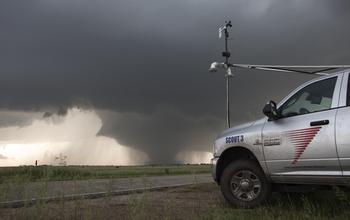
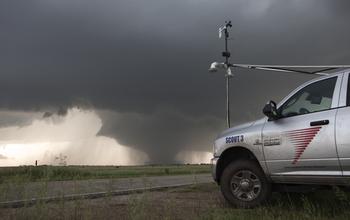
Spring also has a darker side. April showers bring thunderstorms with whipping winds that spin into tornadoes. Last May, severe thunderstorms were forecast for the southern part of Oklahoma. It was the "go" call for atmospheric scientists studying twisters during tornado season from May 1 through June 15. That's when two ingredients required for tornadoes — very unstable air and strong vertical wind shear — are most common.
NSF-funded researchers are developing 3-D maps of the strongest tornado winds near the ground and studying how these winds cause damage to buildings, power lines, trees and anything else in their way.
The dangers of spring also lurk below carpets of woodland wildflowers, where ticks carrying Lyme disease may hide.
Following the discovery of Lyme disease in the 1980s, scientists identified new tick-borne diseases — including anaplasmosis in the 1990s and babesiosis in the early 2000s — that have infected people throughout the Northeast, Mid-Atlantic and Midwest. NSF-funded researchers are working to understand what's triggering the spread of these diseases, as well as how people with Lyme disease may be co-infected with anaplasmosis and babesiosis, affecting symptoms, treatments and outcomes.
As you tend your just-planted garden, watch the season's bird migration, or make that first warm-season trip to the coast, find out what scientists are learning about spring.
April Showers Bring…The Science of Spring follows an NSF special report on the science of winter: Let It Snow! The Science of Winter.
###
Media Contact
Cheryl Dybas
[email protected]
@NSF
http://www.nsf.gov
############
Story Source: Materials provided by Scienmag