• HOME
  • NEWS
  • EXPLORE
    • CAREER
      • Companies
      • Jobs
    • EVENTS
    • iGEM
      • News
      • Team
    • PHOTOS
    • VIDEO
    • WIKI
  • BLOG
  • COMMUNITY
    • FACEBOOK
    • INSTAGRAM
    • TWITTER
Monday, October 5, 2026
BIOENGINEER.ORG
No Result
View All Result
  • Login
  • HOME
  • NEWS
  • EXPLORE
    • CAREER
      • Companies
      • Jobs
        • Lecturer
        • PhD Studentship
        • Postdoc
        • Research Assistant
    • EVENTS
    • iGEM
      • News
      • Team
    • PHOTOS
    • VIDEO
    • WIKI
  • BLOG
  • COMMUNITY
    • FACEBOOK
    • INSTAGRAM
    • TWITTER
No Result
View All Result
Bioengineer.org
No Result
View All Result
Home NEWS Science News

Milk study improves understanding of age-related diseases

Bioengineer by Bioengineer
April 20, 2017
in Science News
Reading Time: 2 mins read
0
Share on FacebookShare on TwitterShare on LinkedinShare on RedditShare on Telegram
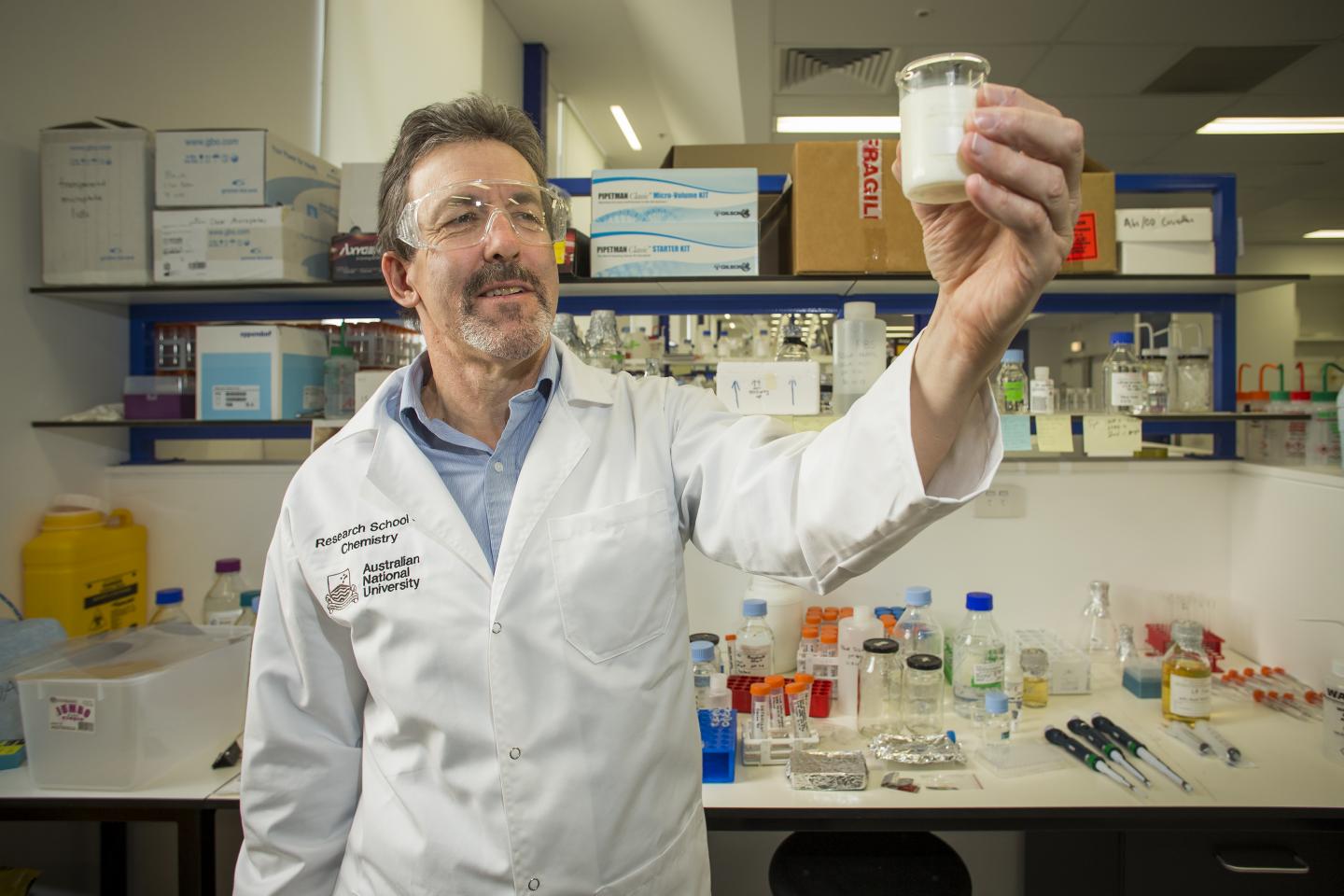
IMAGE

Credit: Stuart Hay, ANU

A new study on UHT milk is helping scientists to better understand Alzheimer's, Parkinson's and type 2 diabetes, opening the door to improved treatments for these age-related diseases.

About 500 million people worldwide suffer from these diseases, which cause millions of deaths each year.

Co-lead researcher, ANU Professor John Carver, said that two unrelated proteins aggregate in UHT milk over a period of months to form clusters called amyloid fibrils, which cause the milk to transform from a liquid into a gel.

He said the same type of protein clusters are found in plaque deposits in cases of Alzheimer's and Parkinson's.

"Parkinson's, dementia and type 2 diabetes are big problems for the ageing population in Australia and many other countries around the world," said Professor Carver from the ANU Research School of Chemistry.

"Our interest in milk proteins led to a discovery of the reason for this gelling phenomenon occurring in aged UHT milk."

"The research does not suggest UHT milk can cause these age-related diseases."

Professor Carver said milk proteins changed structurally when heated briefly to around 140 degrees to produce UHT milk, causing the gelling phenomenon with long-term storage.

He said normal pasteurised milk did not form amyloid fibrils.

ANU worked with CSIRO, University of Wollongong and international researchers on the study, which is published in the journal Small.

Watch a video interview with Professor John Carver about the study.

###

FOR MEDIA ASSISTANCE:

Will Wright
ANU Media Team
P: +612 6125 7979
M: +61 478 337 740
W: [email protected]

Media Contact

Will Wright
[email protected]
61-261-257-979
@ANUmedia

http://www.anu.edu.au/media

############

Story Source: Materials provided by Scienmag
Share12Tweet8Share2ShareShareShare2

Related Posts

Carbon Dots and Molecular Metal Clusters Team Up to Split Light into Hydrogen

Carbon Dots and Molecular Metal Clusters Team Up to Split Light into Hydrogen

October 5, 2026
Ethiopian Sesame Trial Finds a Champion Variety That Wins Almost Everywhere

Ethiopian Sesame Trial Finds a Champion Variety That Wins Almost Everywhere

October 5, 2026

Tiny Field-Driven Particles Are Being Recast as Distributed Micromachines

October 5, 2026

Migraine Drug Safety Reassuring in Patients With Prior Stroke and Heart Disease, Small Study Finds

October 5, 2026
Please login to join discussion

POPULAR NEWS

  • Alloys That Shrink Their Own Grains: New PIX Mechanism Refines Metals With Heat Alone

    Alloys That Shrink Their Own Grains: New PIX Mechanism Refines Metals With Heat Alone

    29 shares
    Share 12 Tweet 7
  • Endurance Exercise Reshapes the Liver in Males and Females Through Distinct Molecular Routes

    29 shares
    Share 12 Tweet 7
  • Single Transcription Factor PU.1 Rapidly Converts Fibroblasts into Macrophage-Lineage Cells

    29 shares
    Share 12 Tweet 7
  • New Scale Measures How Ready Nurse Educators Really Are for the AI Era

    29 shares
    Share 12 Tweet 7

About

We bring you the latest biotechnology news from best research centers and universities around the world. Check our website.

Follow us

Recent News

Alloys That Shrink Their Own Grains: New PIX Mechanism Refines Metals With Heat Alone

Endurance Exercise Reshapes the Liver in Males and Females Through Distinct Molecular Routes

Single Transcription Factor PU.1 Rapidly Converts Fibroblasts into Macrophage-Lineage Cells

Subscribe to Blog via Email

Success! An email was just sent to confirm your subscription. Please find the email now and click 'Confirm' to start subscribing.

Join 85 other subscribers
  • Contact Us

Bioengineer.org © Copyright 2023 All Rights Reserved.

Welcome Back!

Login to your account below

Forgotten Password?

Retrieve your password

Please enter your username or email address to reset your password.

Log In
No Result
View All Result
  • Homepages
    • Home Page 1
    • Home Page 2
  • News
  • National
  • Business
  • Health
  • Lifestyle
  • Science

Bioengineer.org © Copyright 2023 All Rights Reserved.