Credit: University of Delaware/ Jeffrey Chase
Encouraging science-based policies and defending science from political attacks are strong motivators for March for Science participants, according to a new University of Delaware Center for Political Communication survey.
The study, conducted from March 31 to April 18, surveyed 1,040 members of March for Science Facebook groups or pages about their reasons for marching in April 22 events across the United States and around the globe. (For a PDF of the study, click here.)
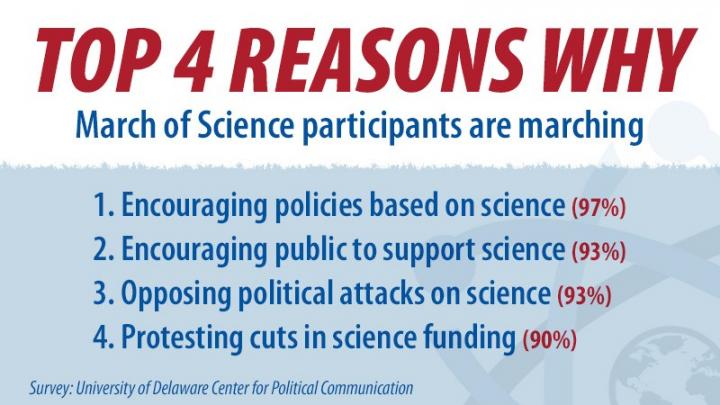
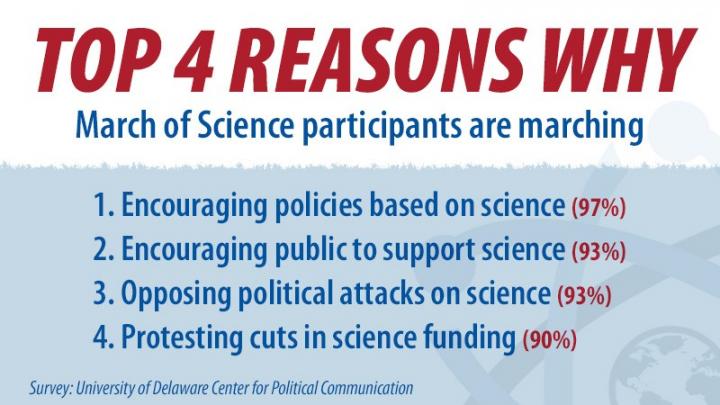
Fully 93 percent of respondents said "opposing political attacks on the integrity of science" would be very important to them as a reason for participating in a March for Science event. At the same time, 97 percent of respondents said that "encouraging public officials to make policies based on scientific facts and evidence" was a top priority, and 93 percent said the same for "encouraging the public to support science."
Other reasons that most respondents rated as very important included "protesting cuts to funding for scientific research" (90 percent), "celebrating the value of science and scientists to society" (89 percent) and "promoting science education and scientific literacy among the public" (86 percent).
Fewer respondents ranked "encouraging scientists to engage the public" (70 percent) and "encouraging diversity and inclusion in science" (68 percent) as highly. Nevertheless, solid majorities said these reasons were very important.
The survey also asked respondents why they had joined or followed March for Science pages, groups or hashtags on social media. Not surprisingly, the top reason (93 percent) was "to learn about March for Science events." A majority (54 percent) also said they joined "to connect with people who share my views."
Other common reasons for joining or following included "to become more involved in politics or policy-making" (45 percent), "to learn about other online advocacy and activism opportunities" (41 percent), "to learn about issues facing scientists and scientific institutions" (36 percent) and "to learn about other offline advocacy and activism opportunities" (32 percent). Only a small percentage of respondents (12 percent) said they joined or followed "to learn about science."
When asked whether their experiences with March for Science social media pages, groups or hashtags had made them more likely to participate in science advocacy, 78 percent of respondents said yes for online advocacy and 74 percent said yes for offline advocacy. In addition, large majorities said their experiences had made them more likely to like or share (76 percent), read (70 percent) and write (64 percent) messages about science on social media.
Almost two-thirds (64 percent) said their experiences with March for Science social media had made them more likely to contact public officials about science. Majorities also said their experiences had made them more likely to discuss science with people they knew (59 percent) and to follow news about science (55 percent).
###
About the study
The study was supervised Barbara Ley, a professor in the Department of Communication and Women and Gender Studies at the University of Delaware, with support from the University of Delaware Center for Political Communication.
The survey was conducted online from March 31 to April 18. The 1,040 respondents were recruited from 81 different participating March for Science Facebook groups and pages (see full list below). The study did not use probability sampling to select respondents; as a result, no sampling error for the study can be calculated, and the results do not necessarily generalize to all March for Science Facebook group and page members. Of the respondents, 82 percent were residents of the United States and 18 percent were residents of other countries. A large majority (81 percent) identified as women, with 18 percent identifying as men, and 1 percent as other. Half (50 percent) of the respondents said they considered themselves scientists.
Participating March for Science Facebook groups and pages
Arkansas; Atlanta, GA; Atlantic City, NJ; Baltimore, MD; Berlin, Germany; Boston, MA; Bratislava, Slovakia; Brussels, Belgium; Buffalo, NY; Cape Town, South Africa; Champaign-Urbana, IL; Charleston, SC; Charlottesville, VA; Cleveland, OH; Copenhagen, Denmark; Denver, CO; Des Moines, IA ; Duluth, MN ; Dunedin, New Zealand ; Estonia; Fargo (ND)/Moorhead (MN); Grand Rapids, MI; Guam; Halifax, Canada; Hamilton, Canada; Houston, TX; India; Indianapolis, IN; Iowa; Irish STEM Solidarity with US; Jackson, MS; Kalamazoo, MI; Kansas City, MO; Las Cruces, NM; Las Vegas, NV; Lexington, KY; Lisbon, Portugal; Lithuania; London, United Kingdom; Los Angeles, CA; Louisiana; Louisville, KY; Luxembourg; Milwaukee, WI; Mobile, AL; Newark, DE; Nigeria; Norway; Oklahoma; Omaha, NE; Panama; Paris, France; Puerto Rico; Philadelphia, PA; Philippines; Phoenix, AZ; Portland, OR; Raleigh, NC; Reykjavík, Iceland; Rhode Island; Riverside, CA; Rochester, NY; Rome, Italy; Rutgers at Trenton, NJ; St. Louis, MO; São Paulo, Brazil; San Francisco, CA; Seattle, WA; Seville, Spain; Silicon Valley, CA; South Bend, IN; Space Coast, FL; Sydney, Australia; Taiwan; Tokyo, Japan; Trinidad and Tobago; Uganda; Vancouver, Canada; Vermont; Virtual March for Science; West Palm Beach, FL
Media Contact
Peter Bothum
[email protected]
302-831-1418
@UDResearch
http://www.udel.edu
############
Story Source: Materials provided by Scienmag