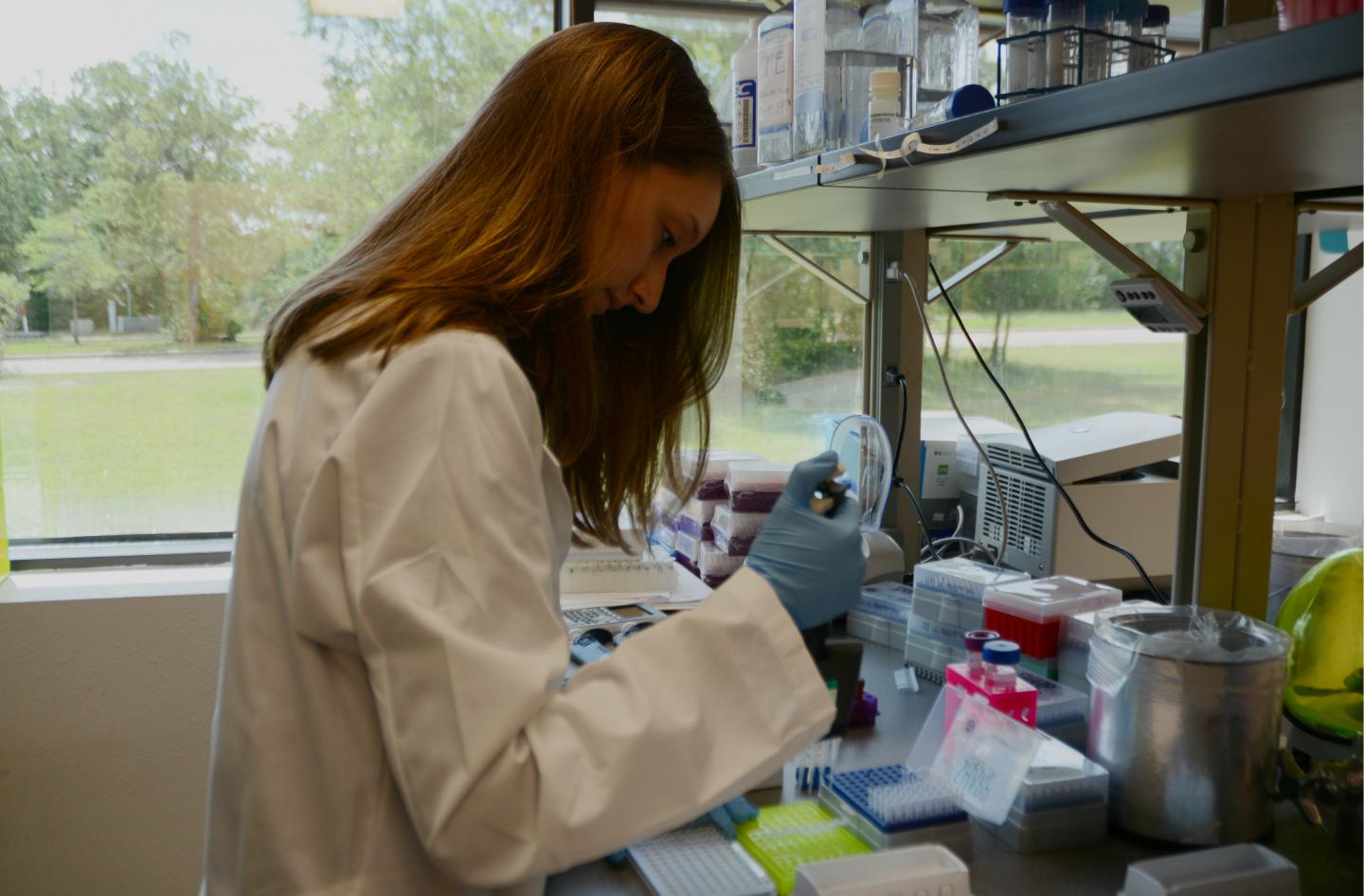
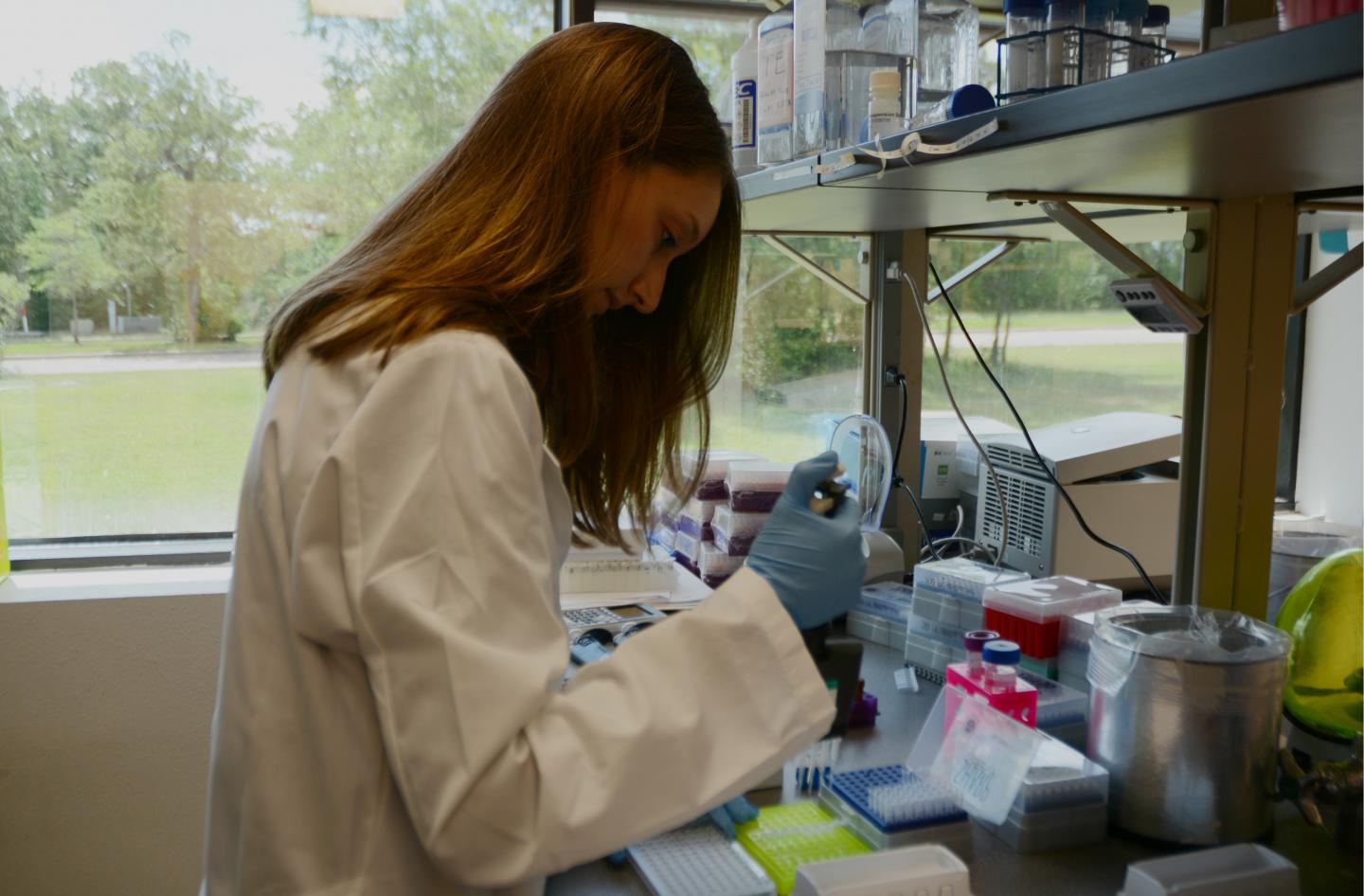
Credit: (Texas A&M AgriLife Research photo by Kathleen Phillips).
Unless your career wardrobe consists of multiple white lab coats and your office has a cache of test tubes, you probably don't remember where you were when it was announced that the human genome had been sequenced.
But, if you know that you can now dish out $100 to map your ancestral migration through history, the term "DNA" may roll off the tongue like the ABCs.
The surge in genetic research and its increasing acceptance in the general public bodes well for health, agriculture and natural resources discoveries — not to mention genealogy enthusiasts. This has scientists scampering to keep up with the technology, according to Dr. Charlie Johnson, director of the Genomics and Bioinformatics at Texas A&M AgriLife Research in College Station.
It's been a productive 20-plus years since two bacterial genomes were first sequenced in 1995, according to the National Institutes of Health-National Center for Biotechnology Information. Almost 125,000 organisms have been sequenced, including — to help pinpoint your ancestry — the human genome in 2003.
"The technology is relatively new. Before 2007, sequencing was very difficult, slow and laborious," Johnson said. "The human genome project, for example, started in 1990 and took 13 years to complete at a cost of about $3 billion."
Texas A&M AgriLife Genomics and Bioinformatics Service in College Station has a central core of the latest equipment and experienced genomics technology scientists to support researchers in a cost-effective, efficient way throughout the Texas A&M University System. (Texas A&M AgriLife Research photo by Kathleen Phillips).
Once science got a grasp of the technology, however, researchers from agriculture to zoology clearly saw how peering into the innermost level of an organism's existence might help address issues such as disease, drought and pestilence.
One problem, however, was cost, Johnson noted.
"The kind of instruments needed to do sequencing are not affordable for a single lab to own," he said. "On the average, they cost about $1 million apiece. And it would be hard for any one investigator to generate enough research work to justify that investment."
AgriLife Research, with its extensive scientific network across Texas, envisioned a bigger picture. In 2010, the agency hired Johnson to establish a central core of equipment and a set of experienced genomics technology scientists who could support researchers in a cost-effective, efficient way. Even more, they provide their expertise to scientists throughout the Texas A&M University System.
"Our reputation for scientific excellence and high-quality data has led to collaborations with scientists around the world, including groups in 35 countries," Johnson noted. "Beginning in 2009 when the first next generation sequencing system was purchased and over the last eight years, AgriLife has continued to keep pace with a technology that is changing so fast. The cost of sequencing has dropped from $3 billion for the first human genome to less than $1,000 today and is expected to dip below $100 in the coming years."
This month, the center will put in place an Illumina NovaSeq 6000, a machine Johnson said can yield the equivalent of 48 human-sized genomes in less than two days. This will significantly cut costs.
"Texas A&M AgriLife is one of the first academic institutions to have access to this technology," Johnson said. "This is the right tool at the right time to face this new era of big agri-genomics, and we are thrilled to be part of it."
In essence, like one's cellphone, DNA sequencing technology is ever-evolving at a frantic pace, he said.
"If you are not constantly upgrading, you quickly fall behind. We work hard to get these new machines so we can continue to provide the highest quality data using the latest genomic technologies to give our collaborators the biggest bang for the buck," he said.
###
Media Contact
Kathleen Phillips
[email protected]
979-845-2872
@texasagwriter
http://today.agrilife.org
############
Story Source: Materials provided by Scienmag