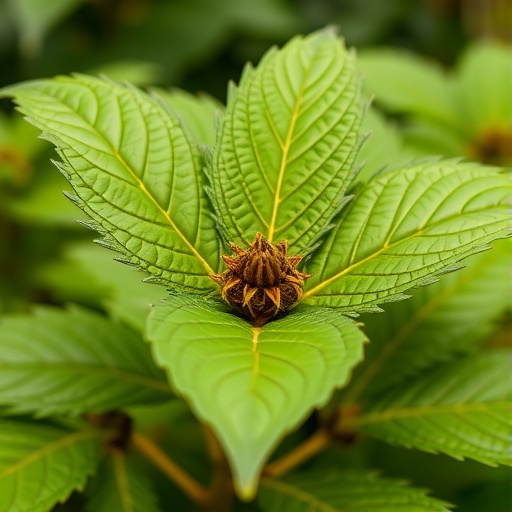
In the evolving landscape of agricultural products and their potential health impacts, the comprehensive profiling of herbal materials becomes ever more critical. A noteworthy study conducted by Sandhya, Mehta, and Oraon delves into the intricate compositions of both green and cured leaves of Nicotiana tabacum (PT76), a variant of tobacco traditionally consumed as Khaini in the Jharkhand region of India. This research sheds light on the differential chemical profiles exhibited by these leaf stages and articulates their implications for consumers and industry stakeholders alike.
The traditional practice of consuming tobacco leaves in forms such as Khaini isn’t merely a matter of fervent cultural heritage but also a subject of significant scientific inquiry. Nicotiana tabacum, commonly known as tobacco, has long fascinated botanists and pharmacologists due to its complex phytochemical makeup. The leaves undergo various transformations during the curing process, which may alter their chemical constituents and, consequently, their biological activity within the human body. Understanding these alterations is pivotal for insights into both therapeutic applications and health risks associated with tobacco consumption.
Utilizing Gas Chromatography-Mass Spectrometry (GC-MS), the researchers executed a meticulous analysis aimed at identifying and comparing the volatile and semi-volatile compounds present in both green and cured Nicotiana tabacum leaves. The significance of GC-MS as a methodological approach in phytochemical analysis is well-documented; it provides a high-resolution means to separate and identify complex mixtures, revealing compounds that might otherwise remain obscured in bulk assessments. By ensuring precision in chemical identification, this technology allows for robust data supporting the study’s findings.
One major outcome of their investigation was the identification of several key phytochemicals that exhibited varying concentrations between green and cured leaves. These included alkaloids, terpenoids, and flavonoids, each of which could significantly influence health outcomes. For instance, nicotine, a notorious alkaloid found in tobacco, is known for its stimulant and addictive properties. The curing process has been shown to heighten nicotine levels, raising questions about the associated health risks for habitual users of Khaini.
Interestingly, the research also pointed to variations in flavonoid content, which could correspond to potential antioxidant activities associated with herbal remedies. Flavonoids are often lauded for their health benefits, including cardiovascular protection and anti-inflammatory properties. Understanding the balance of pro- and antioxidant substances in tobacco through comparative analysis of these leaves can provide crucial insights into their health implications for users.
Moreover, the study goes beyond mere compound identification; it elaborates on how environmental factors—from soil conditions to atmospheric influences—impact the chemical makeup of Nicotiana tabacum. The authors emphasize that future research should also consider these variables, as they can significantly alter phytochemical profiles. This aspect highlights the importance of integrating ecological factors into the discussion of tobacco consumption.
Furthermore, the cultural significance of Khaini in Jharkhand cannot be overlooked. Consumed traditionally as a form of snuff, it informs not just personal habits but also community identities. The juxtaposition of cultural practices with scientific findings thus offers a multifaceted perspective on an age-old tradition. For health educators and policymakers, understanding the relationship between cultural practices and health implications becomes vital in crafting effective educational interventions and regulations.
On a broader scale, the implications of such research extend to public health perspectives. With a growing awareness of the dangers associated with tobacco use—amplified by studies linking it to various forms of cancer and respiratory illnesses—the findings from this research could serve as a pivotal reference in anti-tobacco campaigns. By elucidating the specific risks associated with the consumption of Khaini, it provides informative resources needed to educate communities, particularly in regions where traditional practices are prevalent.
Additionally, the integration of phytochemical research into agricultural practices could lead to more sustainable and health-oriented cultivation methods. If certain compounds are identified to be beneficial or harmful, farmers could adjust their agricultural practices accordingly, ensuring the growth of tobacco varieties that minimize health risks for consumers.
The findings from this research are indeed suggestive of requiring further in-depth studies, particularly longitudinal ones, that assess the health impacts of both green and cured tobacco consumption over time. It encourages an approach that combines traditional knowledge with modern scientific methods, promoting a holistic view of agricultural health products.
Moreover, interdisciplinary collaboration between agricultural scientists, toxicologists, and health professionals could expedite the development of guidelines and practices that ensure the safe consumption of these culturally significant products. Only through such comprehensive frameworks can we hope to mitigate the health risks associated with traditional habits while honoring their cultural significance.
In conclusion, this comparative study of the phytochemical profiles between green and cured Nicotiana tabacum leaves presents a long-overdue exploration into both the benefits and drawbacks of a widely consumed product in certain cultural circles. It encapsulates the intersection of tradition and innovation, blending the lessons of longstanding practices with the rigorous scrutiny of modern scientific inquiry. As this research awaits further validation and discussion, it undoubtedly sets a notable precedent for future scholarly exploration in the field of ethnopharmacology and public health.
Subject of Research: Comparative chemical profiling of Nicotiana tabacum leaves.
Article Title: Comparative GC-MS and phytochemical profiling of green and cured leaves of Nicotiana tabacum (PT76) consumed as Khaini in Jharkhand.
Article References: Sandhya, S., Mehta, S. & Oraon, V. Comparative GC-MS and phytochemical profiling of green and cured leaves of Nicotiana tabacum (PT76) consumed as Khaini in Jharkhand. Discov. Plants 2, 311 (2025). https://doi.org/10.1007/s44372-025-00398-8
Image Credits: AI Generated
DOI: https://doi.org/10.1007/s44372-025-00398-8
Keywords: Nicotiana tabacum, Khaini, GC-MS, Phytochemical profiling, Tobacco consumption, Health implications, Cultural significance.
Tags: agricultural products and healthchemical profiling of tobaccocultural significance of KhainiGC-MS analysis of tobacco leavesgreen vs cured tobacco leaveshealth impacts of tobacco varietiesKhaini tobacco consumptionphytochemical composition of Nicotiana tabacumsemi-volatile compounds in herbal materialstherapeutic applications of tobaccotraditional tobacco practices in Indiavolatile compounds in tobacco