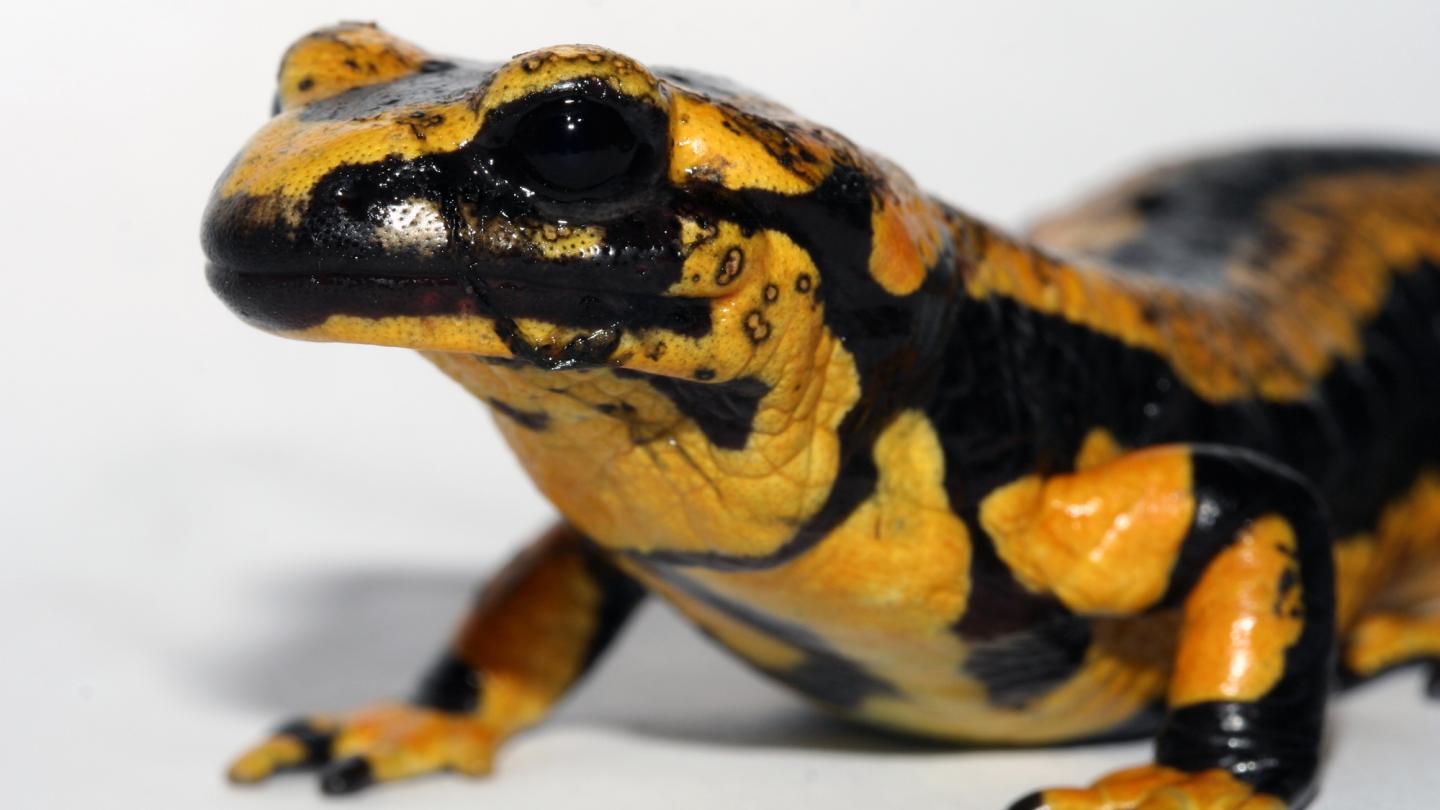
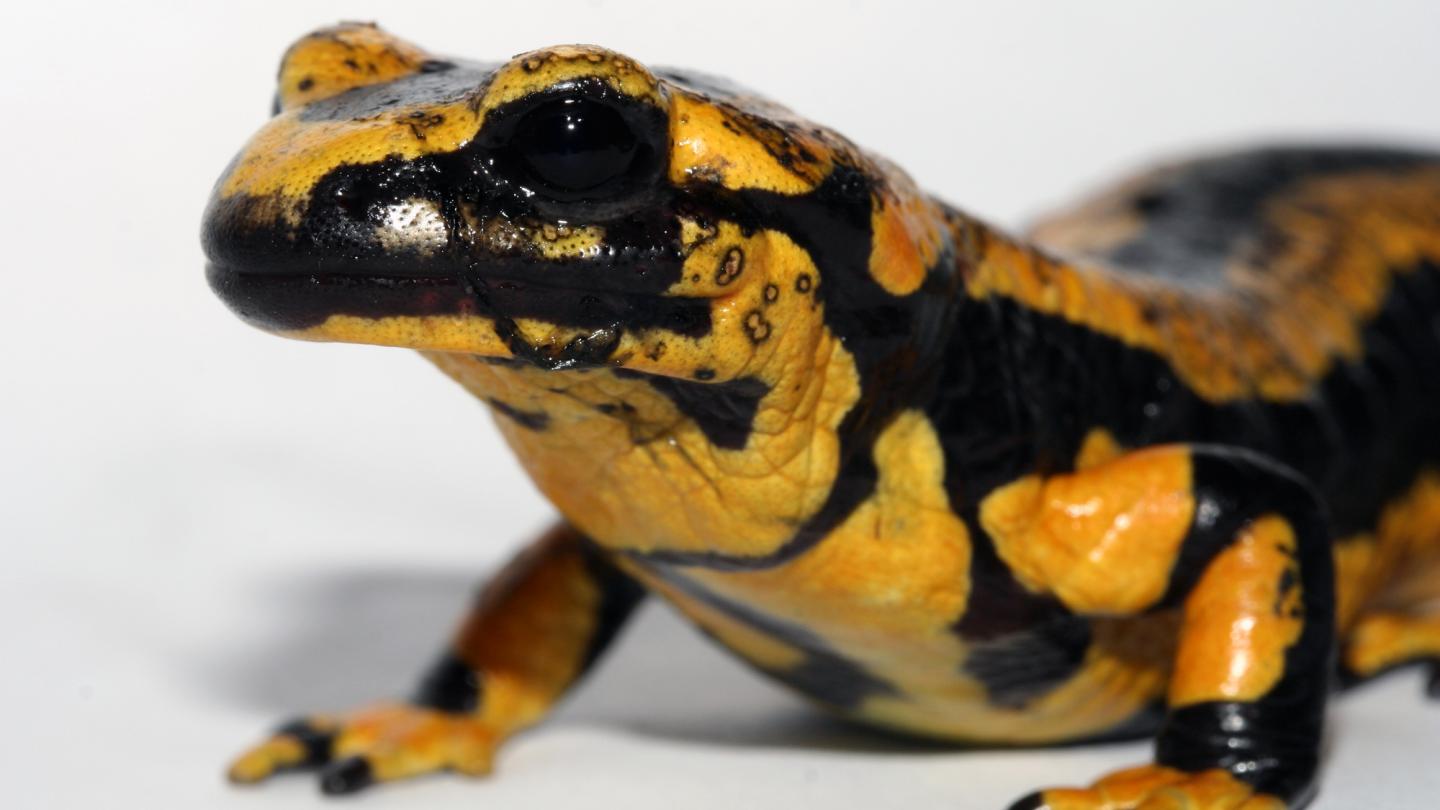
Credit: Frank Pasmans
The situation is alarming: The invasive Asian fungus has recently led to mass mortality of fire salamanders in the Netherlands, Belgium and Germany. Only small numbers of the black-yellow amphibian have survived the invasion of Batrachochytrium salamandrivorans – the "devourer of salamanders." The aggressive fungus, which presumably came to Europe through the amphibian trade, affects the skin of the animals, leading to the formation of skin necrosis and ultimately death.
The death rate is extremely high, as a study by researchers in the team of Benedikt Schmidt has proven. Schmidt, research group leader at the Department of Evolutionary Biology and Environmental Sciences at the University of Zurich and academic associate for the Swiss Amphibian and Reptile Conservation Programme, says, "Our mark-and-recapture data shows that only 13 percent of the infected salamanders survive over a 10-day period." And, if that were not enough: "The numbers also show that a third of the healthy salamanders became infected with the fungal disease in the same time period." According to An Martel, head of the study and professor at the University of Ghent in Belgium, it is therefore not surprising that an afflicted population shrinks by more than 90 percent within just a few weeks and then disappears.
This fungus is the "perfect" enemy
The aggressive fungus from Asia has not yet been found in Switzerland. "We must do everything to make sure it stays that way and the disease does not continue to spread," biologist Schmidt warns. Once the "devourer of salamanders" arrives, its epidemiological properties as a "perfect" pathogen make it a deadly enemy: Infection experiments demonstrate that salamanders are not able to build up a resistance to the pathogen. In addition, mere contact with a just a few fungus spores suffice for an infection that ends in death. The fungus also has resistant spores that are not strongly affected by weather conditions and are able to survive for a long time in the environment.
Other amphibian species such as the alpine newt react less sensitively to Batrachochytrium salamandrivorans; what is lucky for the alpine newt, however, involves an additional risk: "More robust species may act as a reservoir," Benedikt Schmidt explains. The fungus therefore lives on, even after more sensitive animals like the fire salamander have already long died. According to Schmidt, all these factors make it almost impossible to save a salamander population in its natural environment once infected. "Reintroduction would also have few prospects for success as the spores are able to survive in nature for a long time."
Research and import stop as measures
If the fungus continues to propagate in Europe, it will pose a great danger to the diversity of European salamanders, many of which are already endangered and on the red list in many countries. Since the fungal disease has initially been limited to a small area, an attempt is being made to prevent it from spreading further: The European Union has launched a research project to create the scientific basis for the control of the "devourer of salamanders" as quickly as possible.
Exotic salamanders and newts are often kept as pets and imported in large numbers: Between 2001 and 2009, for example, more than two million fire belly newts, the carriers of the fungal disease, were shipped to the United States. For this reason, both Switzerland and the United States preventively prohibited the import of salamanders and newts. "In case of invasive diseases, this is an unavoidable measure," Schmidt says in support of the measure, "even if trade restrictions are unpopular."
###
Literature:
G. Stegen, F. Pasmans, B.R. Schmidt, L.O. Rouffaer, S. Van Praet, M. Schaub, S. Canessa, A. Laudelout, T. Kinet, C. Adriaensen, F. Haesebrouck, W. Bert, F. Bossuyt, A. Martel: Drivers of Batrachochytrium salamandrivorans mediated salamander extirpation. Nature. April 19, 2017. DOI: 10.1038/nature22059
Contact:
Dr. Benedikt Schmidt
Department of Evolutionary Biology and Environmental Sciences
University of Zurich
Phone +41 78 719 69 16
E-mail: [email protected]
Media Contact
Benedikt Schmidt
[email protected]
41-787-196-916
@uzh_news
http://www.uzh.ch
############
Story Source: Materials provided by Scienmag