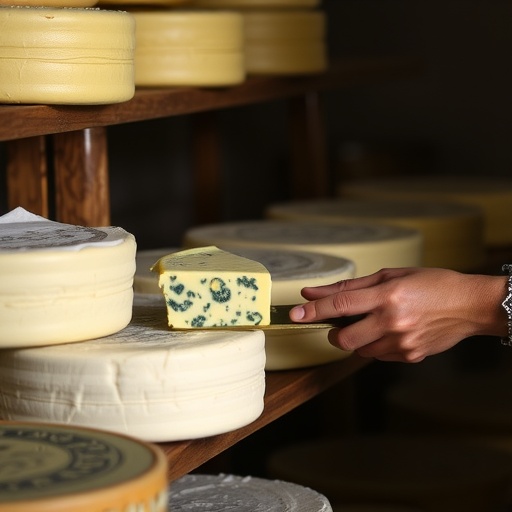
A pioneering literature review conducted by researchers at the DTU National Food Institute has unveiled compelling opportunities to revolutionize cheese production by enhancing its efficiency and sustainability. By delving into underexploited strategies rooted in scientific evidence, this work sets the stage for transformative advances in dairy manufacturing, promising notable benefits for producers and the environment alike. This comprehensive examination illuminates how subtle modifications within the fermentation and ripening phases can yield profound impacts on product quality, operational costs, and waste reduction.
Cheese remains a ubiquitous and culturally significant dairy product, favored worldwide for its diversity, satiety, and preservation qualities. However, its manufacture is intrinsically resource-intensive, demanding large volumes of milk and generating substantial by-products. Notably, the production process yields an excess of whey — a liquid fraction rich in lactose, proteins, vitamins, and minerals — which is often undervalued or discarded in many facilities. This represents both an economic loss and an environmental challenge, as whey disposal entails handling complexities and potential ecological harm.
Quantitatively, for every kilogram of cheese produced, dairies can generate up to nine kilograms of whey. Yet, global practices frequently involve selling this valuable by-product at minimal prices to large whey processing plants or, even worse, discarding it altogether. Addressing this gap, the research underscores innovative methods for harnessing whey’s nutritional wealth. Technological advances now allow for techniques such as protein recovery and reintegration into the curd matrix, potentially elevating cheese yield by nearly 30%, alongside preserving essential nutrients.
One of the formidable obstacles during fermentation is the presence of bacteriophages—viruses that specifically infect lactic acid bacteria critical for fermentation. These phages can abruptly derail production batches by lysing starter cultures, leading to delays or complete loss of product. Traditional mitigation strategies revolve around periodic rotation among different bacterial strains, a tactic that, while somewhat effective, is laborious and inefficient. The current review reveals a breakthrough approach: encapsulating lactic acid bacteria within protective microenvironments prior to their introduction into the cheese vat. This physical barrier shields the bacteria from phage attacks during the vulnerable initial hours of fermentation, ensuring greater batch consistency and reducing process disruption.
Propagation techniques also represent an economic frontier. The industry standard revolves around purchasing Direct Vat Set (DVS) starter cultures, prized for their reliability but burdened with high acquisition costs. By cultivating in-house starter cultures starting from small inoculum volumes, dairies can drastically slash expenses — potentially achieving cost reductions up to one hundredfold. This practice demands rigorous process control and impeccable hygiene regimes to maintain culture integrity; however, it offers an attractive financial and operational alternative, especially for larger dairies or cooperatives sharing fermentation facilities.
Beyond biological considerations, controlling the chemical environment of the cheese surface during ripening emerges as a subtle yet powerful lever. Manipulating surface pH values by carefully balancing brine composition, washing protocols, and humidity conditions can accelerate desirable microbial activity on rinds, directly speeding maturation. This rapid ripening minimizes storage duration and costs while simultaneously thwarting undesirable contaminants, including molds and pathogenic bacteria such as Listeria monocytogenes, thereby enhancing product safety and quality.
Moreover, the strategic, tightly controlled use of bacteriophages introduces a paradoxically beneficial function. By applying minimal phage doses at precise points in the fermentation timeline, producers can induce self-lysis of lactic acid bacteria cultures when optimal flavor compound release is desired. This enzymatic release expedites flavor development, cutting months off traditional aging times for specialty cheeses with extended ripening requirements. However, such sophisticated modulation mandates stringent process controls and thorough parameter standardization.
Collectively, these interlinked innovations underscore an overarching principle: optimizing the cheese manufacturing process via modest, evidence-backed interventions can yield substantial economic, environmental, and sensory benefits without necessitating radical overhaul of existing equipment or infrastructure. The reviewed measures are adaptable across various cheese types and production scales, though the researchers caution that some approaches will require pilot validation and regulatory review prior to widespread adoption.
The significance of this research extends beyond dairy industry stakeholders to consumers and policymakers focused on food sustainability. By reducing waste streams, enhancing resource utilization, and lowering production costs, these findings resonate with global commitments to more sustainable food systems. The integration of biotechnological insights into traditional food processing exemplifies the growing synthesis of modern science and age-old culinary arts.
This body of work roots itself in an academic tradition of probing the microbiological, chemical, and engineering aspects of dairy production, providing a roadmap to an array of innovations that have, until now, remained underexplored. It highlights the value of multidisciplinary approaches, combining microbiology, bioprocess engineering, and food technology to design smarter, more resilient cheese production chains.
In summary, the DTU National Food Institute’s review offers a compelling vision for the dairy sector, advocating for the adoption of novel, cost-effective strategies to enhance the efficiency and environmental performance of cheese manufacture. Whether through enhanced whey valorization, better protection of bacterial cultures, or precision in fermentation management, these insights pave the way towards more sustainable cheesemaking—a promising convergence of tradition and technology.
Subject of Research:
Cheese production efficiency and sustainability improvements through novel fermentation and ripening strategies.
Article Title:
Cheese production revisited – Novel and overlooked strategies for improving efficiency and sustainability of cheese manufacturing
News Publication Date:
21-Aug-2025
Web References:
http://dx.doi.org/10.1016/j.tifs.2025.105213
References:
Cheese production revisited – Novel and overlooked strategies for improving efficiency and sustainability of cheese manufacturing, Trends in Food Science & Technology
Image Credits:
Not provided
Keywords
Cheese production, fermentation, lactic acid bacteria, bacteriophages, whey valorization, starter cultures, cheese ripening, sustainability, dairy technology, enzyme release, microbial encapsulation, food biotechnology
Tags: cheese industry ecological challengeseconomic benefits of sustainable cheeseefficiency in dairy manufacturingenvironmental impact of cheese productionfermentation and ripening innovationsimproving cheese product qualityliterature review on cheese sustainabilityreducing waste in dairyresource-intensive cheese manufacturingsustainable cheese productionunderexploited dairy production techniqueswhey utilization strategies