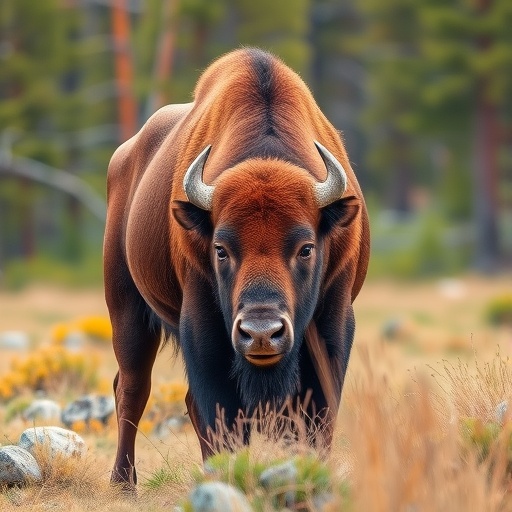
In the expansive and ecologically rich Greater Yellowstone Ecosystem, a groundbreaking new study unveils the nuanced ways large mammal species respond behaviorally to rising summer temperatures. This collaborative research effort, co-led by Justine Becker, an assistant professor of ecology at Montana State University, challenges preconceived notions about wildlife’s adaptability to climate change by emphasizing the crucial role of habitat structure over inherent biological traits.
The investigation synthesized GPS tracking data from nine majestic species, encompassing herbivores such as bison, bighorn sheep, moose, mountain goats, mule deer, pronghorn, and elk, alongside apex predators like wolves and cougars. By studying these diverse populations across the Greater Yellowstone region during the peak summer months—from mid-June to late August—the scientists sought to decipher patterns of behavioral plasticity related to thermal stress.
Dr. Becker and her interdisciplinary team utilized extensive datasets collected from 2001 through 2019, contributed by multiple conservation and governmental agencies including the Bureau of Land Management and the National Park Service. The longitudinal nature of the data allowed the team to rigorously analyze animal movements and habitat utilization across varying environmental conditions and thermal gradients.
A key revelation from the study is that large mammals exhibit pronounced alterations in their behavior in response to increasing daytime temperatures, primarily by seeking cooler microhabitats and reducing movement to conserve energy and avoid overheating. This aligns with known thermoregulatory survival strategies but importantly highlights the dynamic and immediate nature of behavioral responses absent any need for genetic adaptation.
What stands out strikingly is the influence of landscape heterogeneity on behavioral adjustments. Contrary to expectations, individuals inhabiting homogenous environments—with little variation in terrain and vegetation—demonstrated more substantial shifts in behavior than those in ecotones or mosaic habitats with diverse features such as shaded forest patches and open meadows. For instance, pronghorns in Wyoming’s Shirley Basin, which typifies a flat, uniform prairie ecosystem, exhibited significant behavioral modulation, traveling greater distances to find relief from heat through shade-seeking.
The research further explored the impact of endogenous characteristics, including sex, body size, and physiological attributes, yet found no consistent correlation between these inherent traits and behavioral plasticity in response to temperature stress. This absence of a direct biological determinant suggests that extrinsic environmental factors predominantly govern how animals cope behaviorally with climate variability.
From an evolutionary biology perspective, the findings provide compelling evidence that large terrestrial mammals, despite their typically longer lifespans and slower reproductive rates, possess immediate behavioral mechanisms to mitigate climate-induced stress. This behavioral flexibility acts as a vital buffer, granting them resilience against rapid environmental shifts that outpace physical adaptations or evolutionary change.
The ecological implications of these discoveries are substantial. They underscore the significance of maintaining habitat complexity and connectivity across vast landscapes. Landscape permeability emerges as critical, facilitating animal access to diverse, thermally distinct microhabitats during extreme heat events. This mosaic-like habitat structure effectively supports behavioral thermoregulation, enhancing species survival probabilities under future climate scenarios.
Justine Becker emphasized the study’s relevance to wildlife management, suggesting that conservation strategies should pivot from species-specific prescriptions toward ecosystem-wide habitat considerations. Protecting and restoring heterogeneous landscapes that offer a variety of thermal refuges could be instrumental in supporting these keystone species amid escalating climate challenges.
Moreover, the collaborative nature of this research highlights the power of data sharing among agencies and scientists, fostering integrative approaches that transcend disciplinary and jurisdictional boundaries. This synthesis of empirical observations opens new frontiers for understanding complex ecological processes in an era of global environmental change.
The team’s work also advocates for ongoing investigations into individual-level behavioral traits and their interaction with environmental variables. Detailed studies examining specific physiological markers, such as coat color or metabolic rates, may further elucidate the intricate biological and ecological synergy underlying behavioral plasticity.
In conclusion, this pioneering multi-species, large-scale study offers a hopeful narrative: large mammals demonstrate remarkable behavioral adaptability to rising temperatures by leveraging their environment’s structural diversity. As the climate crisis intensifies, such insights are invaluable for shaping forward-thinking conservation policies that prioritize ecological resilience and the preservation of biodiversity in the Greater Yellowstone Ecosystem and beyond.
Subject of Research: Animals
Article Title: Expression and mechanisms of behavioral plasticity in large mammals
News Publication Date: 20-Oct-2025
Web References: http://dx.doi.org/10.1002/ecs2.70432
References: Ecosphere journal article by Justine Becker et al.
Image Credits: Alex Becker
Keywords: behavioral plasticity, large mammals, climate change, Greater Yellowstone Ecosystem, habitat heterogeneity, thermoregulation, GPS tracking, wildlife ecology, conservation management
Tags: behavioral adaptations to heatconservation data analysisecological implications of climate changeecological study of herbivores and predatorseffects of rising summer temperaturesGPS tracking of wildlifeGreater Yellowstone Ecosystemhabitat structure and climate changeinterdisciplinary ecological researchlarge mammals climate responsethermal stress in mammalswildlife movement patterns