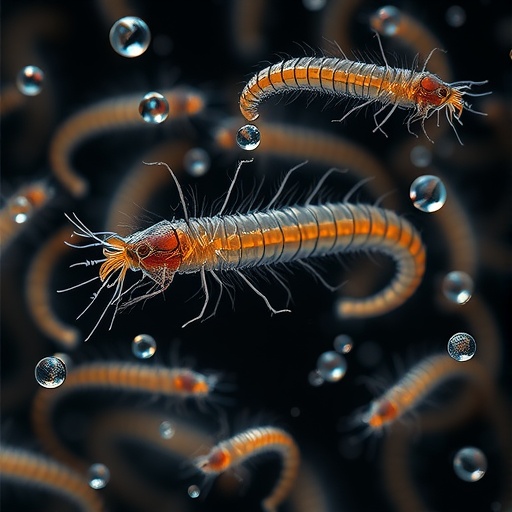
In a groundbreaking study that could revolutionize the fight against parasitic infections, researchers have unveiled a novel approach to controlling Anisakis larvae using nanoemulsions derived from natural essential oils combined with brines. This innovative method leverages the potent antimicrobial properties of thyme, garlic, and grape seed essential oils, nanoemulsified to enhance their efficacy and bioavailability, representing a significant leap forward in parasitology and food safety.
Anisakis larvae, the causative agents of anisakiasis, pose a substantial threat to both public health and the seafood industry worldwide. These parasitic nematodes infect marine fish and squid and can cause severe gastrointestinal distress and allergic reactions in humans when ingested through raw or undercooked seafood. Traditional methods of controlling Anisakis larvae have had limited success, and the search for safer, eco-friendly alternatives has intensified amid growing concerns over chemical residues and environmental impact.
In response to these challenges, the research team employed a sophisticated nanoemulsion technology to encapsulate essential oils extracted from thyme, garlic, and grape seeds. Nanoemulsification not only improves the solubility and stability of these hydrophobic compounds but also facilitates their penetration into the larvae, thus maximizing their anthelmintic effects. This cutting-edge approach bridges the gap between natural product application and nanotechnology, offering a promising solution to longstanding parasitic control issues.
The experimental design featured an in vitro assessment where Anisakis larvae were exposed to various concentrations of these nanoemulsified essential oils, both independently and in combination with saline brines, renowned for their osmoregulatory stress on parasites. The results were compelling: larvae mortality rates significantly increased when treated with the nanoemulsions, particularly in synergy with brines, showcasing a multi-modal attack on parasite viability that could enhance food safety protocols.
One of the critical merits of using thyme, garlic, and grape seed essential oils lies in their diverse biochemical compositions, which include thymol, allicin, and proanthocyanidins, respectively. These bioactive compounds have long been recognized for their antimicrobial, antioxidant, and antiparasitic properties. Thyme oil, for instance, disrupts cellular membranes and metabolic pathways in pathogens, while garlic’s allicin inhibits enzymatic activities crucial for parasite survival. Grape seed oil adds a powerful antioxidant dimension, potentially reducing oxidative stress in both the host and the parasitic larvae.
Moreover, the integration of these oils with brines introduces osmotic pressure as an additional stress factor, synergistically enhancing the antiparasitic efficacy. Brines, commonly used in food preservation, create inhospitable ionic environments that can weaken parasite membranes and physiological functions. When combined with the nanoemulsified oils, this stress is amplified, resulting in accelerated larvae mortality and diminished infective capabilities.
The implications of this research extend far beyond mere parasitic control. The adoption of nanoemulsified essential oils in commercial seafood processing could drastically reduce the reliance on synthetic chemicals and harsh treatments, aligning with consumer demand for natural, sustainable food products. Industry stakeholders stand to benefit from improved product safety, longer shelf life, and compliance with stricter regulatory standards, all while minimizing environmental impact.
This study also sheds light on the potential of nanoemulsions as delivery systems for bioactive compounds in parasitology. The nano-sized emulsified droplets facilitate enhanced interaction with target organisms, offering controlled release and improved bioavailability. Such technological advancements open avenues for tailored parasite management strategies across various foodborne and zoonotic pathogens, potentially reshaping preventive healthcare in aquaculture and food industries.
Furthermore, these findings encourage a deeper exploration into the molecular mechanisms underlying the antiparasitic action of essential oils in nanoemulsified form. Understanding how these compounds interact at the cellular and molecular levels within Anisakis larvae could inspire the development of highly targeted interventions, minimizing off-target effects and ensuring host safety. The prospect of nanoemulsion formulations adapted to specific parasite species also becomes a tantalizing possibility.
While the current study’s in vitro nature provides a robust foundation, future investigations must extend to in vivo models and real-world applications to fully assess safety, efficacy, and regulatory compliance. Evaluating the sensory effects on seafood products, potential allergenicity, and stability during storage and cooking processes will be essential to ensuring consumer acceptance and industrial scalability.
Moreover, this research embodies a broader trend toward integrating natural products and nanotechnology to combat infectious organisms. As resistance to conventional anthelmintics grows and environmental concerns mount, such innovative, cross-disciplinary approaches represent the forefront of sustainable parasitic disease management. They hold promise not only for seafood safety but also for veterinary and human medicine.
In the context of global food security, these advances are particularly crucial. With seafood consumption rising and the risk of parasitic infections persisting, protecting the health of consumers while preserving the integrity of marine resources is paramount. Employing targeted, eco-conscious parasite control methods resonates with international efforts to promote safe, nutritious, and environmentally responsible food production systems.
The transformative potential of nanoemulsified essential oils combined with brines also invites collaboration between researchers, industry stakeholders, and regulatory agencies. Establishing standardized protocols, quality control measures, and safety benchmarks will accelerate the translation from laboratory discoveries to commercial products, ensuring that this technology delivers on its promise effectively and responsibly.
Ultimately, this study exemplifies how harnessing nature’s chemical arsenal through cutting-edge technology can address pressing public health challenges. It underscores the value of interdisciplinary research encompassing parasitology, nanotechnology, chemistry, and food science, poised to innovate and inspire new paradigms in disease control and food safety for a healthier future.
Subject of Research: In Vitro Control of Anisakis Larvae Using Nanoemulsified Essential Oils and Brines
Article Title: In Vitro Control of Anisakis Larvae Using Nanoemulsified Thyme, Garlic, and Grape Seed Essential Oils Combined with Brines
Article References:
Cadun, A., Pekmezci, G.Z., Şen Yılmaz, E.B. et al. In Vitro Control of Anisakis Larvae Using Nanoemulsified Thyme, Garlic, and Grape Seed Essential Oils Combined with Brines. Acta Parasit. 70, 204 (2025). https://doi.org/10.1007/s11686-025-01146-4
Image Credits: AI Generated
Tags: alternative methods to chemical treatmentsAnisakis larvae controlanthelmintic properties of oilseco-friendly pest managementfood safety and healthnanoemulsified essential oilsnanotechnology in parasitologynatural antimicrobial agentsparasitic infection preventionseafood safety innovationssustainable seafood practicesthyme garlic grape seed oils