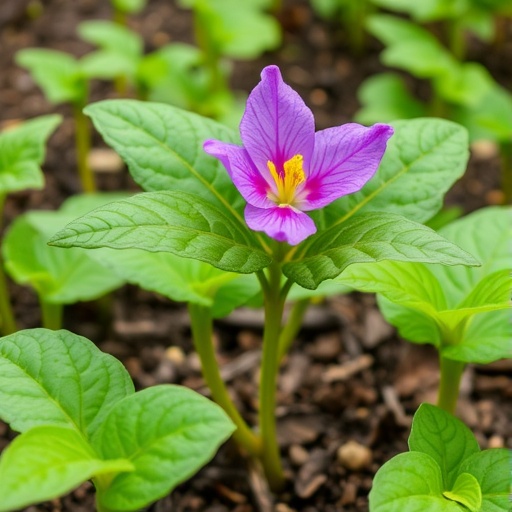
In the face of increasingly unpredictable climate conditions, the quest for enhanced plant resilience has gained significant urgency. A recent study that explores the interaction between strigolactones and other phytohormones offers exciting prospects for improving plant adaptability under climate change. This research presents an innovative approach that could not only benefit agricultural productivity but also contribute to broader ecological stability.
Strigolactones are a class of plant hormones that play critical roles in regulating plant growth and development. These compounds are instrumental in mediating various physiological responses, including root architecture, shoot branching, and stress tolerance. Their unique ability to influence plant behavior in response to environmental challenges makes them key players in the quest for sustainable agriculture.
The study conducted by Fathi and colleagues delves deeply into the mechanisms by which strigolactones interact with other phytohormones, including auxins, cytokinins, and gibberellins. These interactions create a complex signaling network that governs plant responses to stressors such as drought, salinity, and extreme temperatures. By elucidating these pathways, the researchers aim to uncover novel strategies to enhance plant resilience.
Understanding the dynamics of strigolactone signaling is essential for developing crops capable of thriving in adverse conditions. The researchers highlight that under drought stress, the interplay between strigolactones and auxins can lead to modifications in root system architecture. This adaptation allows plants to access deeper soil moisture, thereby enhancing their survival prospects in arid environments.
Furthermore, the study emphasizes the role of strigolactones in enhancing nutrient acquisition, particularly in nutrient-poor soils. This characteristic is crucial in many regions where conventional fertilizers may not be feasible or sustainable. By promoting symbiotic relationships with mycorrhizal fungi through strigolactone signaling, plants can improve their nutrient uptake efficiency, thus reducing dependency on chemical inputs and bolstering food security.
The implications of strigolactone research extend beyond agricultural practicality. By enhancing plant fitness in the face of climate change, we can also support biodiversity and ecosystem functions. Healthy plants play pivotal roles in maintaining soil health, supporting various forms of wildlife, and sequestering carbon from the atmosphere—all critical factors in combating climate change.
Moreover, Fathi and his team highlight the potential for engineering crops with optimized strigolactone pathways. Genetic modifications could fine-tune the production of these hormones, tailoring plant responses to specific environmental challenges. This biotechnological approach could revolutionize crops, making them more resilient and resource-efficient, which is vital for addressing the food demands of a growing global population.
In addition to the technical aspects, the research also raises important questions about the ecological consequences of manipulating plant hormones. While enhancing strigolactone signaling could yield immediate benefits for agricultural practices, the long-term impacts on natural ecosystems must be carefully considered. Striking a balance between agricultural needs and environmental health is a delicate task that requires collaborative efforts from scientists, policymakers, and stakeholders.
As we move forward, interdisciplinary approaches will be essential for successfully integrating this research into practical applications. Collaborations between plant biologists, agronomists, and ecologists can lead to holistic solutions that promote sustainable agricultural practices while ensuring the conservation of biodiversity. The insights generated from the study are likely to inspire new research directions, fostering innovation in plant science.
The urgency of the climate crisis underscores the need for actionable strategies that advance our understanding of plant biology in the context of environmental change. Strigolactones, as revealed in this research, hold the key to unlocking new levels of agricultural resilience. As we harness the power of plant hormones, we embark on a path towards creating a more sustainable future that addresses both food security and environmental preservation.
In conclusion, the research led by Fathi and collaborators opens up exciting possibilities for enhancing plant adaptation to climate change through strigolactone and phytohormone interactions. The potential to foster resilient crops while supporting ecological balance underscores the transformative power of plant science. As we stand at a critical juncture for our planet, continuing to explore and apply these insights will be paramount for the future of agriculture and the environment.
The importance of this study cannot be overstated; it represents a turning point in our ability to mitigate the impact of climate change on our food systems. By capitalizing on the natural interactions between phytohormones, we can pioneer agricultural practices that are not only productive but also sustainable. The integration of scientific research into real-world applications will be crucial for navigating the challenges that lie ahead.
Subject of Research: Interaction between strigolactones and phytohormones in enhancing plant adaptability under climate change.
Article Title: Harnessing strigolactones and phytohormone interactions to enhance plant adaptation under climate change.
Article References:
Fathi, A., Shiade, S.R.G., Shohani, F. et al. Harnessing strigolactones and phytohormone interactions to enhance plant adaptation under climate change.
Discov. Plants 2, 296 (2025). https://doi.org/10.1007/s44372-025-00378-y
Image Credits: AI Generated
DOI: 10.1007/s44372-025-00378-y
Keywords: Strigolactones, phytohormones, plant adaptation, climate change, agricultural resilience.
Tags: climate change and plant adaptabilitydrought stress response in plantsecological stability through plant hormonesenhancing agricultural productivityimproving crop resilience under stressmechanisms of strigolactone signalingplant growth regulation and environmental challengesplant resilience strategiesroot architecture and stress tolerancesignaling interactions in plantsstrigolactones and phytohormonessustainable agriculture practices