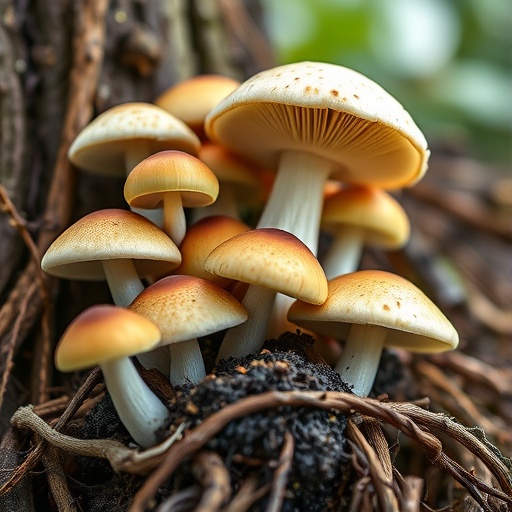
In the realm of sustainable agriculture and waste management, a groundbreaking study has emerged that focuses on the intricate interactions of microbial communities within the composting process. Researchers Kang, Wang, and Zheng have delved deep into the world of microbial dynamics, specifically targeting the degradation of terpenes found in pine sawdust composting. The implications of this research extend far beyond mere decomposition; they suggest a profound link between microbial health and the quality of substrates used for sustainable mushroom cultivation.
The study seeks to address a critical challenge faced by the agricultural industry—how to effectively recycle lignocellulosic waste materials like pine sawdust into valuable resources. By deploying specific microbial inoculants during the composting process, the researchers have demonstrated that not only can terpene degradation be accelerated, but also that these microbial communities can be strategically managed to enhance overall compost quality. This insight is particularly significant as mushrooms represent a rapidly growing sector in the food industry, and optimizing the substrate on which they grow is essential for maximizing yield and nutritional value.
At the heart of this research is the complex relationship between microbial species, which thrive in the humic environment created during composting. Terpenes, a diverse class of organic compounds, are notorious for their resistance to degradation, presenting an obstacle to the effective composting of pine sawdust. However, the application of tailored inoculants fosters an environment where specific microbial taxa flourish and work synergistically to break down these compounds. This finding not only highlights the potential for improving compost quality but also opens avenues for further research into microbial synergy and its applications in various composting systems.
The researchers meticulously designed their experiments, employing a range of analytical techniques to measure microbial diversity, terpene levels, and overall compost quality. By comparing inoculated and non-inoculated compost piles, they uncovered significant differences in terpene concentrations and the diversity of microbial taxa present. The findings suggest that strategic microbial introductions could reduce the time required for compost maturation while improving its utility as a growth substrate for mushrooms.
Central to the success of this process is the regulation of microbial networks. The study reveals that certain bacterial and fungal species harness metabolic pathways that enable them to thrive in the presence of terpenes. By stimulating these species through the addition of specific inoculants, the researchers were able to effectively enhance the breakdown of these complex organic molecules. Interestingly, the study also highlights the adaptability of microbial communities, which can shift in response to changing environmental conditions and substrate compositions.
Furthermore, the research emphasizes the need for a holistic understanding of microbial interactions within the compost ecosystem. It undertakes a systems biology approach, acknowledging that the interconnectedness of microbial species can lead to emergent properties that are not apparent when examining species in isolation. This perspective lays the groundwork for future explorations into microbial ecology and its applications in agri-food systems, reinforcing the notion that every organism plays an essential role in the process of decomposition and nutrient cycling.
The implications of this work extend beyond the scientific community, offering tangible solutions to farmers and mushroom cultivators seeking sustainable practices in waste management. By adopting microbial inoculation techniques, growers can reduce their reliance on chemical fertilizers and pesticides, ultimately contributing to a more sustainable agricultural landscape. This shift towards natural composting practices aligns with the increasing demand for organic produce and environmentally responsible cultivation methods.
Moreover, the research sheds light on the economic benefits of utilizing pine sawdust—a byproduct of the forestry industry—thus addressing two environmental issues simultaneously: waste management and sustainable agriculture. The findings underscore the importance of innovation in recycling biowaste and its potential to transform into nutrient-rich substrates for food production.
As the world grapples with climate change and resource scarcity, studies like this one play a pivotal role in developing sustainable practices that could lead to significant environmental benefits. Understanding how to optimize composting processes not only aids in creating better growth conditions for crops but also reflects a broader shift towards sustainability within the agricultural sector.
In essence, the work of Kang, Wang, and Zheng is an invitation to rethink our approach to composting and waste utilization. The deliberate inclusion of microbial inoculants is portrayed as a beacon of hope for enhancing the efficacy of substrate preparation in mushroom production. This research is not merely theoretical; it directly contributes to practical applications that can reshape how we view and manage organic waste.
As this study gains traction, we anticipate more research in this dynamic field, exploring the complex interplay between microbial organisms and organic materials. The pathways to creating a circular economy in agriculture are rapidly evolving, and the microbial innovations detailed in this study pave the way for future explorations that could redefine environmental practices in food production.
The work also demonstrates a successful collaboration across disciplines, merging microbiology, agriculture, and sustainability science. It invites researchers from various fields to engage with these findings and explore their implications in diverse contexts, fostering a multidisciplinary dialogue around waste management and ecological stewardship.
In conclusion, the detailed research conducted by Kang, Wang, and Zheng represents not just an academic advancement but a necessary evolution in our approach to sustainable farming practices. Their focus on microbial inoculants in pine sawdust composting provides compelling evidence of how science can inform and improve agricultural practices. The application of such knowledge is critical in driving forward an agenda that prioritizes ecological balance while meeting the growing food demands of an expanding global population.
Subject of Research: Microbial inoculant-driven terpene degradation and microbial network regulation in composting.
Article Title: Microbial Inoculant-Driven Terpene Degradation and Microbial Network Regulation in Pine Sawdust Composting for Sustainable Mushroom Substrate Preparation.
Article References:
Kang, C., Wang, W., Zheng, X. et al. Microbial Inoculant-Driven Terpene Degradation and Microbial Network Regulation in Pine Sawdust Composting for Sustainable Mushroom Substrate Preparation.
Waste Biomass Valor (2025). https://doi.org/10.1007/s12649-025-03359-0
Image Credits: AI Generated
DOI:
Keywords: Terpenes, microbial inoculants, composting, sustainable agriculture, fungal and bacterial dynamics.
Tags: compost quality enhancement strategiescomposting process innovationsenhancing yield in mushroom farminginteractions of microbial species in compostlignocellulosic waste recyclingmicrobial communities in agriculturemicrobial inoculants for compostingoptimization of mushroom substratesustainable agriculture practicessustainable mushroom cultivation techniquesterpene degradation in compost