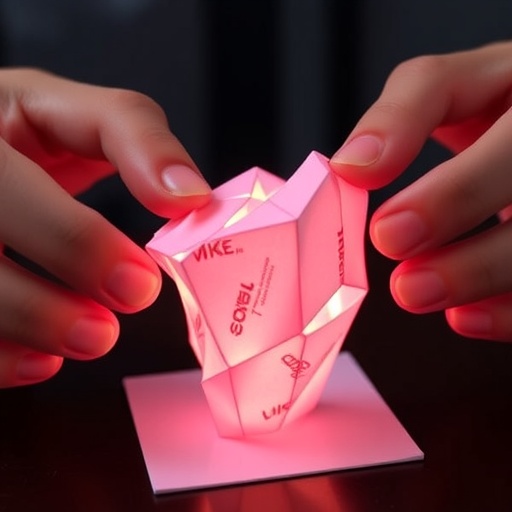
In an era where energy harvesting technologies are increasingly vital, researchers have unveiled a groundbreaking thermoelectric generator that promises unprecedented stretchability and superior thermal contact through a revolutionary pop-up kirigami design. This innovation, led by a team including Terashima, Ohnishi, and Shiomi, represents a radical leap in flexible electronic devices, addressing long-standing challenges in converting waste heat to useful electrical energy across irregular surfaces.
The essence of this novel thermoelectric generator lies in its ingenious use of kirigami, a Japanese paper art involving strategic cutting to transform flat sheets into expandable, three-dimensional structures. Unlike previous rigid thermoelectric devices, the application of kirigami enables the creation of a pop-up mechanism that expands and conforms seamlessly to non-planar and dynamic surfaces. This adaptive quality marks a significant improvement over traditional devices, which often suffer efficiency losses due to poor thermal interface contact and mechanical deformation when subjected to stretching.
At the core of this device is the synergy between mechanical flexibility and efficient thermoelectric performance. Thermoelectric generators fundamentally rely on the Seebeck effect, where a temperature gradient across materials generates a voltage difference, enabling the conversion of heat into electricity. Achieving high stretchability while maintaining this thermoelectric performance has been a notorious hurdle because mechanical strain often disrupts electrical pathways and degrades material properties. The kirigami-inspired architecture elegantly circumvents this, providing predefined stretch zones that mitigate strain on the active thermoelectric components.
The pop-up structure, revealed upon mechanical deformation, is meticulously engineered to maximize both thermal contact and mechanical resilience. By strategically patterning cuts and folds within the thermoelectric layer, the generator expands in three dimensions, allowing it to envelop complex geometries such as curved human skin or irregular industrial surfaces. This geometric adaptability not only enhances wearer comfort and device longevity in wearable applications but also improves heat harvesting efficiency by optimizing the thermal interface between the device and heat source.
Conformal thermal interfaces represent another critical advance exhibited by this technology. Traditional flat thermoelectric devices struggle to maintain intimate thermal contact with rough or moving surfaces, often causing thermal resistance and consequently reducing energy conversion efficiency. The kirigami pop-up design dynamically adjusts its contour to the surface topology, minimizing interfacial gaps that lead to thermal losses. This intimate contact promotes efficient heat flow from the heat source into the thermoelectric elements, heightening the overall power output.
Material selection remains paramount in this achievement. The research team employed advanced thin-film thermoelectric materials with high Seebeck coefficients, low thermal conductivity, and adequate electrical conductivity, ensuring robust energy conversion even under mechanical deformation. The implementation of stretchable substrates and conductive interconnections further enhances device durability and maintains electrical continuity throughout repetitive deformation cycles.
Another dimension of this work tackles the integration challenge characteristic of flexible thermoelectric systems. Conventional devices are often bulky or involve complex fabrication steps that hamper scalability and widespread adoption. The kirigami pop-up generator, by contrast, is fabricated through cost-effective processes adaptable to large-area manufacturing techniques. This aspect paves the way for scalable production and represents a crucial stride toward commercial applications ranging from wearable electronics to industrial waste heat recovery.
The potential applications for this transformative technology extend broadly. In wearable health monitors, for example, the stretchable thermoelectric generator could supply power by harnessing body heat without impeding natural movements or comfort. Such self-powered wearables could revolutionize medical diagnostics and fitness tracking by obviating the need for batteries. Industrially, embedding these conformal generators onto irregular machinery surfaces could recover and convert otherwise wasted thermal energy into auxiliary power, contributing to sustainable energy ecosystems.
This research also highlights remarkable durability under mechanical stress. Experimental data demonstrate that the device retains stable energy conversion performance even after multiple cycles of stretching and folding, underscoring its robustness for real-world conditions. The kirigami pattern inherently distributes strain uniformly, preventing localized damage that often plagues flexible electronic devices, thereby extending operational lifespan.
Thermal management is another inherent advantage of this innovation. The 3D pop-up structure naturally facilitates heat dissipation due to its increased surface area and air flow within folded segments, which can mitigate overheating issues common in tightly packed thermoelectric systems. This passive cooling effect can ensure consistent performance over prolonged operation, which is critical for both wearable and industrial environments.
Moreover, by combining mechanical adaptability and efficient thermal interfacing, this thermoelectric generator sets a new benchmark for multifunctional flexible electronics. It not only harvests energy but can also be integrated into sensor platforms that demand conformal and robust components. The versatility of the kirigami design opens avenues for smart skins and next-generation electronic textiles, potentially enabling devices that adapt in real-time to dynamic environmental conditions.
From a broader scientific perspective, the application of kirigami principles to thermoelectric energy harvesting introduces a paradigm shift, blending artful geometry with cutting-edge material science. This interdisciplinary approach underscores the importance of novel structural engineering concepts in overcoming physical limitations in flexible electronic devices, illustrating how biomimicry and cultural art forms can inspire high-tech solutions.
The implications of this development are far-reaching, particularly as the global push towards sustainable, decentralized energy solutions intensifies. By providing a flexible, efficient, and scalable method for converting low-grade heat into usable electrical power, the kirigami pop-up thermoelectric generator aligns perfectly with green technology initiatives aimed at enhancing energy autonomy and reducing fossil fuel dependence.
In conclusion, this pioneering work merges the elegance of kirigami design with state-of-the-art thermoelectric materials to produce a highly stretchable, conformal thermoelectric generator capable of efficient heat energy harvesting across complex surfaces. Its impressive mechanical resilience, scalable fabrication, and improved thermal interfaces mark it as a promising candidate for powering future flexible electronics and energy scavenging systems, potentially transforming how we harness and utilize ambient heat energy.
As energy demands evolve and the Internet of Things becomes increasingly pervasive, devices such as this kirigami thermoelectric generator will be pivotal in enabling sustainable, self-sufficient electronics. The research exemplifies how cross-disciplinary innovation can solve entrenched problems in energy technology and sets an exciting precedent for future explorations into adaptable, multifunctional electronic materials.
Subject of Research: Flexible and stretchable thermoelectric energy harvesting devices using kirigami-inspired design.
Article Title: Pop-up kirigami thermoelectric generator with high stretchability and conformal thermal interfaces.
Article References:
Terashima, S., Ohnishi, M., Shiomi, J. et al. Pop-up kirigami thermoelectric generator with high stretchability and conformal thermal interfaces. npj Flex Electron 9, 105 (2025). https://doi.org/10.1038/s41528-025-00454-z
Image Credits: AI Generated
Tags: adaptive energy harvesting solutionsadvanced materials for thermoelectric deviceschallenges in thermoelectric performanceflexible electronic devices innovationkirigami design in energy harvestingmechanical flexibility in thermoelectricsnon-planar surface energy conversionpop-up mechanism technologySeebeck effect applicationsstretchable thermoelectric generatorsthermal contact improvement in generatorswaste heat to electricity conversion